

Reasons
“Why, why, why?” muttered Smudge as he paced up and down in front of the chalkboard.
The animals looked at him a little strangely.
“Why what?” asked the hedgehog, blinking.
Smudge grinned. “Well, my little spiky friend—now we know what mandalas are—why should we make them? You could be out all night spiking people instead!”
Hmm, he had a good point, the hedgehog thought. I do like spiking… especially the monkeys. They were very annoying sometimes.
“Well,” Smudge continued, pointing to a particularly beautiful mandala on the wall, “there are a few very good reasons.”
“First, mandalas help us to slow down. Life can be busy, noisy and messy. But when you draw a mandala—following a circle, round and round—everything suddenly feels… calmer.”
“I do like calm,” said the hedgehog, stretching out his little arms.
“OUCH!” squeaked the mouse beside him after receiving an accidental spike.
The hedgehog leaned in for an apologetic hug.
“NO!” yelped the mouse, scrambling backwards.
“Careful, Hedgehog—please!” said Smudge gently.
“I apologise,” muttered the hedgehog, folding his arms and legs tightly. “Do continue.”
“Second,” Smudge went on, “mandalas help us to focus. Look at these repeating patterns—dots, triangles, spirals. Your hand makes them, but your mind is the one paying attention. It’s like training your thoughts to walk in a straight line instead of bouncing all over the place like…” Smudge glanced at the monkeys.
They froze, grinning guiltily and scratching their heads with exaggerated innocence.
“Exactly that,” Smudge said.
“And finally,” Smudge continued, sketching a rainbow of spirals, “mandalas are fun. They can be bright and bold, messy and colourful, or neat and tidy—it all depends on the maker.”
“The best bit? Mistakes don’t spoil them—they spark new patterns. A smudge here, a wobble there… and suddenly you’ve invented something brand new.”
Why Mandalas?
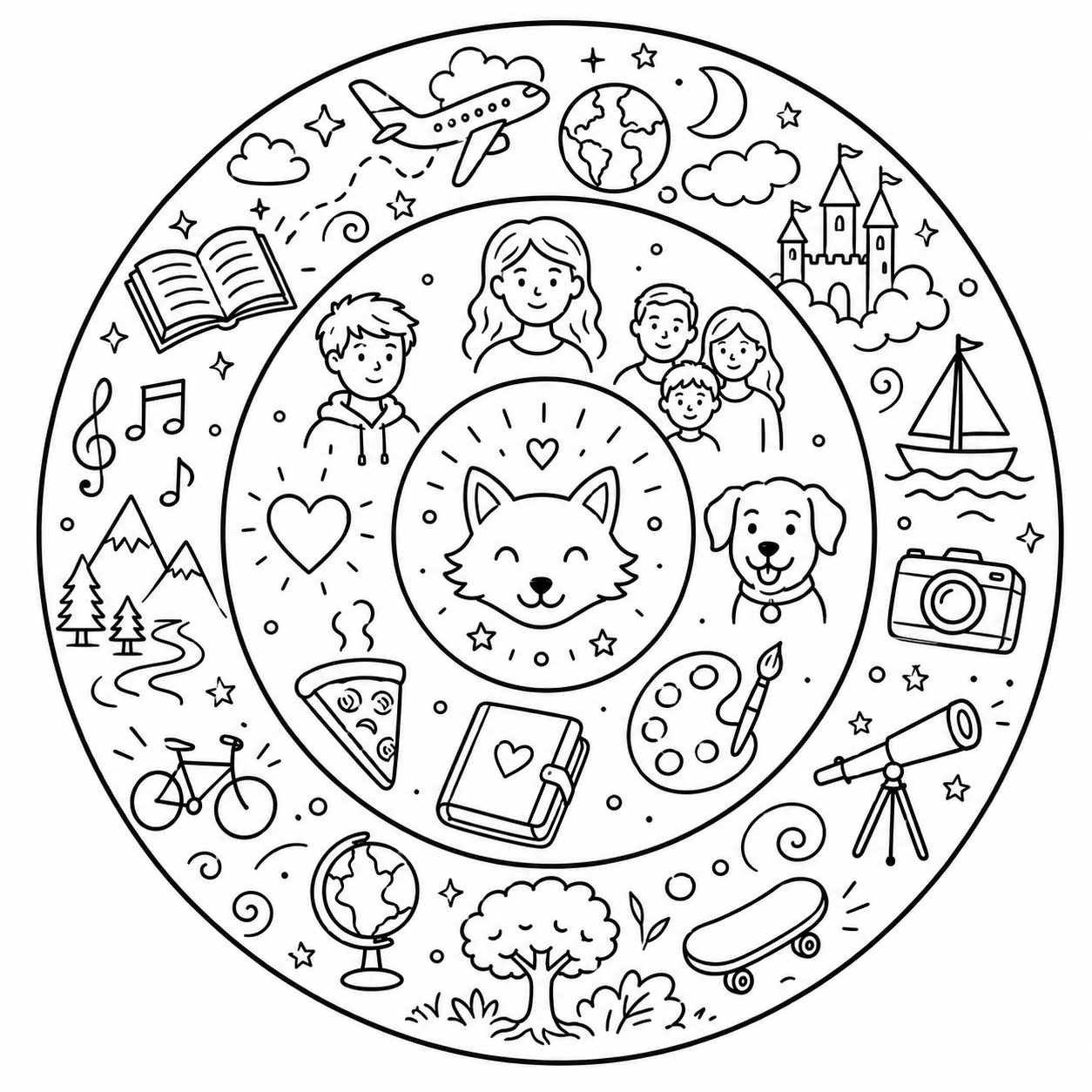
Mandalas can hold meaning as well as beauty. Let’s try one that tells your story.
Imagine this mandala as a map of you: the centre shows who you are, the middle ring shows what supports you and the outer ring shows your dreams.
- Draw three circles with the same centre: small, medium and large.
- In the centre, draw something that represents you.
- In the middle ring, draw symbols for what helps you most—friends, family or favourite things.
- In the outer ring, draw your dreams: things you would like to learn, places you would like to go or even silly wishes, such as unlimited ice cream.
- Add patterns and colours to tie it all together.
Place it centre stage—you have created a mandala that is more than shapes and colours. It is your own story, told through the power of circles: endless, connected and whole.