

The Inventory of Everything
Inventory Note
Confusion calls for clarity. Clarity clears confusion.
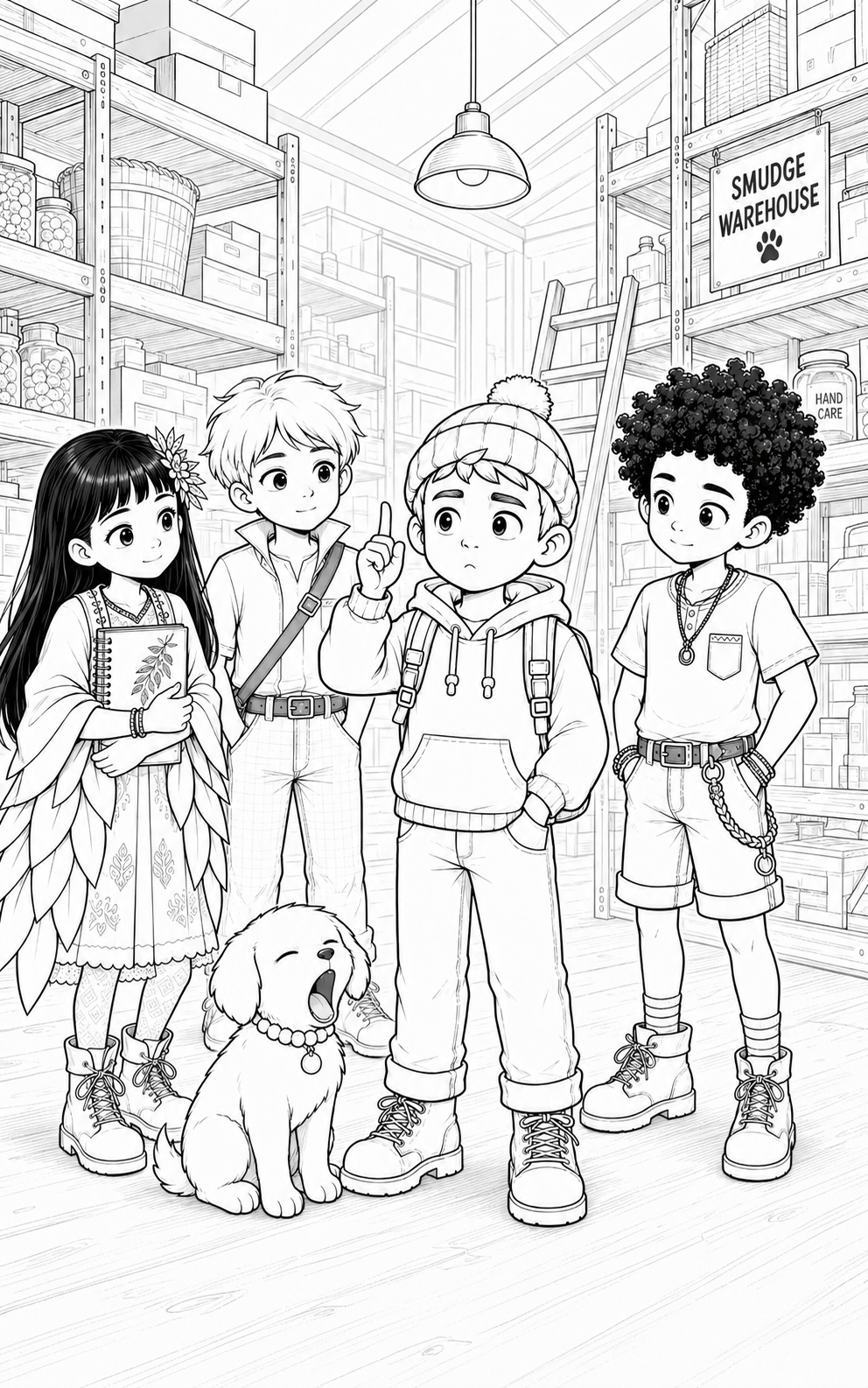
Everyone stood around the completed grid, seeing it properly for the first time.
For a moment, nobody said anything.
Partly because Smudge’s little job felt different now, and partly because Smudge had raised one finger in the air, as if he were about to say something very wise.
Everyone looked at him.
“Are you going to say something?” asked Lyra.
“I can feel wisdom about to arrive,” said Smudge.
Smudge listened carefully.
Biscuit yawned.
“No,” said Smudge, lowering his finger. “Nothing.”
He turned back to the completed grid.
“What does it mean?”
“You know what the symbol is,” said Orin.
“Yes,” said Smudge. “I know that part. But what does it mean?”
“It helps you find your way,” said Lyra.
Smudge glanced around the warehouse.
“But we’re already here… in the warehouse.”
“Not that kind of way,” said Zia.
Smudge frowned. “There are other kinds?”
“There are,” said Orin as he picked up one final task from the table.
He held it out for Smudge to see. At the top, in official-looking letters, it said:
The Inventory of Everything: Finding Your Way
Lyra nodded and pointed at the nine squares.
“What did all these tasks have in common?”
Smudge looked at the grid.
“They were all in the warehouse?”
“That’s true,” said Orin.
“And they all involved me?”
“That is also true,” said Zia.
“And they were all handled extremely well by management?”
There was a short silence.
“Let’s keep looking,” said Lyra.
They looked at the grid again.
At first, the tasks seemed completely different.
A tiny cart, a mail mountain, a Biscuit imposter, a buzzing crate, holes, jars, shelves, boxes, and odd bits.
Each one had begun with confusion.
Some things got stuck. Others got mixed up. Some looked true, but weren’t. Some made noises. Others didn’t fit. And some just kept going wrong.
And each time, they had to pause, look again, and work out what was really happening.
Smudge looked back at the completed grid. He had always thought of being lost as something that happened in large forests, confusing corridors, or shops with too many kinds of jam.
But now he began to see that you could be lost in a problem as well.
And when you’re lost in a problem, you still have to find your way.
Not out of a forest.
Out of the muddle.
Finding Your Way
Lyra pointed gently at the symbol.
“That’s what the symbol represents,” she said. “Finding your way.”
“Finding your way,” Smudge repeated.
“Not just where you are,” said Orin. “What’s happening, how the pieces fit together and what to do next.”
Lyra smiled. “That’s what all these jobs taught us—how to turn confusion into clarity.”
“And once things are clearer,” said Zia, “you can decide what to do next.”
Smudge was quiet for a moment.
This was unusual, so everyone allowed it.
Then his face brightened as the final piece fell into place. “So the compass reminds us to find our bearings.”
Smudge looked at the nine squares again. The tasks had been messy, noisy, strange and occasionally biscuit-related. But each one had taught them to pause, look again and use different ways of thinking to make sense of what was happening.
Out of nowhere, Smudge gave a tremendous gasp. Everyone jumped.
“I think,” he said carefully, “the wisdom may have arrived.”
His face went blank.
“No, sorry. It’s gone.”
A moment later, he gasped again. “It’s back! Paper!” he demanded.
Lyra blinked. “What?”
“And a pencil!”
“Why?” asked Zia.
“Quickly,” said Smudge. “Before the wisdom escapes.”
Orin slid a sheet of paper and a pencil across the table.
Smudge leaned over the table and began scribbling.
“What are you doing?” asked Lyra.
Smudge didn’t look up.
“An invention,” he said.
“For the warehouse?” asked Orin.
“For anyone,” said Smudge. “Anyone trying to find their way through a problem.”
He scribbled furiously, scattering sheets across the floor and leaving his hair pointing in directions no compass could explain.
At last, he dropped his pencil, stood back and revealed the invention of all inventions:
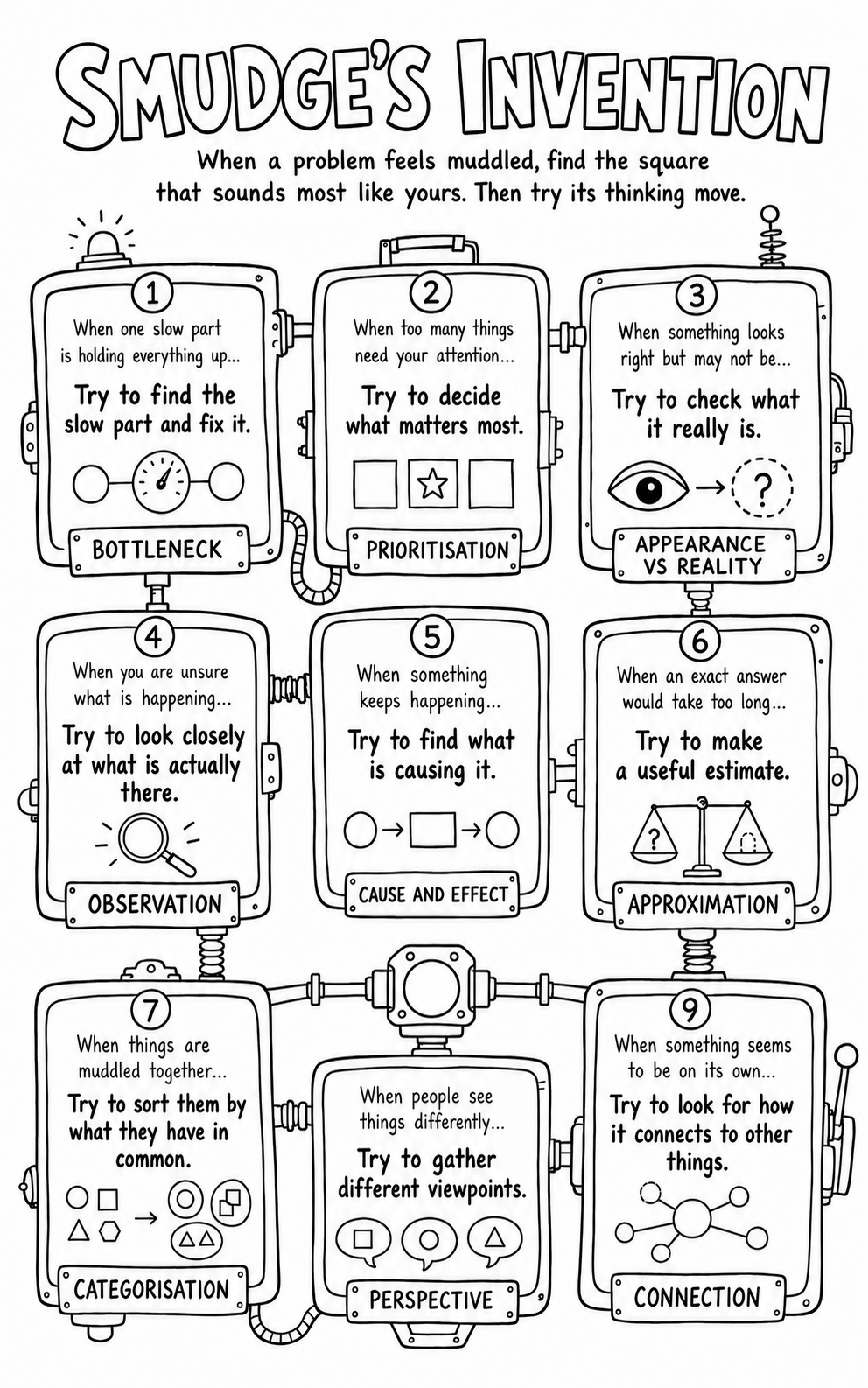
Biscuit wagged his tail.
The whole journey finally made sense.
And Smudge, somehow, had found his next big idea.
Looking Back
Every warehouse job began with a muddle, but not every muddle was the same.
Before the team could decide what to do, they first had to make sense of what was happening. Sometimes they needed to look more carefully, find a cause, decide what mattered, gather another viewpoint or discover a connection.
Finding your way means making sense of a problem so that you can choose a useful direction.
Smudge’s Takeaway
Before you solve a problem, find your bearings. Then begin.
Try It
You have used all nine sensemaking ideas inside Smudge’s warehouse. But you have probably used some of them in your own life too—perhaps without knowing their names.
Use Smudge’s Problem Compass to think of three examples from your own life:
- One from the past.
- One in the present.
- One you might meet in the future.
They can be big muddles or very small ones.
Where Next?
The warehouse job is finished, but the Problem Compass is yours to keep.
Whenever you find yourself lost in a muddle, pause and use it to find your bearings.
Then begin.