

The Circle
Once your page is prepared, the first real act of geometry can begin.
The circle.
Simple to look at. Slightly less simple to draw well. A compass can make a beautiful circle, but only if you use it properly.
Orin once attempted a perfect demonstration and produced something that looked rather like a squashed potato. He would like it recorded that this was intentional.
Mostly.
The important point is this: if your compass technique goes wrong, the circle goes wrong with it. And if the first circle goes wrong, everything built from it becomes suspiciously potato-shaped.

Orin’s Circle Rule
Do not fight the compass.
Anchor the centre. Keep the pencil sharp. Turn gently from the top. Let the pencil glide around the page.
A good circle is not forced into existence. It is guided.
Compass Technique
Before drawing circles everywhere with great confidence, pause for a moment.
Confidence is excellent. Uncontrolled confidence is how one gets potatoes.

Sharpen the pencil
A blunt pencil makes thick, lumpy lines. A sharp pencil gives you a cleaner circle.

Match the points
The compass point and pencil point should reach the page evenly. If one is much longer, the circle may wobble.

Anchor the centre
Press gently on the needle point, not the pencil. The centre is the anchor, and anchors should not wander about.

Turn from the top
Twist the compass lightly with your fingers, like turning a small key in a lock.

Let the pencil glide
Do not push, drag, scrape, or bully the line into existence. Let the pencil travel smoothly.

Follow the motion
Lean the compass gently as it moves around the circle. Your hand should guide the motion, not wrestle with it.
Circle Practice
Begin with your prepared page.
Set your compass carefully, place the point at the centre, and draw one calm circle. Then draw another. Then another.
Try different sizes
Draw small circles, medium circles, and large circles. Each size teaches your hand something slightly different.
Use the same centre
Try concentric circles: several circles sharing one centre point. Start small and work outward.
Reverse the order
Now try outside-in: begin with a larger circle, then draw smaller circles inside it.
Watch the line
Aim for smooth, unbroken circles. If the line jumps or wobbles, slow down rather than pressing harder.
Repeat calmly
The goal is not one perfect circle and a victory parade. The goal is steady improvement.
Notice progress
Compare your first circle with your later ones. Practice turns wobbles into wonders. Eventually.
The more you practise, the more your hand, compass, and attention begin to work together. Orin considers this a highly satisfactory development.
Circle Art
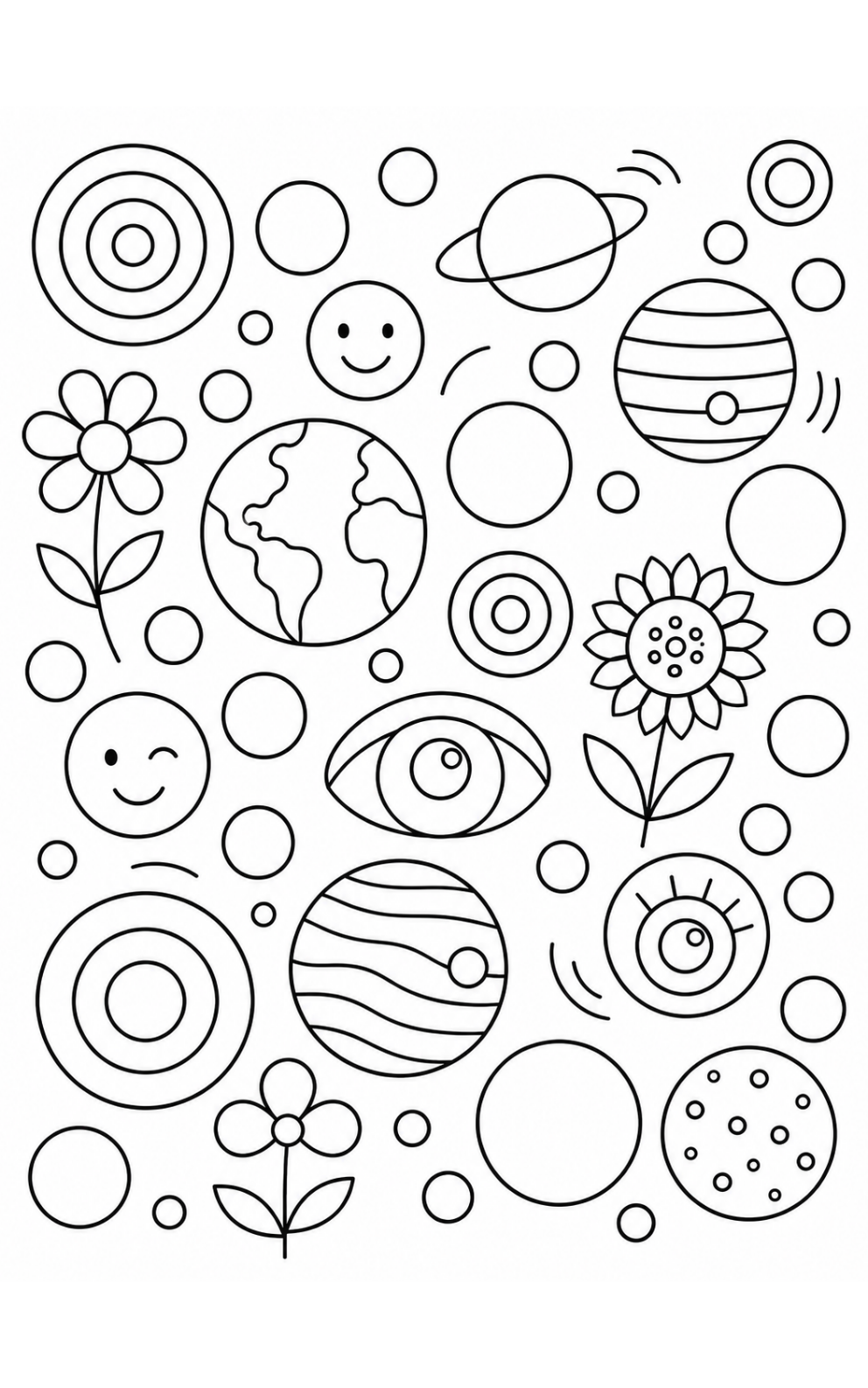
Once you have filled a page with circles, do not throw it away.
Your practice page is not just practice. It is an art piece waiting to be noticed.
Look first
Study your circles before adding anything. Some may already suggest flowers, planets, eyes, bubbles, wheels, suns, or moons.
Choose a few
You do not need to decorate every circle. Pick the ones that seem most interesting and begin there.
Add details
Draw patterns inside the circles, around the circles, or between them. Small details can make a plain circle feel alive.
Connect shapes
Use lines, curves, dots, petals, triangles, or other shapes to connect your circles into one larger design.
Add colour
Use coloured crayons or pencils to bring warmth, contrast, and rhythm to the page.
Finish properly
When the page feels complete, sign and date it. A finished practice page is still finished work.
This is how practice becomes artwork. First the circle behaves. Then the imagination may be trusted to join in.