

Tiny Cart
Inventory Note
The smallest thing can be the biggest problem.
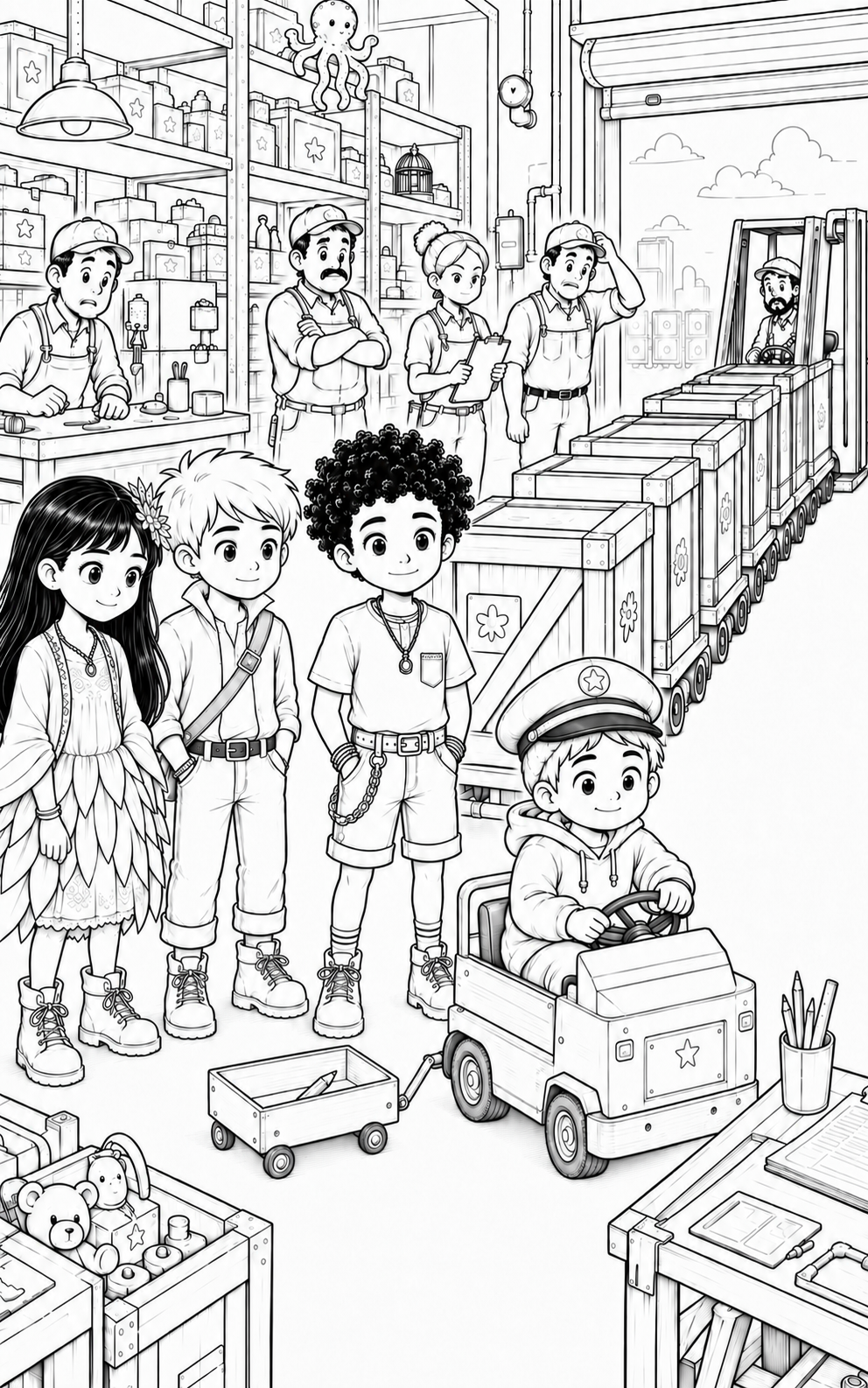
Lyra, Orin, and Zia entered one of the busiest sections of the warehouse. Very busy.
Workers carried boxes. Machines rattled. Crates moved. Clipboards shuffled. Shelves creaked. Bells dinged. Someone hurried past with six pencils behind one ear and a label stuck to their elbow.
There was a lot happening. Unfortunately, a lot of the lot was waiting.
A worker stood beside a crate, waiting. Another worker stood beside a shelf, waiting. A machine rattled for a moment, then stopped and waited. A clipboard was passed from one person to another, who looked at it carefully, then waited.
Zia frowned. “Why is everyone waiting?” Nobody seemed to know. One worker pointed towards the shelves. Another worker pointed towards a crate. A third worker pointed at the clipboard, which did not look responsible, but was clearly being blamed anyway.
Then a small horn sounded.
Parp.
Everyone turned. A tiny cart appeared from between two shelves. Driving the cart was Smudge.
“How did you get over there?” asked Lyra.
Smudge adjusted his hat. It was a very special hat—different from his official warehouse hat. This one was a driver’s hat. He had put it on specifically for cart-driving responsibilities. “Inventory transport,” he said. “It’s a very serious business.”
Behind the cart was a tiny trailer. It was so tiny that calling it a trailer felt generous. It had room for exactly one item. One. At that moment, the item was a pencil.
Smudge drove to a waiting worker, delivered the pencil, gave a serious nod, turned the cart around, and drove away. The worker began writing. Everyone else kept waiting.
A while later, the horn sounded again.
Parp.
Smudge returned. This time the tiny trailer held one label. He delivered the label to another worker, gave another serious nod, turned the cart around, and drove away.
“Where do you keep going?” Orin tried to ask.
Smudge was already halfway down the aisle. “Supplies!” he called out as he vanished around a corner.
While he was gone, the trio watched the warehouse. A worker needed a form. Another needed tape. Another needed a ruler. Another needed a pencil sharpener. Several people needed labels. One person needed a biscuit, although that did not seem strictly necessary. Absolutely everyone was waiting.
Orin took out a pencil and began making neat notes on the edge of the inventory sheet. “Form waiting. Tape waiting. Ruler waiting. Labels waiting,” he muttered.
Parp.
Smudge was back. This time the tiny trailer held one form. He delivered it proudly. “Excellent transport work,” he announced. Then he drove away again.
Lyra looked at Zia. Zia looked at Orin. Orin looked at the tiny cart disappearing into the distance. “We should follow him,” said Orin. So they did.
They followed Smudge past the shelves, around a stack of crates, through a narrow gap, across a wide stretch of warehouse floor, around another shelf, past three barrels, behind a ladder, and finally into a far corner of the warehouse. There, parked neatly against the wall, was a large supply trailer.
It was full to the brim with everything you could imagine.
Labels. Forms. Pencils. Tools. Tape. Rulers. String. Spare clips. More forms. More labels. Three pencil sharpeners. A box marked SECRET BISCUITS, which Smudge had his head in.
Lyra stared at the supply trailer. Zia stared at the distant workers. Orin stared at Smudge’s tiny cart.
Zia picked up a label and a pencil and tried to put them both in the tiny trailer. The pencil rolled straight out.
“This cart has the carrying capacity of a thimble,” she said.
After extracting his head from the biscuit box, Smudge picked up one label and placed it carefully in the tiny trailer. “A very important thimble,” said Smudge with a mouthful of biscuit. “Back I go.”
“Wait,” said Orin.
Smudge paused. This was clearly difficult for him, because he had been about to do more excellent transport work.
Orin pointed at the huge supply trailer. “Why is this all the way over here?”
Smudge looked at the trailer. “It lives here,” he said.
“Does it have to live here?” asked Zia.
Smudge frowned, as if nobody had ever asked about the supply trailer’s living arrangements before.
Lyra looked back across the warehouse. “Everyone is waiting for things from this trailer.”
“Yes,” said Smudge.
“And you are bringing them one at a time.”
“Yes.”
“In a tiny cart.” Orin rubbed his forehead. “From a very, very long way away.”
“Yes.” Smudge nodded. “Inventory transport is a serious responsibility.”
Zia looked back at the waiting workers. “So the whole warehouse is waiting for one tiny cart to bring one tiny thing at a time.”
Orin looked from the tiny cart to the huge supply trailer, then back across the warehouse to the waiting workers. “The workers are ready,” he said slowly. “The supplies are ready. The cart is doing its best… but it’s tiny. Too tiny.”
Orin pointed to the supply trailer with his pencil. “Why don’t we just move that?”
Silence.
Lyra blinked.
Zia blinked.
Smudge blinked.
“Move what?” asked Smudge.
“The supply trailer.”
“Move the supply trailer?”
“Yes.”
“To over there where everything is needed?”
“Yes.”
Smudge looked genuinely shocked. For a moment, nobody spoke. Then Smudge slowly removed his driver’s hat. “But what about my hat?” he asked.
“You can wear it to drive the big trailer over to where it’s needed,” said Orin. “If you can handle the responsibility, that is.”
Smudge straightened up and puffed out his chest. “You leave this with me, young man,” he said.
A moment later, the hat was back on, and the large supply trailer was moved to the centre of the warehouse. All of a sudden, people stopped waiting.
Forms arrived faster. Labels arrived faster. Pencils arrived faster. Tools arrived faster. Tape arrived faster. Everything arrived faster.
Nobody was working harder. Nobody was rushing around. Nobody had become suddenly brilliant at warehouse work. The supplies were simply in the right place. The work flowed. The delays disappeared.
Smudge stood proudly beside the large trailer. “You know,” he said, “I can still drive the cart in emergencies.”
“Pencil!” shouted one of the warehouse workers.
Smudge immediately climbed into the cart, started the engine, drove forward, stopped, delivered one pencil, and then drove back. The journey was approximately three feet.
Parp.
“Excellent transport work,” he announced.
Looking Back
In this story, everyone was busy. Or at least, they were trying to be.
There were jobs that needed doing, crates that needed moving, and a warehouse full of noise, motion, and important-looking activity. But something wasn’t quite right. A lot of the busy was actually waiting.
That was the important thing to notice. The problem wasn’t everywhere. It wasn’t the workers, or the shelves, or the crates, or the general amount of effort being used.
The problem was the tiny cart.
Everything had to pass through one small, slow part before the work could continue.
That kind of problem is called a bottleneck.
A bottleneck happens when lots of things are ready to move forward, but one slow part holds them up.
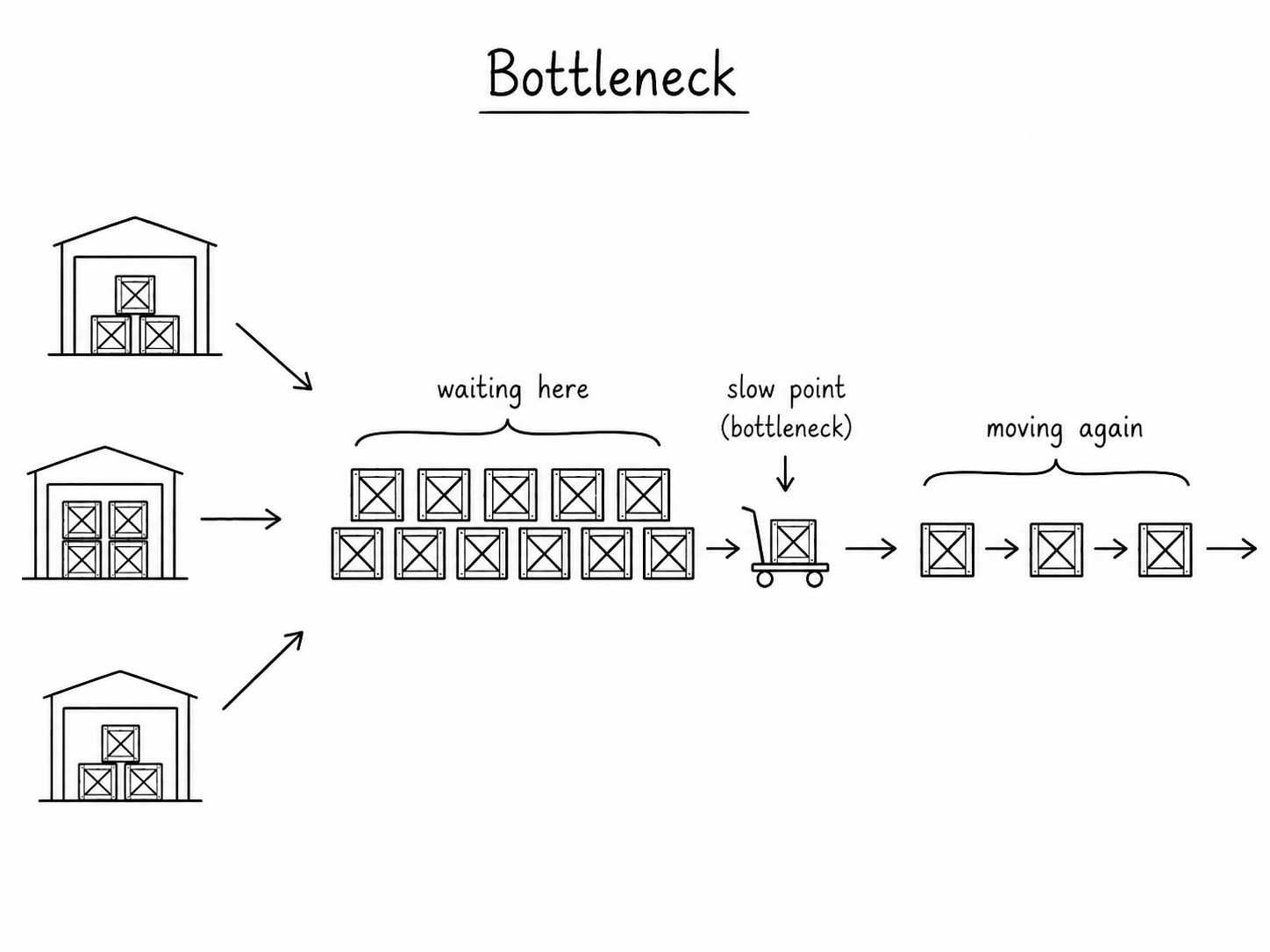
The crates were ready. The workers were ready. The job was ready. But the cart could only carry a little at a time, so everyone had to wait.
When there’s a bottleneck, working harder elsewhere doesn’t really help. The better thing to do is find and fix the slow part.
That way, you fix the most important problem first.
Smudge wasn’t wrong to like the tiny cart. It was a very fine tiny cart, after all. It was just doing a job that was much too big for it.
And as much as Smudge enjoyed wearing his important hat, getting everything else moving was more important.
Smudge’s Takeaway
When progress is slow, find the slowest part. Fixing it can make the biggest difference.
Concept Check
Circle the best answer for each question.
Which sentence best describes a bottleneck?
- A place where everything speeds up.
- A place where work gets held up.
- A place where people take a snack break.
Which of these could become a bottleneck?
- Ten empty football pitches.
- A quiet beach with nobody on it.
- One narrow doorway with lots of people trying to leave.
Which choice would probably help a bottleneck?
- Asking everyone to wait more neatly.
- Making the slow part easier, bigger, or quicker.
- Giving the problem a more important name.
How sure are you?
- I understand it well.
- I mostly understand it.
- I want to read the story again.
Try It
After the tiny cart problem was discovered, Smudge became very excited.
He found a clipboard. He found a pencil. He found a biscuit, and he was ready.
“I have an announcement,” Smudge declared. “Think how much better the warehouse could be if we found all the bottlenecks.”
Lyra nodded.
Orin nodded.
Zia wanted a biscuit too.
“So,” continued Smudge. “We are going bottleneck hunting!”
Can You Help Smudge?
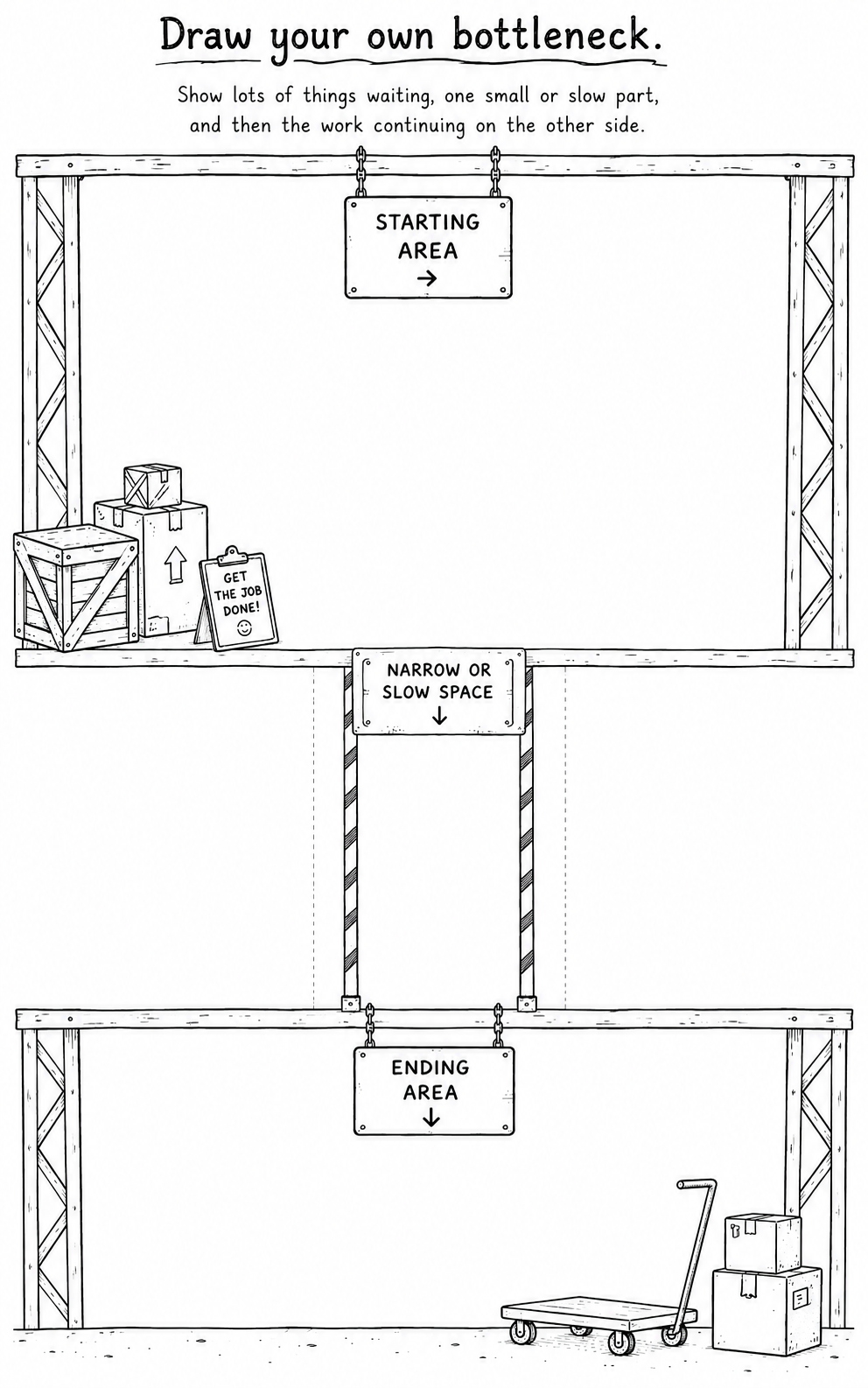
Your task is to create a bottleneck for Smudge to find.
In the following space, invent your own warehouse bottleneck. Show:
- Lots of things waiting.
- One small or slow part where everything gets stuck.
- Things moving again after the slow part.
Now, how would you solve your own bottleneck?
What is one change that would help?
You might add a bigger cart, another lift, a second doorway, a new helper, a new route, or one firm but polite sign saying:
NO BOTTLENECKS
Smudge thinks this may help.
Your Grid Fragment
That’s the Tiny Cart job complete. The bottleneck has been found, fixed, and probably given a tiny parking space.
Now you’re ready to collect your fragment and add it to your grid.
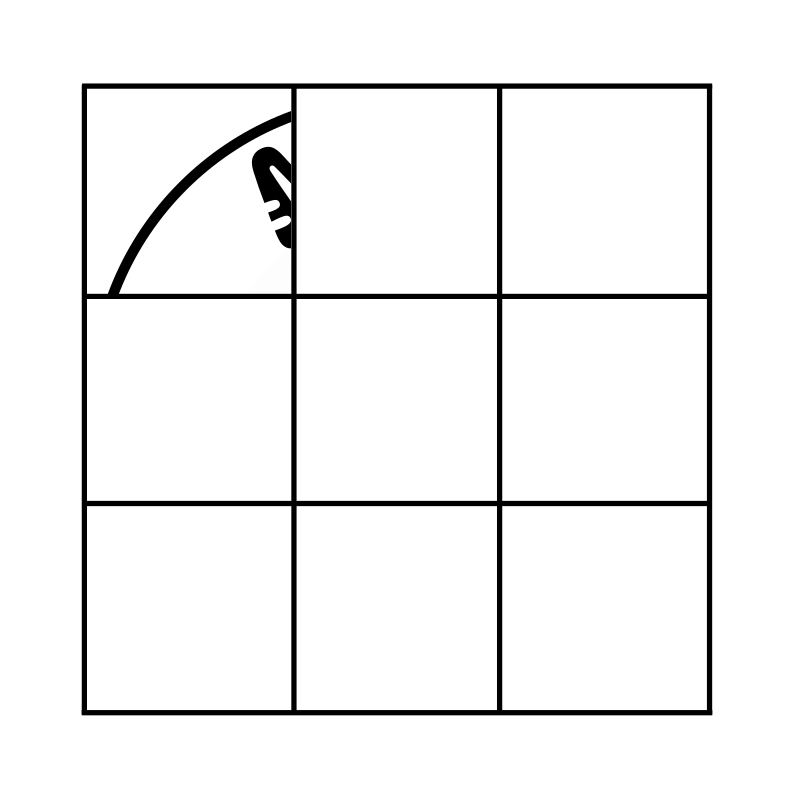
- Do you know what it is yet?
- Can you guess what it might become?
- What makes you think that?
Choose Next Story
Where Next?
Anywhere you like! Choose your next story from the grid.
Finished all nine warehouse jobs? Then you’re ready for The Symbol chapter.