

Shelf 27
Inventory Note
A pile is not a plan.
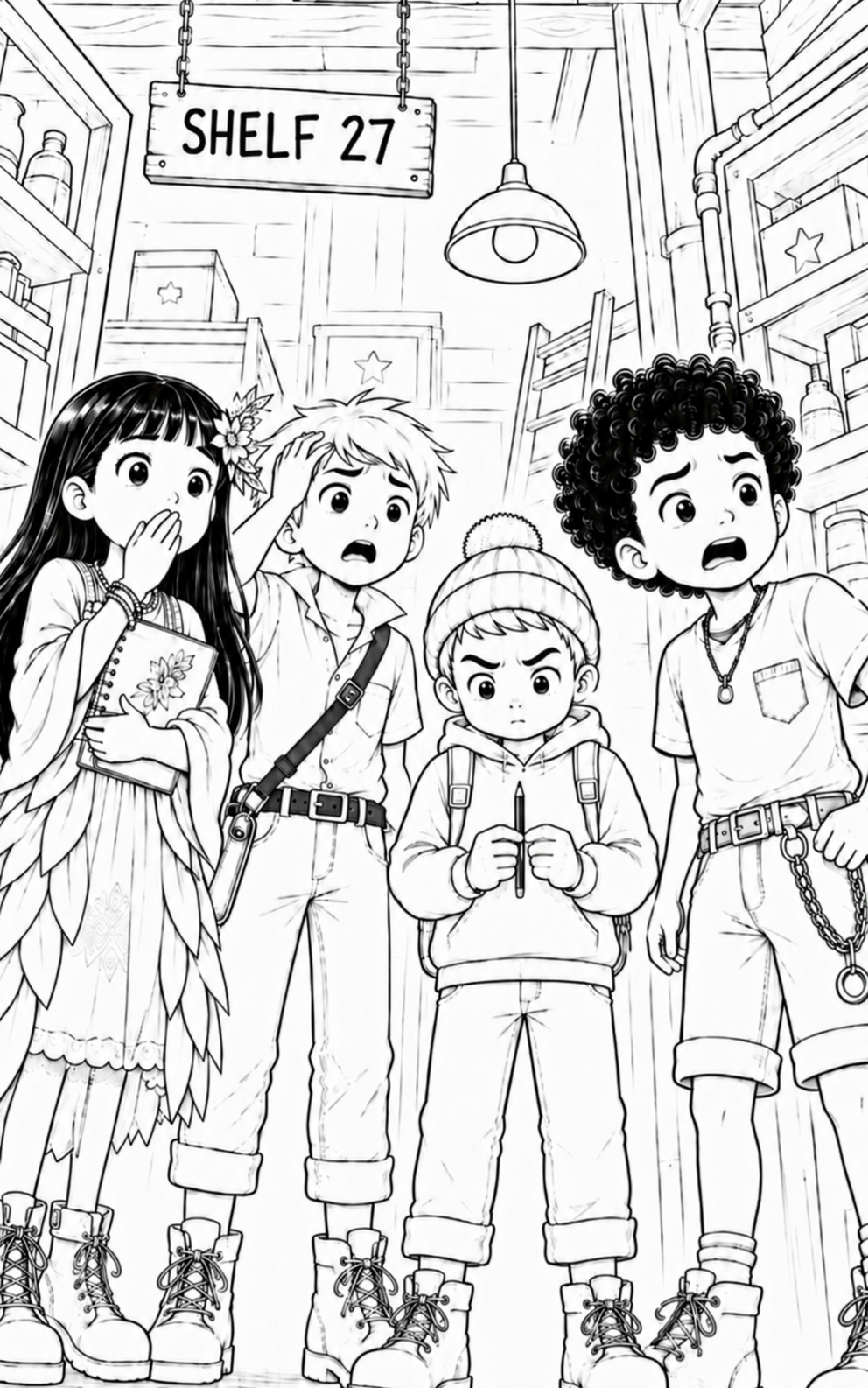
“Right,” said Smudge. “Shelf 27.”
The trio looked at Shelf 27. Then they looked at Smudge. Then they looked back at Shelf 27.
Shelf 27 was a disaster. A rubber duck sat beside a wrench. Three spoons were tangled together with a sock. A banana rested on top of a map. A tiny screw was sitting in the bottom of a teacup. A pencil was balanced on something that might have been a machine part, a hat stand, or a very small chair. And that was only one corner of the shelf.
“According to the inventory note…” said Smudge, “our task is to count everything.”
“Everything?” asked Orin.
“Everything.”
Before Orin had time to object, Zia got to work. She reached for the tangled spoons and the sock tightened around them. The teacup wobbled. The rubber duck tried to escape entirely.
“The shelf is fighting back,” said Zia.
“Please don’t wrestle the shelf,” said Orin. “We are here to count it, not defeat it.”
“One duck,” Lyra called.
“Three spoons,” said Zia.
“One wrench,” added Orin reluctantly.
“Two spoons,” said Smudge.
Everyone stopped. Smudge was proudly holding a spoon in each hand.
“When did you pick those up?” asked Lyra.
“A moment ago.”
“Wait,” said Zia. “Was that two more spoons, or two of my three spoons?”
Smudge shrugged. He seemed to like spoons for some reason.
“Please put them back.”
Smudge returned the spoons.
The counting began again.
“One duck.”
“One wrench.”
“Three spoons.”
“One banana.”
“Two bananas,” said Smudge.
Everyone stopped again. Smudge was now holding two bananas.
“Fine bananas,” he said.
“Smudge, please.”
Smudge returned the bananas.
“Right,” said Orin. “Was that one banana, two bananas, or three bananas?”
No one was sure.
The counting began again. Actually, the counting restarted several more times. That was until Lyra folded her arms in a way that meant the counting was over.
“We can’t count anything if everything keeps moving, disappearing, reappearing, or hiding.”
“Why are you looking at me?” asked Smudge.
Lyra didn’t answer.
Zia looked at the shelf. Then at the objects. Then back at the shelf. “I have an idea,” she declared proudly. “I think Smudge needs a job.”
Smudge stood up straight and puffed out his chest. “At your service.”
After a short discussion, the trio gave him an important job. A very important job. An extremely important job. Possibly the most important job in the warehouse.
“You count the pencil,” said Lyra.
Smudge looked at the pencil. Then at the clipboard. Then back at the pencil. He nodded seriously. “Under control.”
“Just the pencil,” said Orin.
“Do not count the spoons,” said Zia.
“Or the bananas,” said Lyra.
Smudge narrowed his eyes at the pencil. “One,” he whispered.
The trio returned to Shelf 27. For a while, they simply stared at it.
“It isn’t just that there are lots of things,” said Orin. “It’s that everything is mixed together. We are trying to count a muddle.”
Lyra picked up a spoon and held it beside the teacup. “How about this? We sort by what kind of thing it is.”
Orin brightened.
“Object type,” he said. “Excellent. A fine category.”
And so that’s what they did.
Zia cleared a space with one dramatic sweep of her arm. “Sorting zone,” she announced.
Next they began moving things carefully into groups. Kitchen things went together: the three spoons and the teacup. Tools went together: the wrench, the potato peeler, a tiny hammer, and something that claimed to be a left-handed screwdriver. Food things went together: the banana, two biscuits, and a tomato that had the potential to complicate things. Machine parts went together: a screw, a spring, a cog, and a bent metal thing that turned out to be a bracket. Mystery things went together too: the sock and the map, because sometimes the correct category is “we do not know yet, but at least we know that.” Toy things went together: the rubber duck.
Slowly, Shelf 27 began to look less like an argument and more like a shelf.
“That’s better,” said Lyra. “Now it’s only a little chaotic.”
“Now we can count how many are in each group,” said Orin.
And so they did that too.
Four kitchen things.
Four tools.
Four machine parts.
Four food things.
Two mystery things.
One toy thing.
Smudge raised his hand.
“One pencil,” he reported.
“Excellent,” said Zia. “Keep monitoring it.”
“I shall.”
The shelf was much easier to deal with now, but Zia still wasn’t happy.
“What is it?” asked Lyra.
“They’re grouped and counted,” said Zia, “but some groups still look messy.”
Orin looked closer. The tools were all together, but the tiny hammer was hidden behind the wrench. The tiny screw was almost invisible beside the large spring. The banana was sitting on one of the biscuits in a way that felt unnecessary.
“We should sort inside the groups,” said Orin.
“Big ones at the back so they don’t squash the tiny ones,” said Zia.
Orin nodded approvingly. “By size.”
So they sorted again. This time, each object type had its own little order. Large things at the back. Medium things in the middle. Small things at the front.
The big wrench went behind the tiny hammer. The large spring went behind the tiny screw. The banana was moved behind the biscuits, and on it went.
At last, Shelf 27 made sense. Not because there were fewer things. Not because the things had become any more sensible. They definitely had not. It made sense because the mess had been given a structure.
Smudge wandered over, still holding the pencil like a guard at a very small palace. “How are we doing?”
“We sorted everything by object type,” said Lyra.
“Then counted how many were in each group,” said Orin.
“Then sorted each group by size,” said Zia.
Smudge looked at the shelf. Then at the clipboard. Then at the pencil.
“One,” he reported.
Lyra nodded, took the inventory sheet, and filled it out confidently.
Shelf 27
Sorted by object type.
Counted by number.
Arranged by size: large at back, small at front.
Kitchen things: 4.
Tools: 4.
Machine parts: 4.
Food things: 4.
Mystery things: 2.
Toy things: 1.
Pencil: 1.
Under Smudge’s supervision.
Looking Back
In this story, the team had a muddle that needed categorisation.
Categorisation means sorting things into groups that make sense. It helps turn a muddle into something easier to understand, count, use, or fix.
That was exactly what Shelf 27 needed.
At first, the team tried to count everything as it was.
That didn’t go well.
Mostly because the shelf was muddled.
After a few failed attempts, the trio realised they needed a plan. The plan was to start sorting. Kitchen things went together. Tools went together. Food things went together. Machine parts went together.
Mystery things went together too, because sometimes “we do not know yet” is a perfectly useful group.
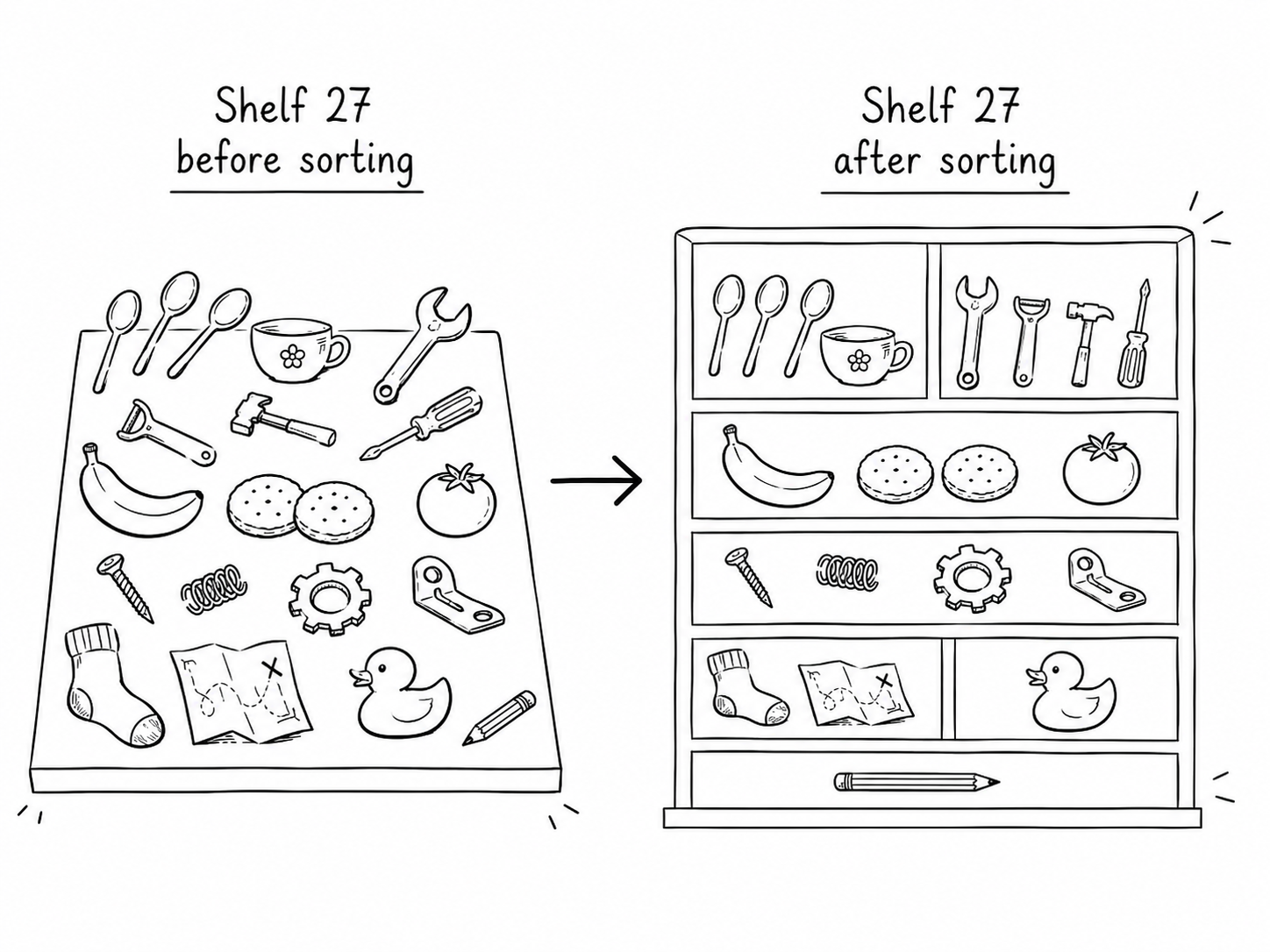
Once the objects were in categories, the shelf made more sense. The team could see what they had, what belonged together, and what still needed thinking about.
Smudge’s Takeaway
When everything is muddled, sort the muddle into groups that make sense.
Concept Check
Circle the best answer for each question.
Which sentence best describes categorisation?
- Putting things anywhere as long as the shelf looks full.
- Counting a muddle without changing anything.
- Sorting things into groups that make sense.
What should a good category have?
- A reason that makes sense.
- A funny name and no plan.
- As many random things as possible.
Which choice shows good categorisation?
- Putting a spoon, a sock, and a banana together because they were nearby.
- Moving everything into one bigger pile.
- Putting tools with tools, food with food, and mystery things together.
How sure are you?
- I understand it well.
- I mostly understand it.
- I want to read the story again.
Try It
Smudge was very proud of Shelf 28.
He said it was organised by Smudge logic.
Lyra looked at the shelf. Then she looked at Smudge. Then she looked back at the shelf.
“Smudge,” she said carefully, “why is there a teacup balanced on a wheel?”
Smudge smiled.
“Because they are both excellent.”
Lyra took a slow breath.
Can You Help Smudge?
It looks like Smudge needs help sorting Shelf 28 into groups that make sense.
In the first space, draw your own mixed-up shelf.
Put anything you like on it. The stranger the shelf, the better.
Then move to the second space.
Draw the same items again, but this time add your own sorting system.
You might group things by what they are, what they do, where they belong, who uses them, or any other pattern that makes sense to you.
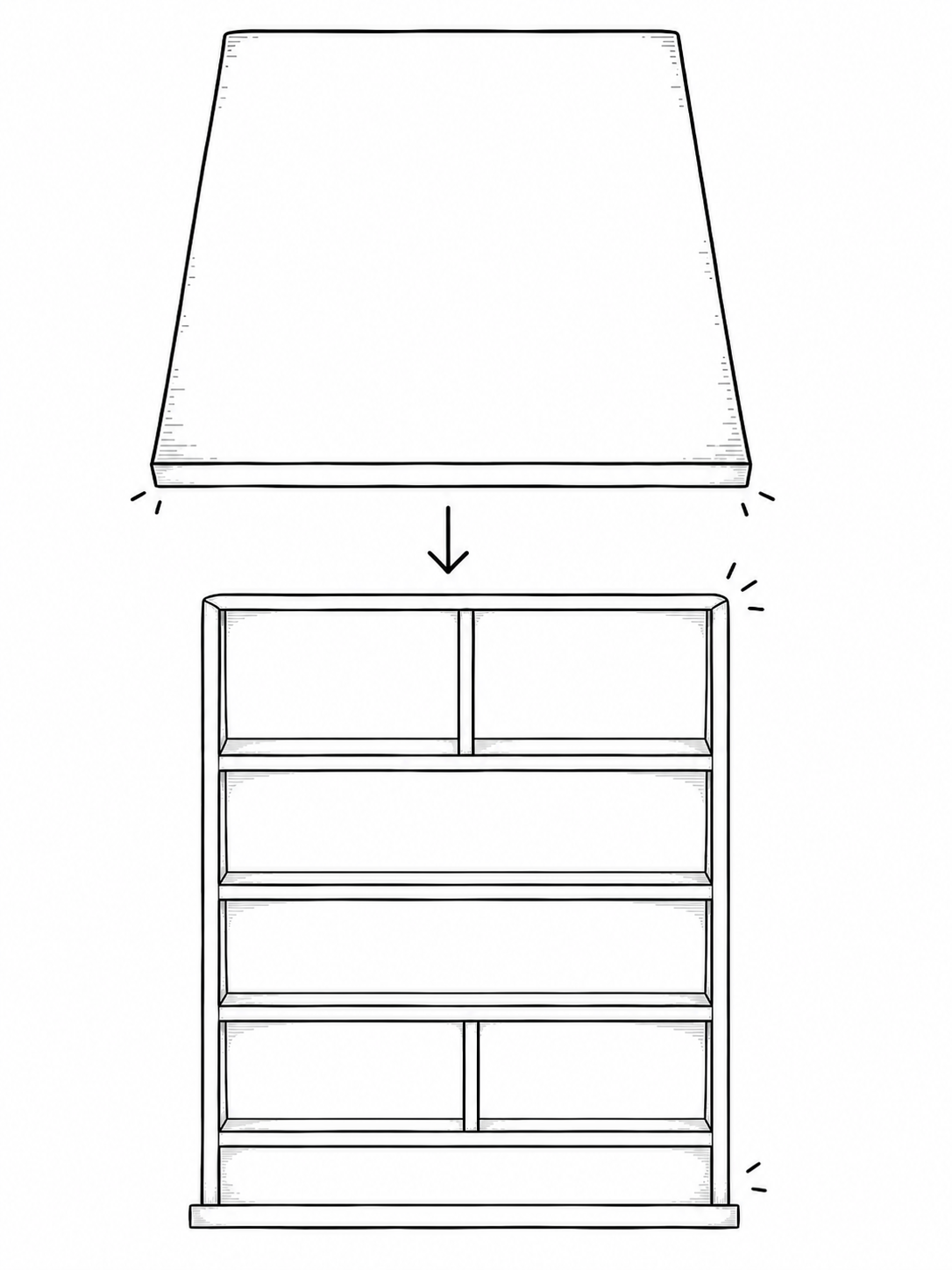
Your Grid Fragment
That’s the Shelf 27 job complete. The muddle has been sorted, the shelf has been organised, and everything is much easier to find.
Now you’re ready to collect your fragment and add it to your grid.

- Do you know what it is yet?
- Can you guess what it might become?
- What makes you think that?
Choose Next Story
Where Next?
Anywhere you like! Choose your next story from the grid.
Finished all nine warehouse jobs? Then you’re ready for The Symbol chapter.