

Lonely Button
Inventory Note
Connections are everywhere.
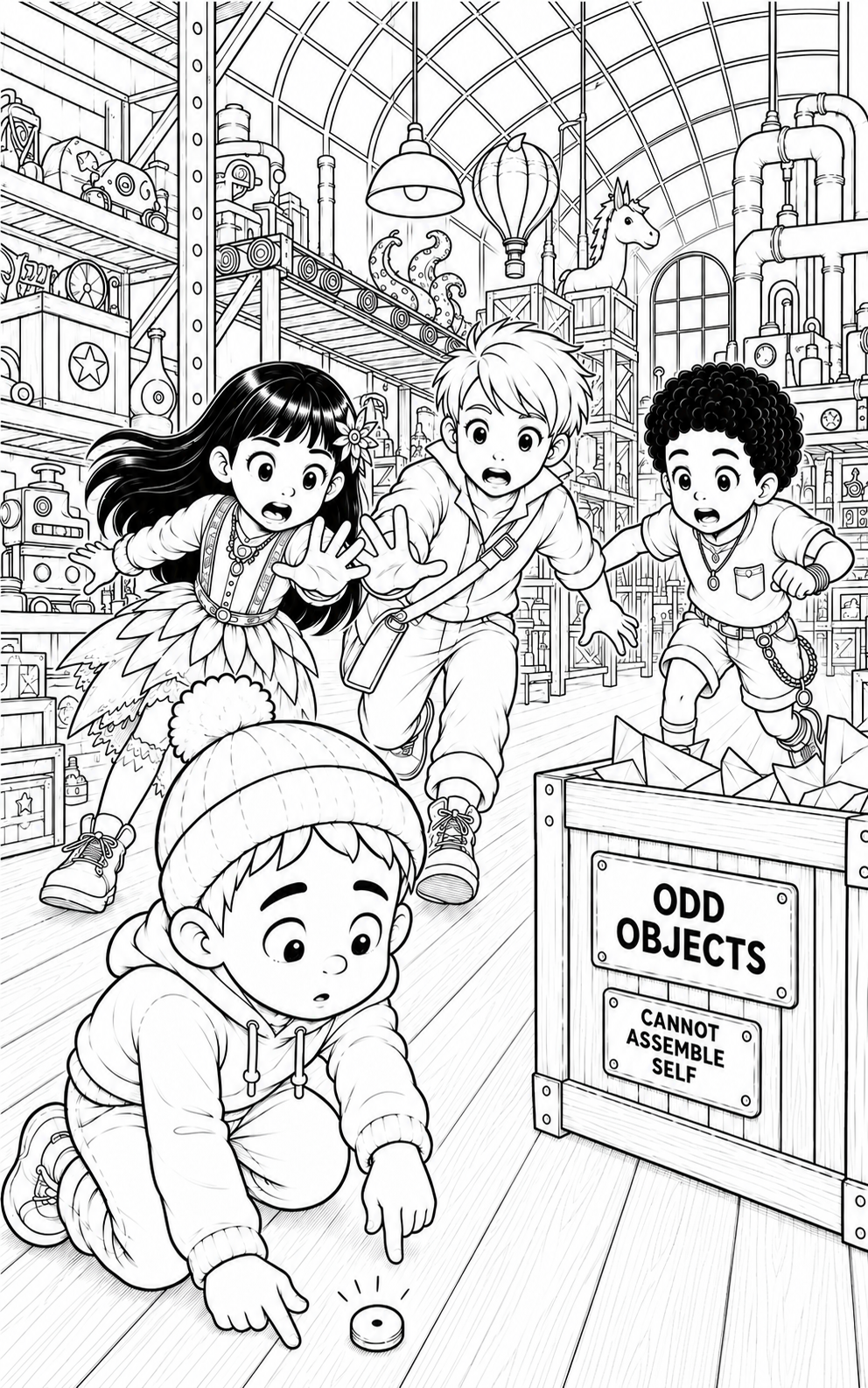
A mystery crate sat by itself at the end of an aisle in Smudge's warehouse.
It wasn’t large. It wasn’t small. It was the sort of crate nobody had known where to put, so they had put it anywhere and walked away quickly.
The crate didn’t hum, rattle, glow, leak, tick, whisper, or smell faintly of something burning. This made Orin suspicious at once, because in Smudge’s warehouse, the normal things often turned out to be the opposite.
Zia gave the crate a cautious nudge with one boot. Nothing happened.
“That is strange,” she said. “Things usually fall off, pop out, or make a noise at us.”
On the front of the crate was a label.
ODD OBJECTS
And underneath that, fixed to the wood with tiny screws, was a little metal plate.
CANNOT ASSEMBLE SELF
Lyra read the plate twice. “What on earth does that mean?”
Smudge didn’t seem particularly interested in what it meant. He was already in the box. Apparently, rummaging first and understanding later was the plan.
Zia shrugged and started rummaging around inside too. After a few moments, she dug out a round thing. “Wheel?” she asked no one in particular.
“Looks more like a floor circle to me,” said Smudge.
“A what?”
“You know. A circle. For the floor.”
The trio stared at him. Not even confused—just… what.
“Definitely a floor circle,” Smudge added.
“It is not a floor circle,” said Orin. “There’s no such thing as a floor circle. It’s a wheel.”
Zia lifted out what was probably a handle. “Handle.”
“Portable handshake,” insisted Smudge.
Lyra picked out a spring. “Spring.”
“Emergency boing,” said Smudge.
Orin stared at him. “Do you have a name for everything?”
“Only the important things,” said Smudge. “And all the unimportant things in case they become important later.”
One by one they took the rest of the objects out of the crate and laid them carefully on the floor.
Smudge helpfully provided names as they went. The tube was a “short-distance tunnel.” The panel was a “shield with ambitions.” The lever was a “finger for machines.” The three little brass feet were “shoes for a tiny table.” The spoon-shaped thing was, according to Smudge, “a soup detector.”
“It has gears,” said Lyra.
“Advanced soup detector,” added Smudge.
Lyra picked up the wheel and turned it over in her hands. It was heavier than she expected, with a tiny metal peg sticking out from the back.
“This has a red sticker on it,” Lyra noticed.
Zia held up the handle. “This too.”
Orin checked the spring. “And this.”
Lyra looked from one red sticker to another. “They’re marked the same way.”
“Ah. Remembery-bits,” Smudge concluded.
“Remembery-whats?” asked Orin.
“Remembery-bits,” said Smudge. “You know. For remembering important things.”
“So what’s the important thing?” asked Lyra.
Smudge looked at the stickers and frowned. “That, I do not know.”
The tube had a red sticker near one end. The panel had one beside a row of holes. The lever had one on its side. Each of the three brass feet had a red sticker. Even the “soup detector” had a red sticker wrapped around its handle.
Near the bottom of the crate, partly hidden under a flap of torn packing paper, Zia found one more object. It was a small button with a blue dot in the middle.
It was shiny, round, and exactly the sort of button that should not be pressed unless everyone had first agreed where to run.
Smudge’s eyes lit up.
“No,” said Orin immediately.
“I didn’t do anything!”
“You were about to.”
Smudge did not bother to argue. He knew they knew he knew he was going to try to push it. His best chance was to pretend he would not, wait until everyone was busy with something else, and then press it later. Sneakily. Quietly. Possibly with a pencil.
Zia placed the blue-dot button beside the crate, away from the other objects, and especially Smudge. Then she placed an empty jar over it.
“Button jail,” she said.
Once all the objects had been taken out, Lyra put the inventory sheet on the floor beside them.
“Right. We need to record what’s here.”
Lyra began to write in the space provided. “Wheel. Handle. Spring. Tube…”
Then her pencil stopped.
She looked at the inventory sheet, then at the objects, then back at the sheet.
“Oh.”
Orin leaned over her shoulder. “What?”
“There isn’t room.”
“There must be room. It’s an inventory sheet.”
“Nope,” said Lyra. “Not on this one. There’s room for a few words.”
They all stared at the sheet.
Lyra was right.
The space wasn’t large enough for a list. It wasn’t even large enough for a small list written by someone with very neat handwriting. It was a single blank line, waiting for a short answer.
Orin looked at the objects scattered across the floor. “Hmm.”
“We could write Miscellaneous,” suggested Zia.
Smudge gasped in disbelief. He marched over and pointed to a sign fixed to the wall.
WAREHOUSE RULES
Rule 1: Put things where they belong.
Rule 2: Do not lick the labels.
Rule 3: Miscellaneous is forbidden.
Smudge tapped Rule 3 with great seriousness.
“No Miscellaneous!”
So that was that.
Orin opened his mouth to ask why, then looked at Smudge’s serious face, the warehouse rules, and the word forbidden. After a brief moment of thought, he closed his mouth again. Some questions, he decided, were probably better left in the warehouse past.
So, they couldn’t write all the objects down. They couldn’t write Miscellaneous. They had one blank line, a crate full of odd objects spread across the floor, a blue-dot button they were trying their best to keep away from Smudge and his button fingers, and possibly a spoon.
Unsure what else to do, Orin picked up the wheel. He turned it over and noticed the little peg on the back. Then he looked at the panel covered in tiny holes. “Wait a minute.”
The others leaned closer as Orin lowered the peg into one of the holes.
Click.
The wheel fitted perfectly.
Nobody spoke for a moment.
“Interesting,” Zia said.
“Very interesting,” said Orin, trying not to sound too pleased with himself. He did not entirely succeed.
Smudge looked alarmed. “You’ve attached the floor circle.”
“It was not a floor circle,” said Orin.
“It was before you attached it,” said Smudge.
Zia picked up the handle.
Now that Orin had found one fit, she looked at her object differently.
“Right,” she said. “Who else has been pretending to be separate?”
It wasn’t just a handle with nowhere to go. It had a narrow slot underneath. She turned it sideways and tried it against the edge of the panel.
Click.
“That’s another one,” said Lyra.
Zia smiled. “It isn’t a box of random objects, is it?”
She picked up the tube next and noticed a little notch at one end. “I wonder if…”
Click.
The tube fitted perfectly in a round opening in the panel.
After that, the work became easier. Not easy, exactly, because Smudge’s warehouse didn’t seem to do easy. But easier.
One piece suggested the next.
Click.
Click.
Click.
Before long, something had taken shape. And whatever it was began to move.
Whrrp.
The wheel spun. The spring bounced. The lever flicked up and down. The little brass feet stamped themselves into position, and the whole thing gave a low, pleased purr, as if it had been waiting a very long time to become itself.
A tiny screen blinked on and words appeared across it.
INVENTION ASSEMBLER PRO
READY TO ASSEMBLE
Lyra stepped back. “Oh.”
Orin stared at the screen. “It’s an invention assembler!”
The invention assembler sat neatly on the floor, no longer a pile of strange objects and no longer a mystery of separate things.
Orin looked at the inventory sheet again.
The blank line no longer seemed too small. It seemed exactly the right size, because now they did not have a pile of odd objects. They had one thing.
Orin wrote carefully:
Invention Ass...
Then he stopped, tapped his chin with the end of his pencil, and looked across the floor.
“What about the blue-dot button?”
The trio turned to witness something unfortunate.
While they had been distracted by the invention assembler coming to life, Smudge had noticed something important: nobody was standing between him and the button anymore.
He was already beside it.
One finger hovered in the air.
“No,” said Lyra.
“Smudge, no,” said Zia and Orin together.
“Jailbreak!” said Smudge as he lifted the jar and pressed the button.
For one glorious second, nothing happened.
Smudge smiled.
“See?”
He looked around proudly.
“Nothing to worry about.”
KLIK-CLANK.
The noise came from behind them—three shelves away.
They looked over to see another crate—this one marked with a blue dot, just like the button.
KLIK-CLANK.
The noise came again, clearly from inside the crate. For a moment, nothing happened. Then the crate began to shake. A few seconds later, its lid popped open.
A tiny metal robot jumped out. It had a blue dot on its chest and very unsettling blue-light eyes. It landed on the shelf, saluted nobody in particular, and shouted, “READY!”
Everyone stared.
It occurred to Smudge, a little late, that the blue-dot button was part of something bigger.
It had friends. Many friends. Too many friends.
“Oh dear,” said Lyra.
KLIK-CLANK.
A second robot jumped out.
“READY!”
KLIK-CLANK. KLIK-CLANK.
Two more jumped out.
“READY! READY!”
“Maybe they’re friendly,” said Smudge.
“We are not friendly,” said the robots together in unison.
“Smudge, what are they ready for?” asked Lyra, looking extremely worried. “Smudge?”
Smudge looked at the button. “I can stop this.”
“No,” said Zia.
Smudge pressed it again.
The crate began to rattle harder.
KLIK-CLANK-KLIK-CLANK-KLIK-CLANK.
Robots sprang out in a blue-and-silver blur.
“READY! READY! READY! READY!”
“Abort,” said Smudge.
“Do NOT press it again,” yelled Lyra.
“Abort, abort, abort,” said Smudge, hammering the button in desperation.
KLIK-CLANK-KLIK-CLANK-KLIK-CLANK-KLIK-CLANK!
The robots marched forwards in a perfectly straight line.
Lyra, Orin and Zia stepped back. Smudge stepped back twice.
But the robots marched straight past them. One by one, they arranged themselves in a tight circle around the blue-dot button, facing outwards with their little metal arms folded.
The last robot replaced the empty jar, climbed on top, and raised a little robot fist.
“BUTTON PROTECTION UNIT READY!”
Smudge blinked. “Protection from what?”
Every pair of blue-light eyes turned towards him.
“YOU.”
For once, Smudge had absolutely nothing to say.
Orin returned to the inventory sheet and carefully finished writing:
INVENTION ASSEMBLER PRO
(Plus one extremely well-protected button.)
Looking Back
At first, the things they found seemed separate: one object here, another clue there. None of them told the whole story on its own. The team only began to understand what was happening when they considered how the different pieces might fit together.
Smudge, admittedly, took a little longer.
This way of looking at a problem is called connected thinking. It means looking at separate pieces and asking how they might belong to something bigger. Instead of only asking, “What is this thing?” you also ask, “What does it belong to—and what might belong with it?”
The crate had seemed to be full of odd objects. A wheel was a wheel. A handle was a handle. A spring was a spring. But the red dots weren’t just decoration. They made the connections easier to see, helping the trio realise that the objects weren’t odd at all—not once they were brought together.
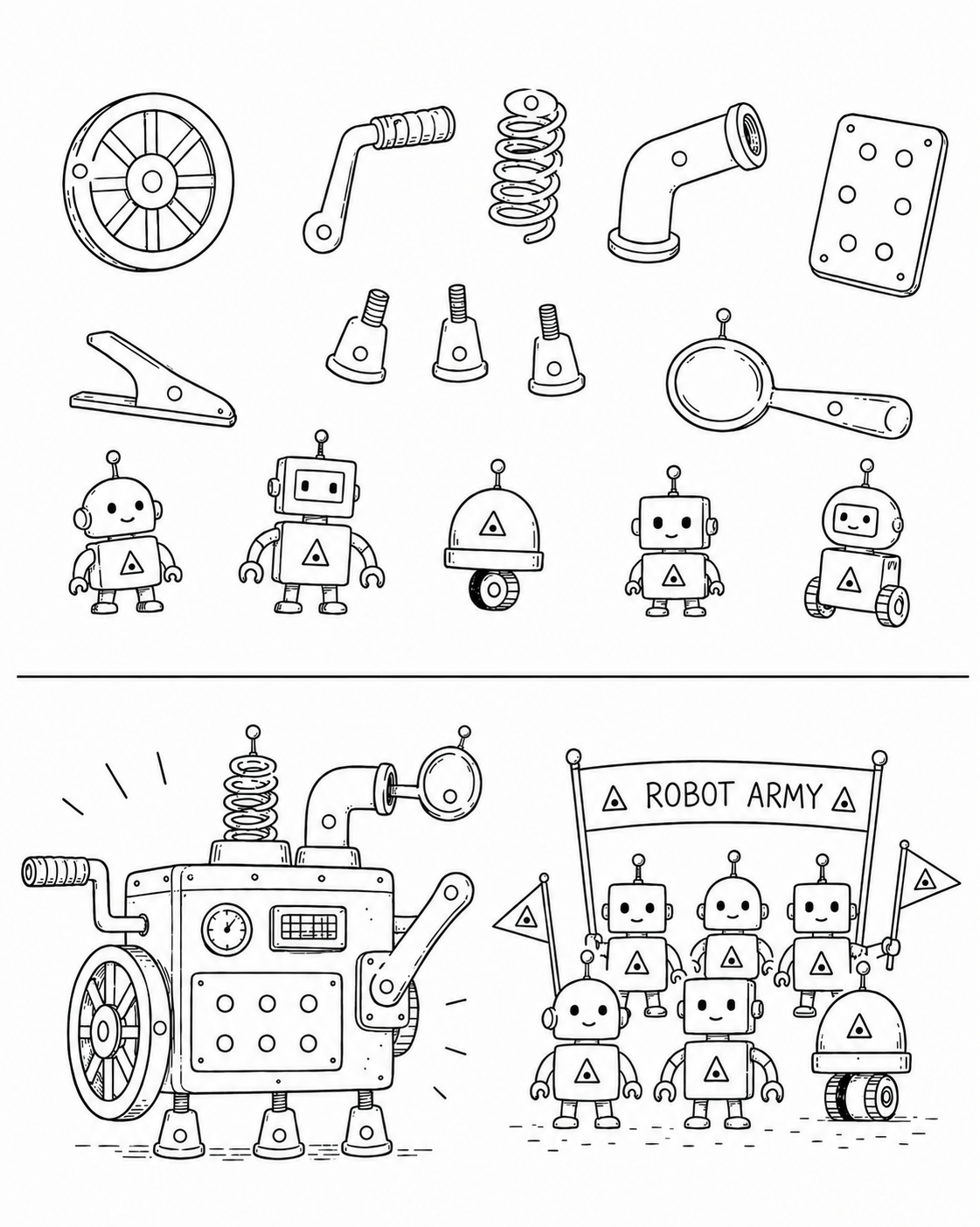
In real life, connections don’t always come with dots. There aren’t always stickers, arrows or helpful little marks showing what belongs together. But that doesn’t mean the connections aren’t there. Sometimes you have to find them yourself.
That’s when connected thinking becomes powerful. You stop seeing only separate parts and start looking for the bigger thing they might belong to—or the missing piece that might complete them.
Smudge’s Takeaway
When things seem separate, look for what connects them.
Concept Check
Circle the best answer for each question.
Which sentence best describes connected thinking?
- Looking at one thing by itself and stopping there.
- Looking at separate pieces and asking how they might belong together.
- Pressing every button because buttons are exciting.
Why can connected thinking be tricky?
- Separate things can never belong together.
- Every connection is obvious immediately.
- Connections are not always marked with dots, arrows, or labels.
Why is connected thinking useful?
- It helps us see how separate parts might make a bigger picture.
- It helps us forget what we noticed.
- It means everything belongs to the same thing.
How sure are you?
- I understand it well.
- I mostly understand it.
- I want to read the story again.
Try It
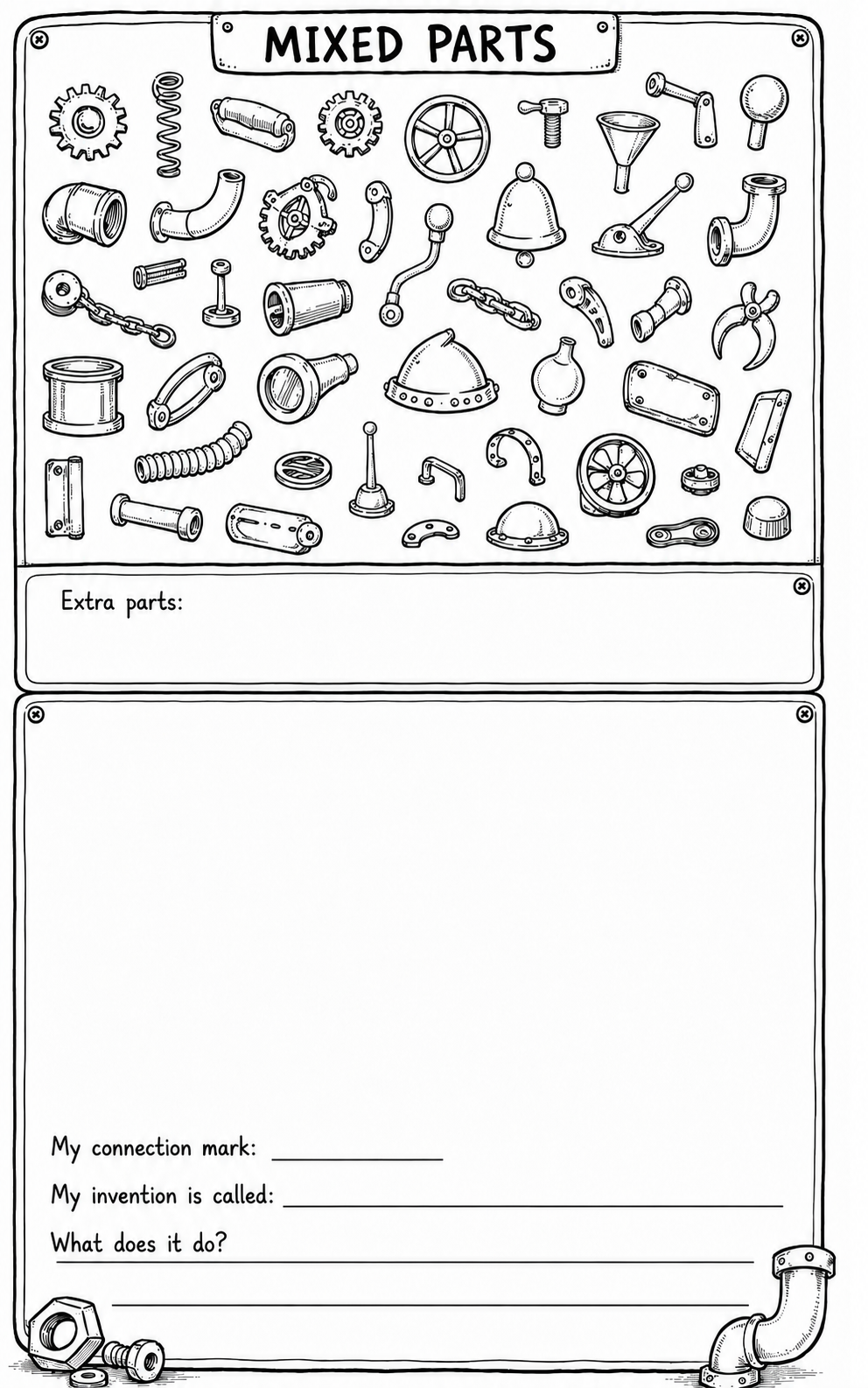
Somehow, another crate had tipped over in Smudge’s warehouse, scattering wheels, handles, springs, tubes and several things that even the inventory list had given up trying to name.
Smudge was standing beside the mess, looking extremely innocent.
“Ah well. We’d better make the best of this terrible situation,” he said, smiling far too broadly for someone who definitely had nothing to do with it. “There’s an invention in there somewhere. We just have to work out which bits belong to it—and what on earth it does.”
Can You Help Smudge?
- Invent something using several parts from the pile.
- Create a connection mark to show which parts belong to your invention. You could use a dot, a moon, a zigzag—or invent a symbol of your own.
- Add your mark to each part you want to use. Leave the other parts unmarked.
- Draw any other parts you might need in the Extra Parts section.
- Bring your chosen parts together in the space provided and draw your invention.
- Give it a name and explain what it does.
Your Grid Fragment
That’s the Lonely Button job complete. The button has been pushed, the parts have connected, and Smudge is now being watched very carefully around anything round, shiny, or pressable.
Now you’re ready to collect your fragment and add it to your grid.

- Do you know what it is yet?
- Can you guess what it might become?
- What makes you think that?
Choose Next Story
Where Next?
Anywhere you like! Choose your next story from the grid.
Finished all nine warehouse jobs? Then you’re ready for The Symbol chapter.