
Biscuit Imposter
Inventory Note
Looks right. Feels wrong.
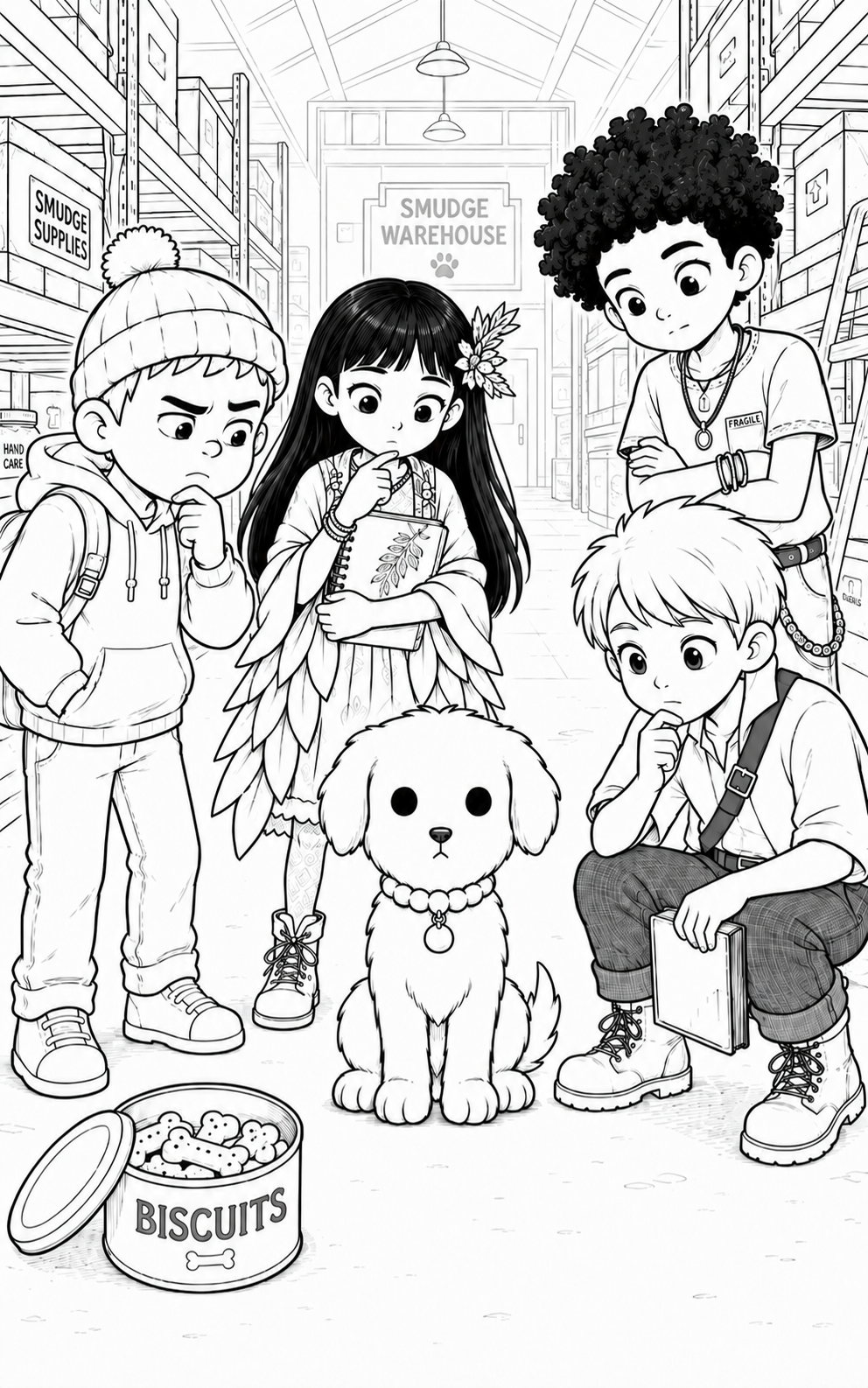
A particularly important job in Smudge's warehouse led to a particularly quiet aisle.
It was quiet. Obviously. Seriously quiet.
Lyra stopped. Orin stopped. Zia stopped. Smudge bumped into all three of them.
In the middle of the aisle sat Biscuit—Smudge’s dog. Or at least, something that looked very much like Biscuit. But something was a bit… off.
He was perfectly still, perfectly upright, and perfectly clean. There wasn’t a single crumb on his nose. There wasn’t a single muddy paw print behind him. There wasn’t even a little wag of his Biscuit tail.
Smudge stared. “That is not Biscuit,” he concluded immediately.
“Don’t be silly,” said Orin, folding his arms. “Of course it’s Biscuit. Look at him.”
“It is not,” said Smudge.
“Well, it looks exactly like him,” said Orin.
Smudge didn’t have an answer to that. Orin was right. Very right. Still Biscuit looked exactly like Biscuit.
Lyra stepped a little closer. “It does look like Biscuit.”
“Golden fur,” said Orin.
“Floppy ears,” said Lyra.
“Biscuit’s collar,” said Zia.
Orin knelt closer to inspect the tag. “Even the tag says Biscuit.”
The tag did indeed say:
BISCUIT
“Case closed,” said Orin. “Biscuit.”
Smudge wasn’t having it.
“Not Biscuit! Labels can be wrong.”
Everyone remembered the box marked SMALL HARMLESS SPOONS. The spoons had not been small. Or harmless. Or, in fact, spoons.
Smudge shook his head. “Nah. Not Biscuit.”
“You cannot just say ‘not Biscuit,’” said Orin. “Where’s the evidence?”
Smudge pointed. “That dog is behaving.”
Everyone looked at still Biscuit. Still Biscuit sat neatly. Still Biscuit blinked slowly. Still Biscuit didn’t knock anything over, eat anything disgusting, lick anything official, or get his head stuck in any kind of container.
Maybe Biscuit had changed. Maybe Biscuit had become tidy. Maybe Biscuit had decided to behave. Maybe Biscuit had turned into a calm and responsible warehouse assistant who respected labels, waited patiently for instructions, and never once put his face in someone else’s lunch.
“Nah. Definitely not Biscuit,” said Smudge, folding his arms.
“It is Biscuit,” said Orin.
“Not Biscuit.”
“Biscuit.”
“Not Biscuit.”
“Biscuit.”
“Not Biscuit.”
Lyra sighed and looked from one to the other. “This isn’t really helping.”
“Right,” said Smudge. “I’ll settle this once and for all.”
He reached into his hoodie pocket and pulled out a heavily chewed pencil and a crumpled piece of paper.
Orin looked at the pencil. “Was that Biscuit?”
Smudge ignored the question and smoothed the paper against a crate.
“What are you doing?” asked Lyra.
“Preparing my case,” said Smudge.
“Your case?” questioned Orin.
Smudge stood up straight, held the paper in one hand, and tapped it with the pencil. “Ladies and gentlemen of the jury—”
“We are not a jury,” said Orin.
“You asked for evidence,” said Smudge. “Now you are a jury.”
Zia folded her arms, but she was smiling. “Go on then.”
Smudge cleared his throat.
“The question before the jury is simple,” said Smudge. “Is that Biscuit?”
“Yes,” said Orin.
“No,” said Smudge. “Please do not interrupt the evidence.”
Orin opened his mouth. Zia shook her head slightly. Orin closed it again.
“I agree that still Biscuit does indeed look like Biscuit. That is true,” continued Smudge. “But looking like Biscuit does not make one Biscuit.”
He tapped the paper again.
“I shall present evidence that this dog only looks like Biscuit, and that nothing here proves that it really is Biscuit. Which can lead to only one extremely serious conclusion…”
Smudge turned dramatically towards still Biscuit and pointed with the chewed pencil. “That… is an imposter!”
There were gasps. Mostly from Smudge.
“Number one,” he continued, wasting no time. “If that is Biscuit, then there should be crumbs.”
The trio turned to inspect still Biscuit. There were no crumbs on his nose. No crumbs near his nose. No crumbs under his nose. No crumbs hiding in his dog beard. Still Biscuit was, indeed, completely crumbless. Smudge checked it off his paper.
“Number two,” continued Smudge. “If that is Biscuit, he should wag his tail when someone says Biscuit.”
He turned to still Biscuit.
“Biscuit?”
Still Biscuit did not wag.
“Biscuit!?”
Still no wag.
Zia crouched down and slapped a quick drumroll on the floorboards—the Biscuit launch rhythm. Nothing. Absolutely nothing.
“Very strange,” said Zia. “Very strange indeed.”
“Tail evidence,” said Smudge, checking off another point on his paper.
“Number three,” said Smudge. “If that is Biscuit, he should be interested in biscuits.”
“And treats,” said Lyra.
“And treats,” said Smudge. “Thank you, Lyra.”
Lyra reached into her bag and pulled out a small dog treat she carried for dog-related emergencies. This was definitely one of them. She held it close to Biscuit’s nose and gave it a teasing little wiggle.
Still Biscuit did not sniff, blink, or lunge forwards. Still Biscuit did not try to eat the treat, Lyra’s hand, or the contents of her bag.
Smudge clutched his chest. “Unthinkable.”
“Maybe he’s full,” said Orin.
Everyone stared at him.
Orin heard what he had just said.
“Objection,” he said quietly.
“Against what?” asked Lyra.
“Myself,” said Orin. “Whatever I just said.”
Smudge nodded. “Sustained.”
“Which leads me to point four,” said Smudge, with extra seriousness. “The real Biscuit has never, ever been full. Ever!”
He smugly checked off another point.
“Number five!” Smudge shouted dramatically. “If that is Biscuit, he should leave a Biscuit trail behind.”
Orin frowned. “What does that mean?”
Smudge gestured around the clean aisle. “You know. Signs of where Biscuit has been.”
They all looked. There were no muddy paw prints. No knocked-over bucket. No chewed label. No dragged string. No suspicious trail. No mystery jam.
“And for number six, ladies and gentlemen of the jury, I call a special witness.”
“We have witnesses?” asked Lyra.
“We do,” said Smudge. “Whiskers.”
Whiskers was the warehouse cat. She was neat, silent, deeply unimpressed by almost everything, and had been sitting on top of a cupboard watching this unfold since they arrived.
“Whiskers, is that Biscuit?” asked Smudge.
“Don’t be silly,” said Whiskers. “Of course that’s not Biscuit. Biscuit is over there eating… something. Hard to say what exactly.”
At that very moment, something crashed in the next aisle. Then something else crashed. Then there was a thud, a scrape, a clatter, and a noise that sounded very much like a dog trying to fit through a gap that was not dog-sized.
A moment later, a biscuit tin rolled out from behind a stack of crates.
Then came Biscuit.
The real Biscuit.
He burst into the aisle with muddy paws, crumbs on his nose, a label stuck to one ear, and three pencils tangled in his fur. His tail wagged so hard it knocked over a small bucket before he had even finished arriving.
Orin turned to still Biscuit. “Oh,” he said. “Right. The label evidence may have been compromised.”
Smudge gave him a look.
Orin sighed. “Not Biscuit.”
Smudge was right. Only one of them had what made Biscuit Biscuit: Biscuitness.
Biscuit saw the dog treat.
Gone.
Instantly.
His tail wagged so hard his back half nearly overtook his front half. He shook himself, sending a spray of mud onto Orin’s shoes. Then he snuffled Lyra’s bag, sneezed, backed into the bucket, and got his head stuck in the biscuit tin.
“So who is this imposter, then?” asked Orin.
Whiskers flicked her tail. “That,” she said, “is Scarecat Biscuit.”
“What?” asked Zia.
“Scarecat Biscuit,” said Whiskers. “It’s supposed to keep me away from the fish biscuit cupboard.”
“Does it work?” asked Orin.
“No,” she said. “I’m sitting on it.”
Looking Back
In this story, the team discovered the important difference between what something looks like and what something really is.
Scarecat Biscuit looked very much like the real Biscuit. It had golden fur, floppy ears, Biscuit’s collar, and even a tag that said BISCUIT. From the outside, it looked convincing. Very convincing.
But Smudge knew immediately that something was wrong. He knew because he knew the difference between what Biscuit looks like and what Biscuit is really like.
To investigate, Smudge thought about what made Biscuit Biscuit, then checked the evidence.
Would Biscuit notice a treat? Would he respond to his name? Would he leave a trail of crumbs, mud, chaos, and possibly mystery jam?
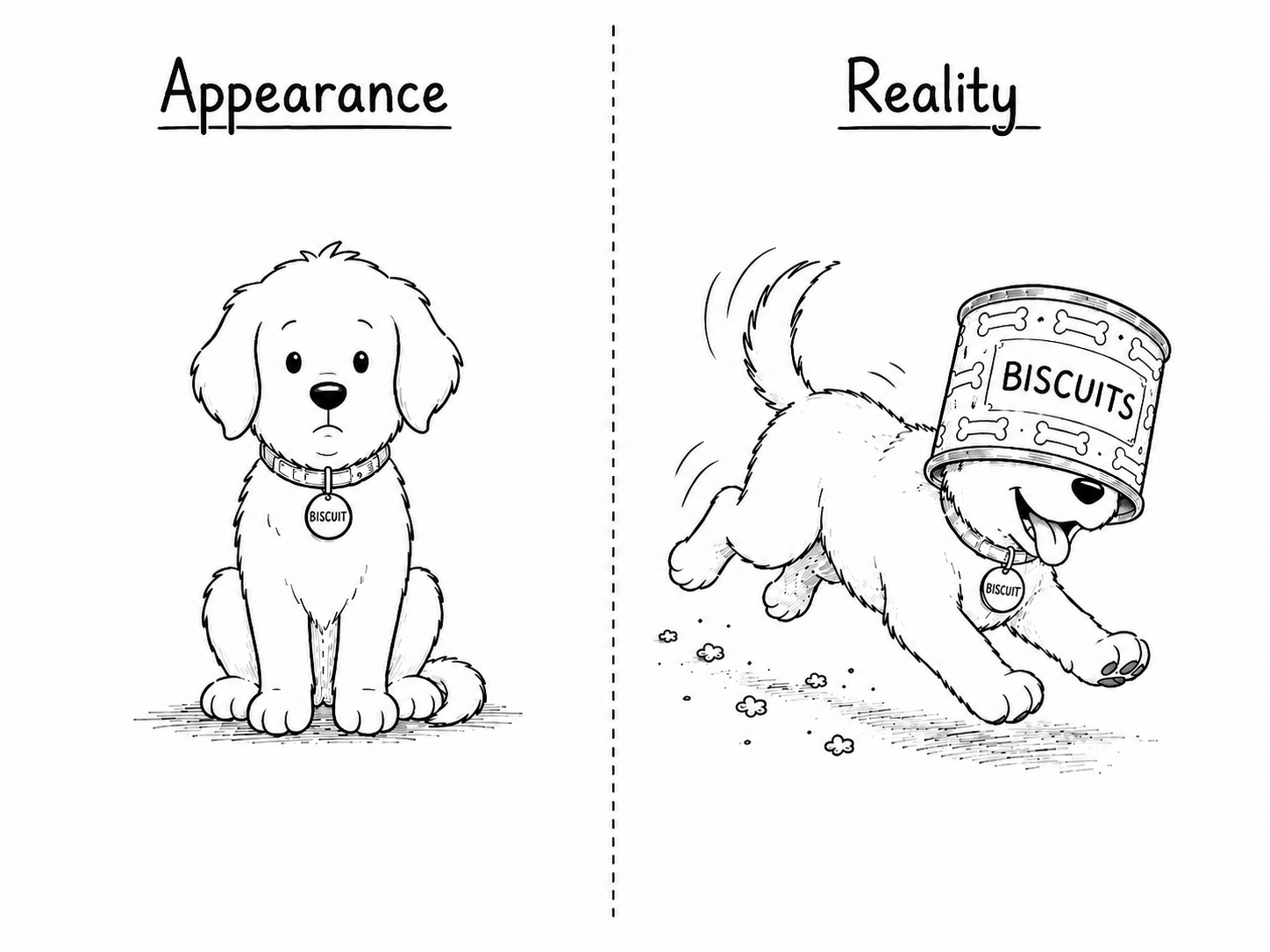
Then the real Biscuit arrived, with muddy paws, crumbs on his nose, a label stuck to one ear, and his head in a biscuit tin.
Scarecat Biscuit had the right appearance. The real Biscuit had the behaviour and evidence to match.
It was obvious which one was really Biscuit.
Smudge’s Takeaway
Don’t rely on appearance alone. Check carefully to discover what is really true.
Concept Check
Circle the best answer for each question.
Which sentence best describes appearance and reality thinking?
- Deciding what something is from its appearance alone.
- Checking whether something is really what it appears to be.
- Thinking that everything unusual must be an imposter.
Why can appearance be misleading?
- Because appearances never provide useful clues.
- Because all clues are always fake.
- Because something can look right on the outside but still be something different.
Why is appearance and reality thinking useful?
- It means we never need evidence.
- It helps us check whether something is really what it appears to be.
- It helps us make decisions from appearance alone.
How sure are you?
- I understand it well.
- I mostly understand it.
- I want to read the story again.
Try It
Something just rustled behind the parcel sacks.
A tail appeared first.
Then two white paws.
Then a cat stepped out, stretched, and sat directly on top of the warmest-looking parcel.
“It’s Whiskers,” said Smudge at once.
Zia narrowed her eyes.
“Is it? How do we know it’s not Imposter 2.0?”
“Oh, trust me,” said Smudge. “That is Whiskers!”
Lyra tilted her head.
“Is it, though?”
Can You Help Smudge?
Uh oh.
Looks like we have another disagreement.
Can you help Smudge settle it?
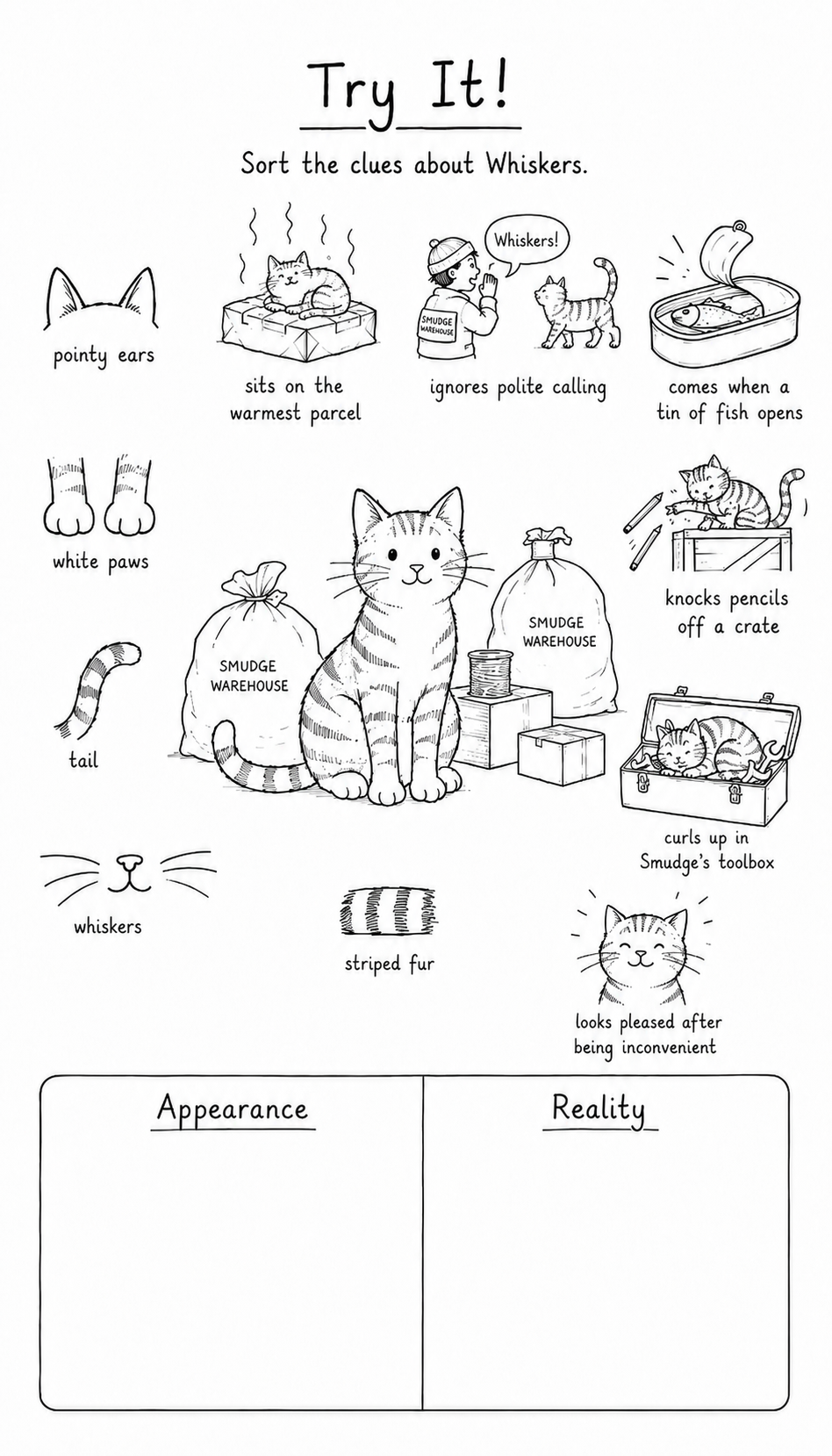
Is this really Whiskers, or an imposter pretending to be Whiskers?
Look carefully at the clues.
Some are appearance clues. They show what the cat looks like on the outside.
Some are evidence clues. They show how the cat behaves and whether the evidence matches what we know about Whiskers.
Sort the clues into the right groups.
Then decide:
Is this really Whiskers?
YES / NO / NOT SURE YET
Your Grid Fragment
That’s the Biscuit Imposter job complete. The clues have been checked, the real Biscuit has been found, and any suspicious imposters have hopefully been asked some very polite questions.
Now you’re ready to collect your fragment and add it to your grid.
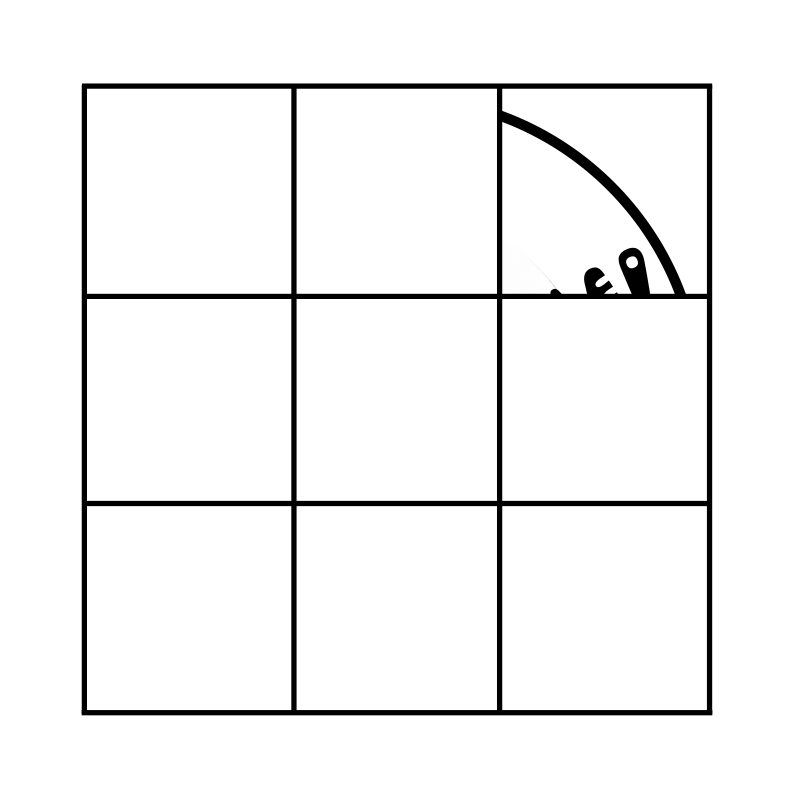
- Do you know what it is yet?
- Can you guess what it might become?
- What makes you think that?
Choose Next Story
Where Next?
Anywhere you like! Choose your next story from the grid.
Finished all nine warehouse jobs? Then you’re ready for The Symbol chapter.