

Holey Crates
Inventory Note
Find the cause. Fix the problem.
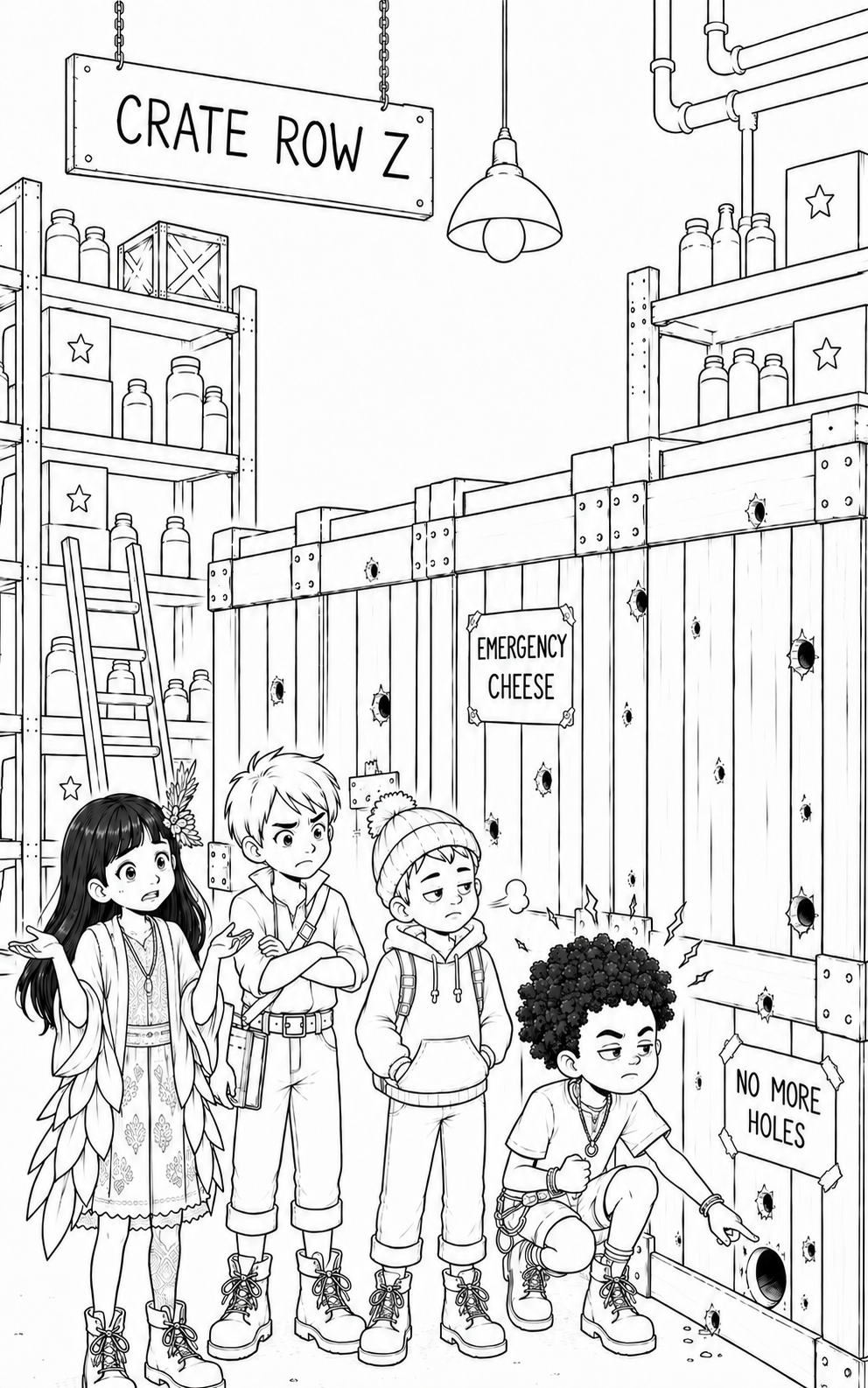
Crate row Z sat near the back of the warehouse. At first, the crates looked fairly ordinary. Some had no labels. Some had faded labels. One had a label that simply said:
YUMMY
Beside the row was a clipboard hanging from a nail. Someone had written in tired handwriting:
(SIGH) HOLES AGAIN
And underneath that, in even more tired handwriting, someone had added:
HELP! HOLES WINNING.
Zia crouched beside the nearest crate. “Here’s one.”
Near the bottom of the crate was a small round hole. Around it lay tiny scraps of wood, as if the crate had been quietly nibbling itself.
Lyra checked the next crate. “This one has one too.”
Orin checked another. “And this one.”
Smudge looked along the whole row. “Holes,” he said. “Lots of them.”
Lyra took a careful breath. “Right. I guess we need hole-fixing stuff then.”
It seemed like a simple enough job, so the team got to work.
Zia found scraps of wood, including one piece that was far too large for the hole but, in her words, “had serious patching energy.”
Orin found nails and immediately began sorting them by size.
Lyra found a pot of thick warehouse glue with a warning label that said:
DO NOT GLUE YOURSELF TO THE PROBLEM
Smudge was more of a tape man. More specifically, he was not allowed near the glue, for reasons best left alone. He had tape in his pocket. Tape in his bag. Tape tucked behind one ear. There was even a small emergency roll of tape hanging from a string around his neck.
Orin stared at it. “Why do you have so much tape?”
“For emergencies,” said Smudge.
“What sort of emergencies?”
Smudge nodded at the holey crates. “Exhibit A.”
“Fair,” Orin replied.
Together, they patched the holes carefully. Zia held each scrap of wood in place while Orin tapped in the nails. Lyra checked that every edge was covered. Smudge added tape over the top, then more tape over the tape, then taped on a small label saying:
HOLE FIXED
After the last hole was patched, Smudge stood back proudly. “Problem solved. Well done us!”
Everyone was extremely satisfied with a job well done.
For the day.
The next morning, the team returned to the same row of crates to check the glue had dried. And, yes. The glue had dried. But alongside the dry glue were more holes!
Lyra stared.
Orin pinched the bridge of his nose.
Zia looked away, as if she needed a moment.
Smudge whispered, “The holes have moved.”
“They have not moved,” said Orin. “These are new ones.”
Smudge looked at Orin suspiciously and counted them to be sure. “Oh no,” he said. “I think you’re right. The holes have friends.”
The new holes were neat and round, just like the old ones. And just as before, tiny scraps of wood lay on the floor beneath them.
“Well,” said Lyra, “we’d better fix these ones then.”
So they did. This time they used thicker wood. Bigger nails. Extra glue. (Not Smudge.)
By lunchtime, every damaged crate had a neat patch, a strong cover, and at least one warning label.
NO MORE HOLES
They left the crates patched, protected, and completely hole-free. Again.
Everyone agreed it was a job well done.
The next morning, the team returned to the same row of crates to check that the glue had dried. And, yes. The glue had dried. But alongside the dry glue and the fixed holes were more holes! A lot more holes.
At this point, somebody made a noise that could only be written down as:
ARRRGHHH
This time there weren’t twice as many holes. There were three times as many holes. And one had appeared directly underneath one of the labels that said:
NO MORE HOLES
Smudge sighed. “That’s just rude.”
Then he looked along the row again. “There’s almost as much hole as crate,” he said. “They’re everywhere.”
Orin stared at the holey mess. “We aren’t fixing the problem,” he said slowly. “We’re decorating it.”
He paused, rubbed his forehead for a moment, then held up both hands. “Right. Stop. Stop. Stop.”
So everyone did. Even Smudge, who had already reached for the tape.
“No more patching,” said Orin.
“Fixing the holes isn’t working,” agreed Zia. “We need to find what’s making them.”
Orin put his hole-fixing stuff to one side and started looking around for clues. That was when he noticed the stamp on the nearest damaged crate.
CHEESE
Zia checked the next damaged crate.
CHEESE
Lyra checked the third.
CHEESE
Smudge checked the last one and read aloud, “EMERGENCY CHEESE.”
Everyone looked at him.
“What?” said Smudge. “Emergencies happen.”
Lyra looked at the crates without holes. One said FAKE CHEESE. Another said MORE FAKE CHEESE. Another said POSSIBLY CATS. None of them had holes.
Now, I don’t like to rush an investigation, but it didn’t take a genius to work out why the holes kept appearing.
Smudge blinked. “Is the cheese trying to escape?”
“No, Smudge. It’s not the cheese trying to escape,” said Orin.
“We don’t know that,” said Smudge.
“We do know that.”
“Where’s the proof?”
Orin decided not to continue arguing with Smudge and let the situation speak for itself. This was often wise.
Zia crouched beside the crates again. Now that they had stopped patching and started looking, she noticed more. The damaged crates were all beside the same wall. The holes were all low down. The edges of the holes were not cracked like broken wood. They were marked with tiny little teeth marks.
Lyra touched the floor beneath the crate. “There are cheese crumbs too.”
Smudge gasped. “Cheese crumbs.” Then, very slowly, he pointed at Orin. “I told you the cheese was escaping.”
Before Orin could answer, a faint sound came from behind the crates.
Scratch scratch scratch.
Everyone froze.
Scratch scratch scratch.
Lyra crouched beside the crates and peered into a gap near the wall. At first she saw only darkness. Then she saw a tiny nose. Then two whiskers. Then a mouse.
The mouse looked at Lyra.
Lyra looked at the mouse.
“What can you see?” whispered Smudge.
“A mouse,” whispered Lyra.
Smudge’s eyes widened. You could see his brain working in overdrive. Nobody spoke for a moment. Even the mouse seemed to be waiting for Smudge to catch up.
“Maybe it’s the mouse!” Smudge said finally.
“Yes, Smudge,” said Lyra. “Maybe it’s the mouse.”
Smudge nodded. “You’re welcome.”
This time, they didn’t reach for the tape, patches or glue. Not at first, anyway.
They put the cheese in mouse-proof boxes with proper lids. They moved the boxes away from the wall and onto a higher shelf. Zia placed a tiny dish of mouse food in a safer corner, well away from the inventory.
“There,” she said. “Snacks without crime.”
Smudge helped. He added a small sign beside it.
MOUSE SNACKS
Everyone looked at the sign. Then everyone looked at the mouse. The mouse looked at the snacks. This seemed fair to everyone.
The next morning, the team returned to the crates.
Smudge inspected the row carefully. No new holes. The patches were still patched. The cheese crates were still crate-shaped, and the cheese had not escaped. Smudge checked the row once more, just to be sure. Then he checked it again, because sure was good, but surer was better.
“Success,” Smudge declared finally.
Lyra nodded and completed the inventory sheet carefully:
Crate row Z
Issue: holes forever.
Status: fixed (hopefully).
Looking Back
Sometimes a problem keeps coming back because we only fix what we can see. To fix something properly, we need to ask what is making the problem happen in the first place.
That kind of thinking is called cause and effect. The effect is what happens. The cause is what makes it happen.
It means asking:
- What is happening?
- Why is it happening?
- What can we change to fix things?
In this story, the team found holes in the crates, so they fixed them. Then more holes appeared, so they fixed those too. Then even more holes appeared. But the holes weren’t appearing by themselves. Something was causing them.
The holes were the effect. The mouse, the cheese, and the crates by the wall were all part of the cause.
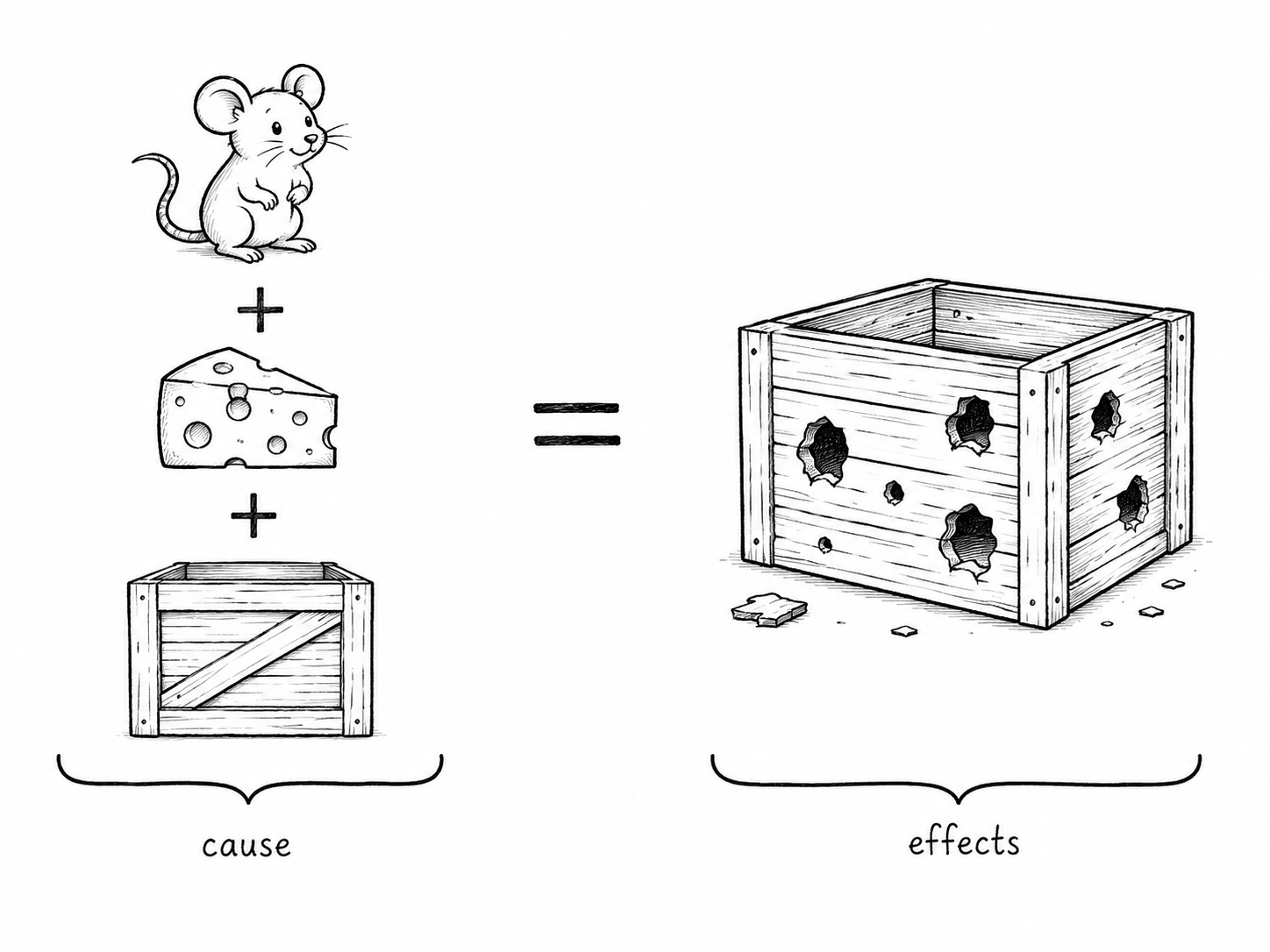
Patching the holes helped for a little while, but it didn’t stop the thing that was making them happen. Once the team understood the cause, they could make a better fix. They moved the cheese, used stronger boxes, and gave the mouse a better snack place.
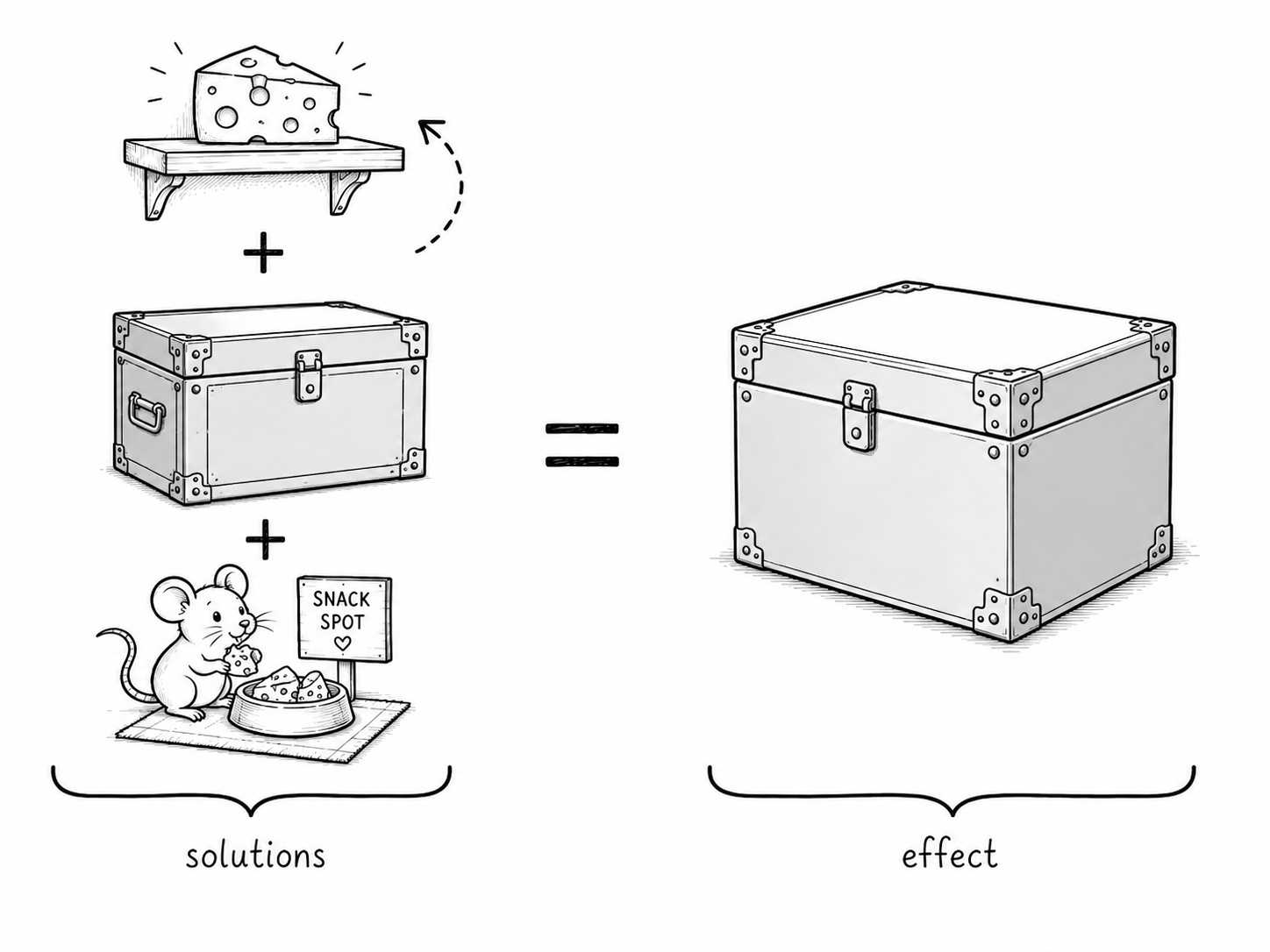
And with the cause fixed, all that remained was one happy mouse, hole-free crates, and four considerably less frustrated hole fixers.
Smudge’s Takeaway
When a problem keeps coming back, look for the cause.
Concept Check
Circle the best answer for each question.
Which sentence best describes cause and effect thinking?
- Fixing what you can see without asking why.
- Looking for what is making a problem happen.
- Blaming the nearest crate.
Why didn’t patching the holes fix the real problem?
- Because the patches were too tidy.
- Because the team had not stopped what was causing the holes.
- Because the holes were moving around by themselves.
Why is cause and effect thinking useful?
- It helps us fix the real problem, not just what we can see.
- It makes problems come back again.
- It means every problem needs more tape.
How sure are you?
- I understand it well.
- I mostly understand it.
- I want to read the story again.
Try It
Smudge has a problem. Actually, Smudge has a list of problems. A very long list.
“I have fixed these at least a thousand times,” he said to himself.
The same shelf keeps getting messy. The same labels keep falling off. The same parcels keep rolling away. The same cupboard keeps opening. The same boxes keep leaning.
Smudge narrowed his eyes. “Maybe I need to find out why.”
Can You Help Smudge?
Choose one problem from Smudge’s list or a repeating problem of your own.
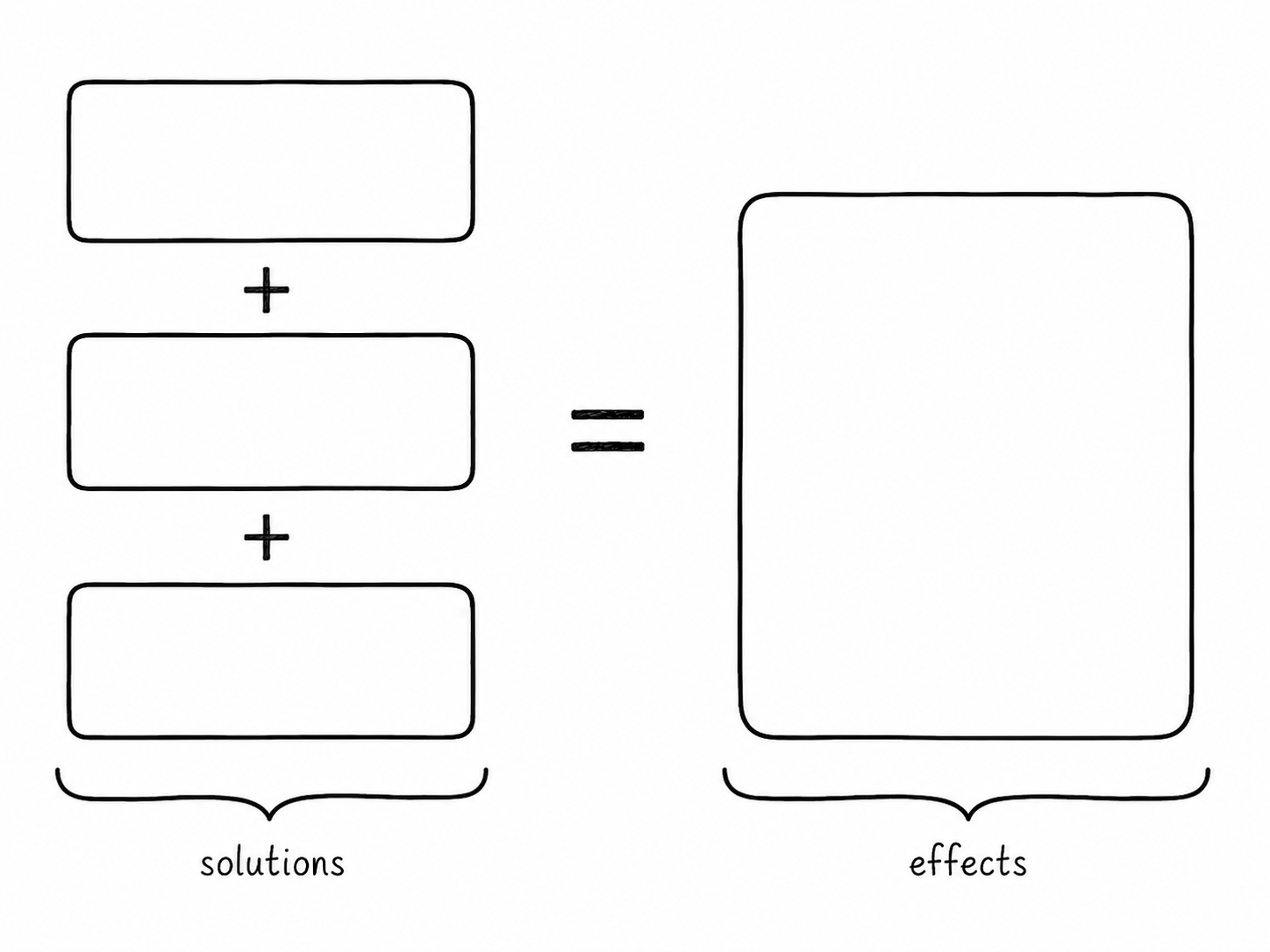
In the following space, show two things:
- The cause: What is making it happen?
- The effect: What happens because of it?
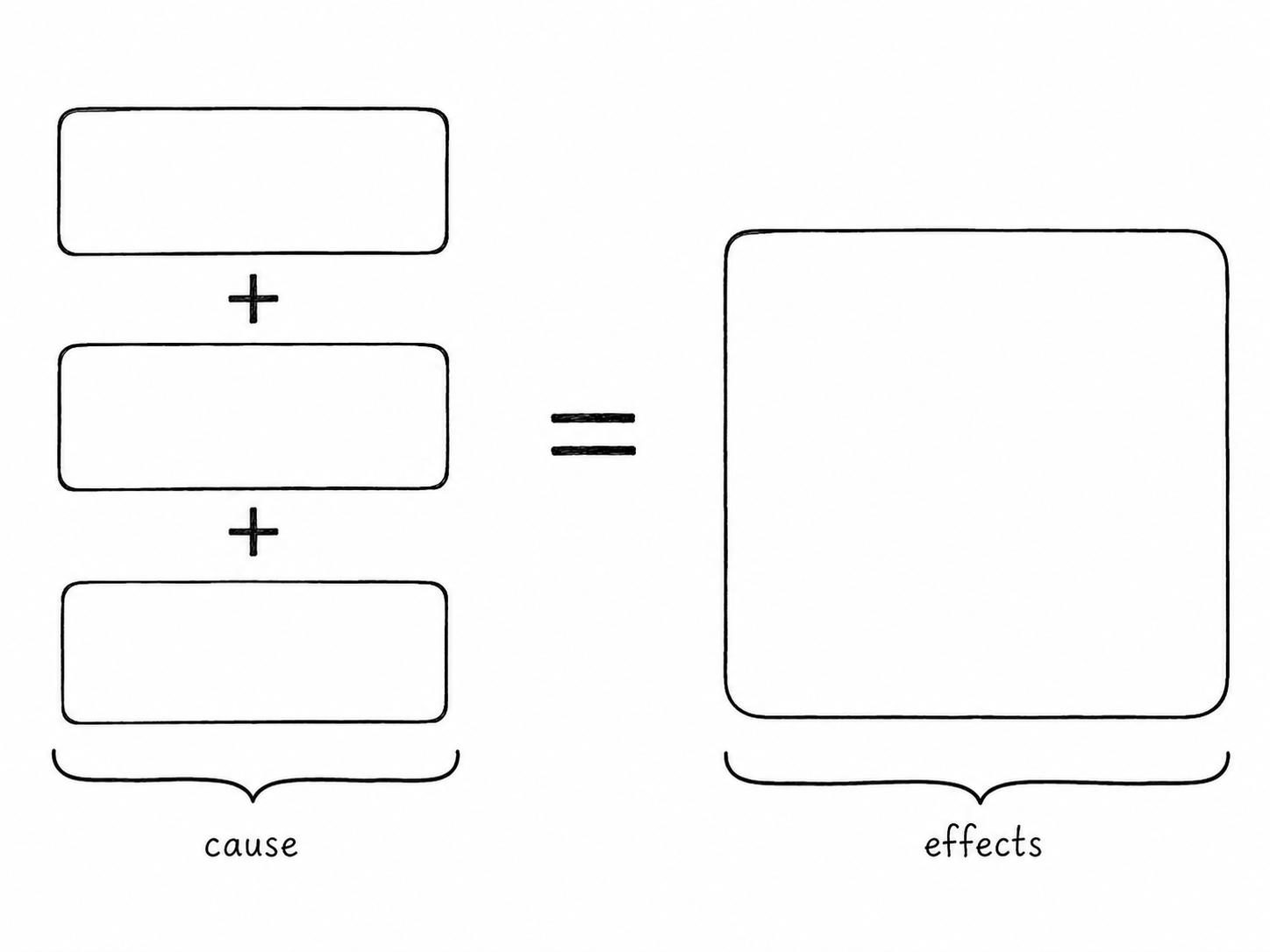
Now look at the cause you found.
What would fix the real problem?
Maybe something needs to be moved, changed, strengthened, labelled, cleaned, repaired, explained, protected, organised, closed, opened, or put somewhere else.
Draw or write your fix for the problem in the following space.
Your Grid Fragment
That’s the Holey Crates job complete. The holes have been noticed, the cause has been found, and the mouse has been redirected to a more suitable snack area.
Now you’re ready to collect your fragment and add it to your grid.
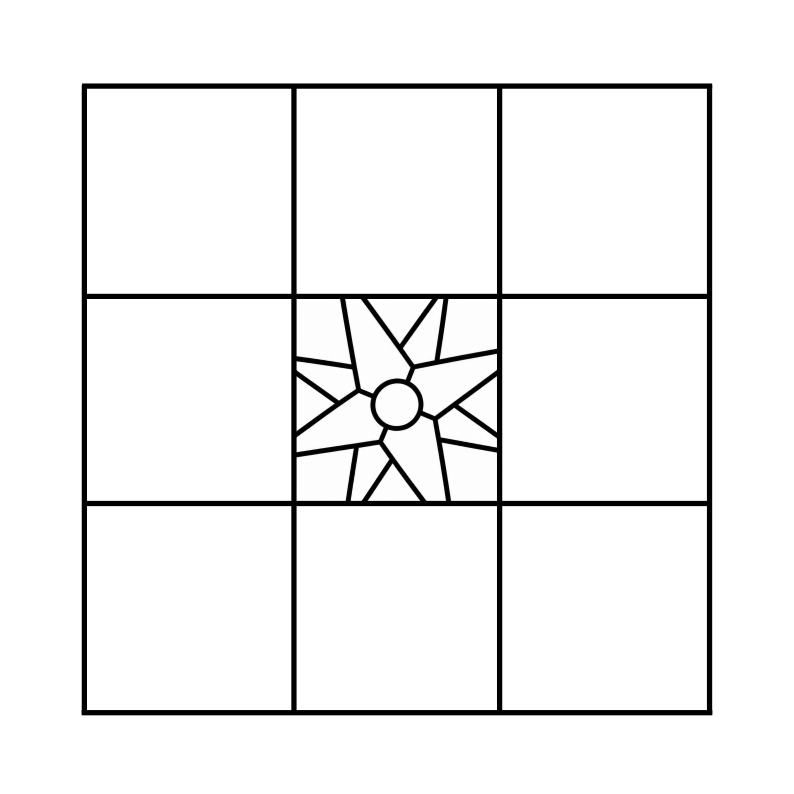
- Do you know what it is yet?
- Can you guess what it might become?
- What makes you think that?
Choose Next Story
Where Next?
Anywhere you like! Choose your next story from the grid.
Finished all nine warehouse jobs? Then you’re ready for The Symbol chapter.