

Smudge's Little Job
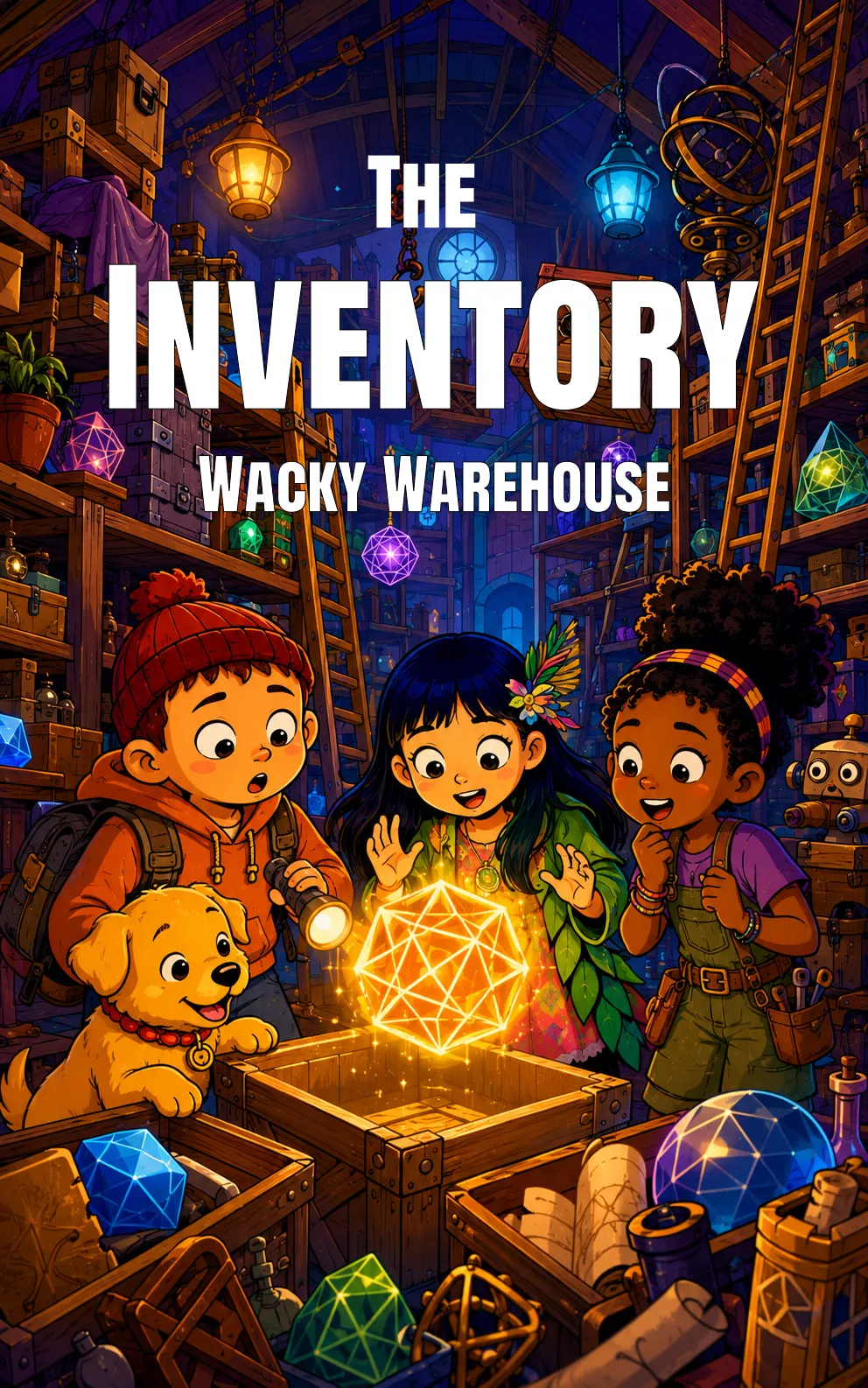
Welcome to Smudge’s extremely untidy warehouse.
Smudge's Little Job is a Story Grid adventure built around nine short stories, nine warehouse problems and nine different ways of thinking.
What’s Inside?
- Stories
- Problems
- Solutions
- Activities
Nine warehouse tasks, nine grid pieces — solve each one to reveal the hidden symbol.
Read the Book
Choose how you'd like to read.
Free & Offline
Complete digital editions are free, and designed to be taken away from the screen.
A Story Grid Adventure
Hello.
Inside this Story Grid, you’ll find nine short stories. Each story is a warehouse job with a problem to solve, a way of thinking to practise, and one small part of the bigger picture.
You can read the stories in order, or choose your own path through the Grid. Either way, keep track of what you discover. The pieces will matter later.
Start by printing the Grid. Then read the opening chapter, choose your first warehouse job, and see what needs fixing first.
New to Story Grids? See how they work →
Choose Your Adventure
Read the complete book, explore the Story Grid online, or take everything offline and work at your own pace.
The Grid
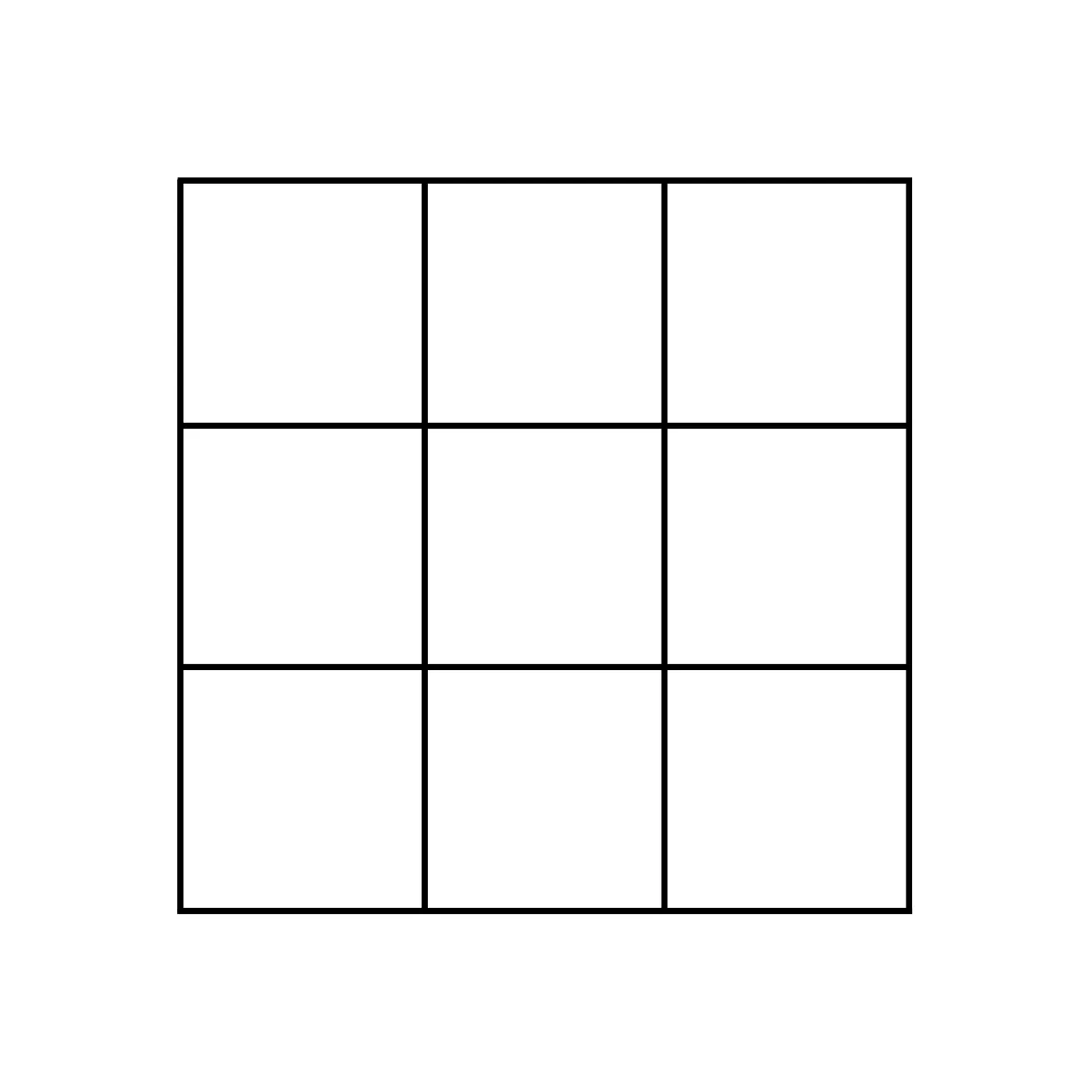
Each story gives you one grid fragment. Collect and draw all nine, reveal the hidden symbol, and complete the journey.
Your Job

Choose a story
Pick any warehouse job and complete its activities.

Collect its grid fragment
Draw it in the matching square.

Complete all nine stories
Reveal the hidden symbol.

The Grid Symbol Is
_______________________________
The Warehouse
Everything was quiet in Smudge’s office.
Well, except for the sound of Smudge snoring. And dribbling a little bit.
What he was supposed to be doing, I’m not entirely sure. But whatever it was, it certainly wasn’t sleeping. And it definitely wasn’t forgetting that Lyra, Orin, and Zia were due to arrive at any moment. Smudge had a “little” job for them after all.
Knock. Knock.
Smudge snored.
Knock. Knock. Knock.
Smudge snored again.
Then came a BANG BANG BANG.
Smudge woke with a start. “No, you’re sleeping!” he shouted, scrambling in his chair.
There was a wobble, a stumble, a flap of arms, and then a crash. A moment later, Smudge was lying in a heap on the floor.
More precisely, he was lying in a heap of his own inventions.
There was the Self-Stirring Soup Spoon, the Automatic Sock Sorter, the Emergency Biscuit Launcher, the Banana-Powered Umbrella, and a collapsible garden rake, which had chosen that exact moment not to collapse.
“Owwww,” yelped Smudge.
The knocking came again.
“Oh! Visitors!”
After untangling himself from the garden rake, Smudge managed to call out, “Come in!”
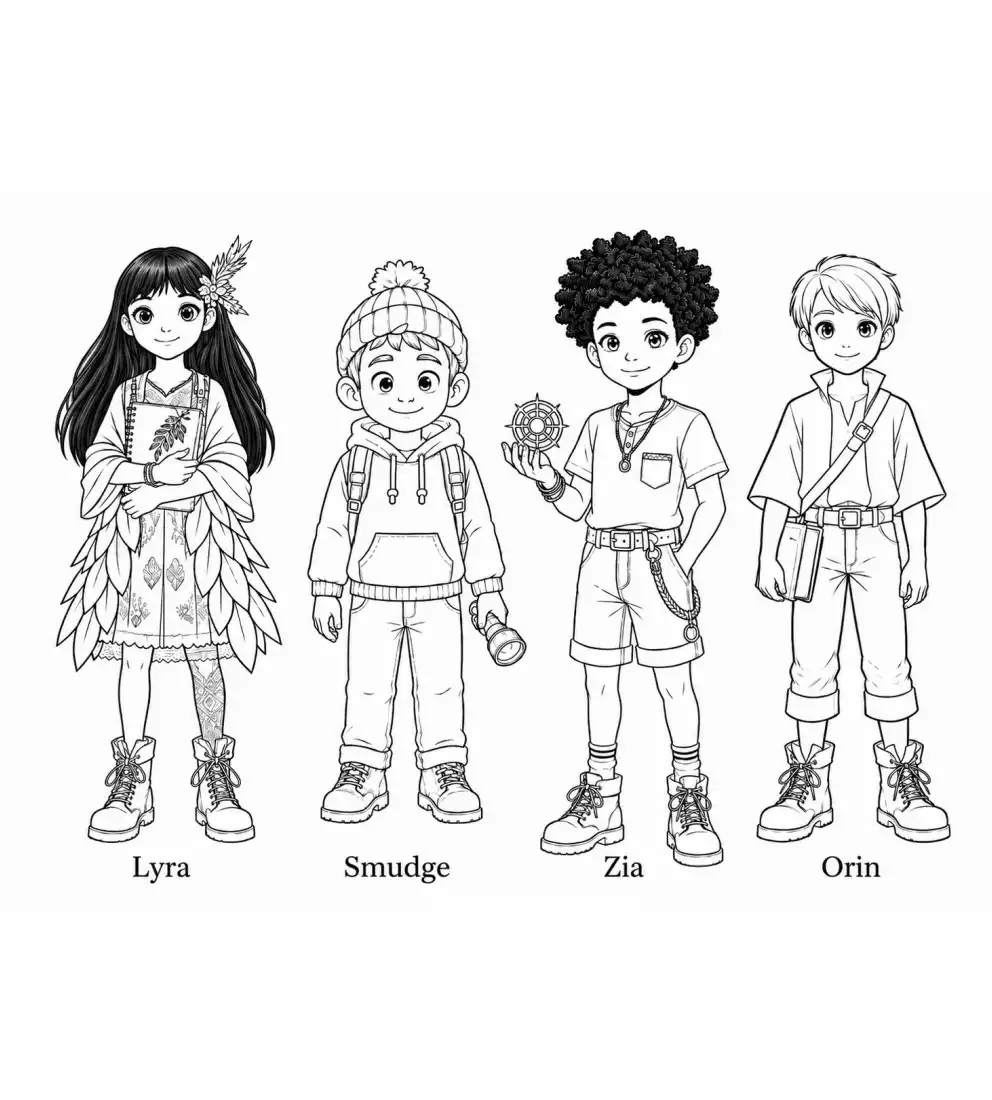
The door opened, and in stepped Lyra, Orin, and Zia. They were the very first students at Sacred Geometry School and good friends of Smudge.
“Hello, Smud—”
Lyra stopped. His office was a total mess. The ultimate mess.
“How do you live like this, Smudge?”
Without saying another word, Lyra gathered a pile of papers and stacked them neatly out of the way. Some were clearly important. Some were self-portraits of Smudge wearing a cape. Some were both.
Orin began gathering pieces of a small ladder that had been dismantled “for inspection” and never put back together. Within minutes it was fixed and leaning against the wall at the most perfect angle imaginable.
Zia quietly collected three random screws from the floor and placed them beside the steam-powered toast catcher that they belonged to. Nobody knew how she knew this, including possibly Zia.
It turned out that all three were excellent at sorting, tidying, fixing, and all manner of helpful things.
Before long, they were in full swing organising Smudge.
Smudge helped, of course. Or at least he appeared to. Mostly, he wandered around shuffling papers from one pile to another while making thoughtful noises.
“Hmm.”
“Hmmm.”
“Very important.”
Reaching into the mess, Orin pulled out a clipboard which looked rather important. It had been wedged between a bent ruler, three envelopes, and a biscuit tin lid. He brushed a few crumbs from the top page, straightened the paper with both hands, and frowned.
“This looks official,” he said. “Official things should not be stored with biscuit tin lids.”
Smudge took it. He glanced at it. Then he glanced at it again.
“Oh.”
“Oh no.”
“What?” asked Lyra.
“The inventory.”
“The what?” asked Orin.
“The warehouse inventory.”
Ah.
That was it.
That was what Smudge was supposed to be doing. Not sleeping. Or dribbling. The warehouse inventory. And if he didn’t need help before, he certainly did now.
The warehouse was where Smudge—the caretaker—stored everything that kept the school running. And it was, let’s say, in need of some organisation.
Smudge looked at the clipboard. He looked at the ceiling. Then he looked at the clipboard again. “I may be a tiny bit behind.”
“How far behind?” asked Zia.
Smudge considered this carefully. “Do you know how some people say they’ll do something tomorrow?”
“Yes,” said Zia.
“Well,” said Smudge, “I may have said that several tomorrows ago.”
“How many?”
“48.”
“48!?”
“It may have been 47,” said Smudge in an attempt to make it sound less bad.
It did not.
Moving swiftly on, Smudge spread his arms wide, as though he were about to announce a grand prize.
“So,” he said brightly. “Excellent news. You’re here to help!”
“We are?” said Lyra.
“Yes,” said Smudge. “Thanks. Good. Very good.”
Orin narrowed his eyes. “What sort of help?”
“Tiny help,” said Smudge.
“How tiny?” asked Zia.
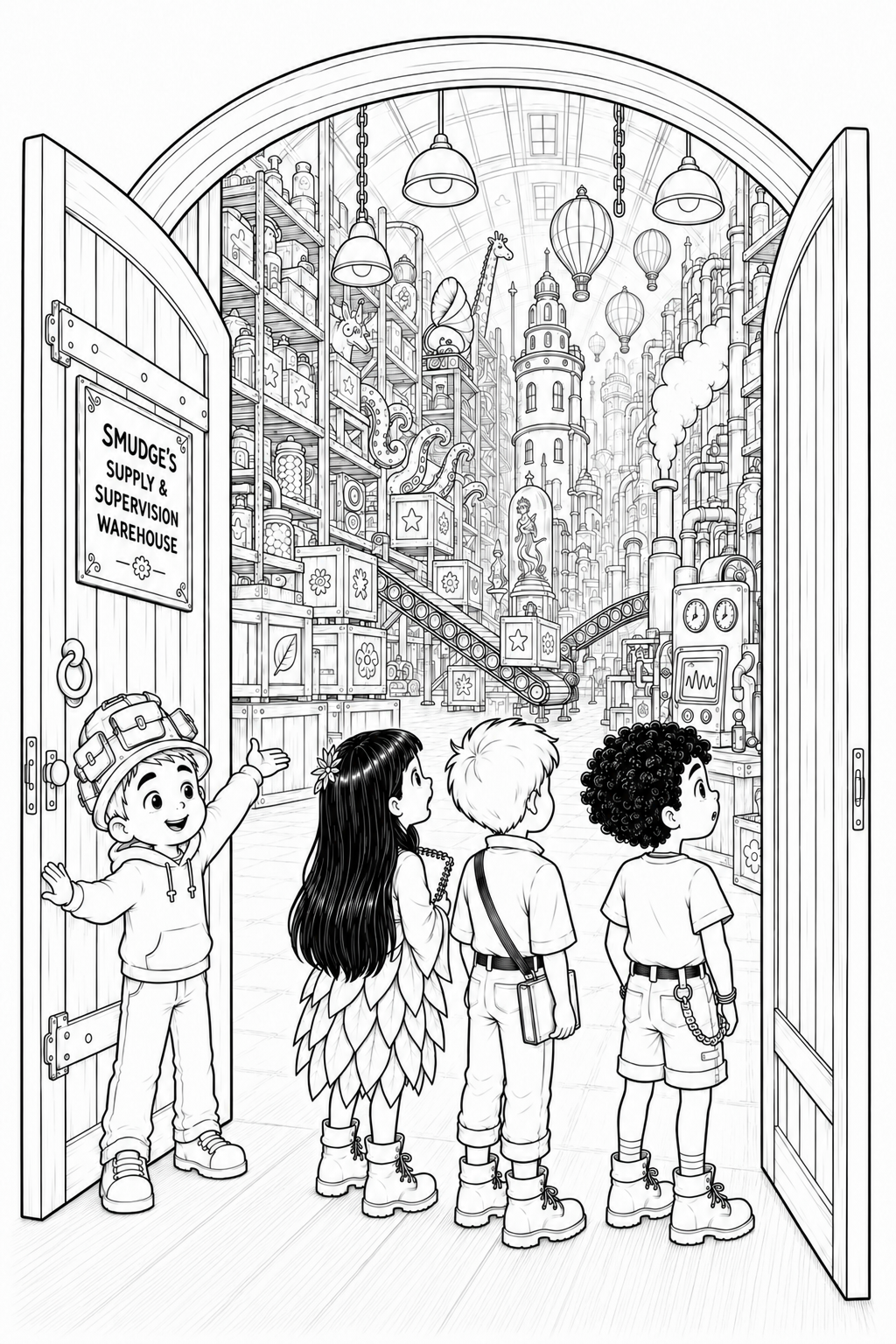
Smudge led them across the office to a large wooden door at the back. “Just a few bits and bobs.”
He placed one hand on the handle. “We’ll beeeee right through it.”
The door swung open.
The trio gasped.
Beyond the doorway stretched the largest warehouse they had ever seen. Shelves climbed so high they disappeared into the shadows above. Crates were stacked in what could only be described as towers. Boxes filled entire aisles. Machines whirred. Labels dangled. Conveyor belts rattled. Strange inventions blinked, buzzed, and occasionally puffed smoke. The warehouse went on… forever.
Lyra opened her mouth. Then closed it again.
Orin blinked.
Zia’s face slowly lit up. “I want to climb it!”
“Absolutely not,” said Lyra and Orin together.
Smudge smiled, reached behind the door, and produced a hat that appeared to have several pockets sewn onto it for no obvious reason. He popped it on his head with great seriousness. “I shall supervise.”
“Are you going to help?” asked Lyra.
“In a supervisory way.”
For a while, nobody said anything. The warehouse hummed. Something clattered. A crate wobbled. Somewhere far away, a bell rang.
The trio weren’t exactly sure how they had got themselves into the biggest job in history. But somehow, here they were.
Smudge rubbed his hands together gleefully. “Well,” he said. “Where do you want to start?”
Choose a Story
Where Next?
Wherever you like. Pick a warehouse job that sounds interesting and see what happens.
Tiny Cart
Inventory Note
The smallest thing can be the biggest problem.
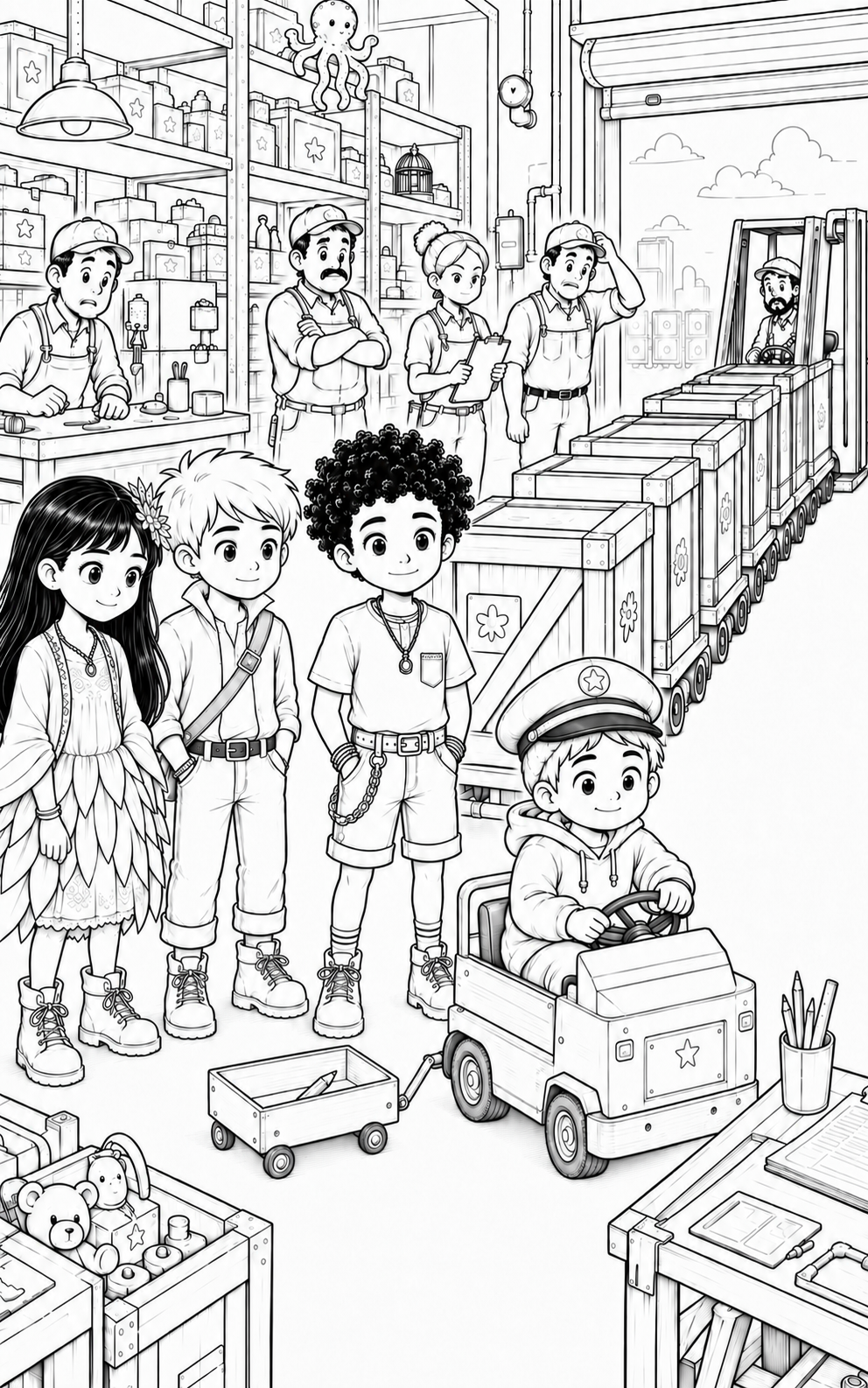
Lyra, Orin, and Zia entered one of the busiest sections of the warehouse. Very busy.
Workers carried boxes. Machines rattled. Crates moved. Clipboards shuffled. Shelves creaked. Bells dinged. Someone hurried past with six pencils behind one ear and a label stuck to their elbow.
There was a lot happening. Unfortunately, a lot of the lot was waiting.
A worker stood beside a crate, waiting. Another worker stood beside a shelf, waiting. A machine rattled for a moment, then stopped and waited. A clipboard was passed from one person to another, who looked at it carefully, then waited.
Zia frowned. “Why is everyone waiting?” Nobody seemed to know. One worker pointed towards the shelves. Another worker pointed towards a crate. A third worker pointed at the clipboard, which did not look responsible, but was clearly being blamed anyway.
Then a small horn sounded.
Parp.
Everyone turned. A tiny cart appeared from between two shelves. Driving the cart was Smudge.
“How did you get over there?” asked Lyra.
Smudge adjusted his hat. It was a very special hat—different from his official warehouse hat. This one was a driver’s hat. He had put it on specifically for cart-driving responsibilities. “Inventory transport,” he said. “It’s a very serious business.”
Behind the cart was a tiny trailer. It was so tiny that calling it a trailer felt generous. It had room for exactly one item. One. At that moment, the item was a pencil.
Smudge drove to a waiting worker, delivered the pencil, gave a serious nod, turned the cart around, and drove away. The worker began writing. Everyone else kept waiting.
A while later, the horn sounded again.
Parp.
Smudge returned. This time the tiny trailer held one label. He delivered the label to another worker, gave another serious nod, turned the cart around, and drove away.
“Where do you keep going?” Orin tried to ask.
Smudge was already halfway down the aisle. “Supplies!” he called out as he vanished around a corner.
While he was gone, the trio watched the warehouse. A worker needed a form. Another needed tape. Another needed a ruler. Another needed a pencil sharpener. Several people needed labels. One person needed a biscuit, although that did not seem strictly necessary. Absolutely everyone was waiting.
Orin took out a pencil and began making neat notes on the edge of the inventory sheet. “Form waiting. Tape waiting. Ruler waiting. Labels waiting,” he muttered.
Parp.
Smudge was back. This time the tiny trailer held one form. He delivered it proudly. “Excellent transport work,” he announced. Then he drove away again.
Lyra looked at Zia. Zia looked at Orin. Orin looked at the tiny cart disappearing into the distance. “We should follow him,” said Orin. So they did.
They followed Smudge past the shelves, around a stack of crates, through a narrow gap, across a wide stretch of warehouse floor, around another shelf, past three barrels, behind a ladder, and finally into a far corner of the warehouse. There, parked neatly against the wall, was a large supply trailer.
It was full to the brim with everything you could imagine.
Labels. Forms. Pencils. Tools. Tape. Rulers. String. Spare clips. More forms. More labels. Three pencil sharpeners. A box marked SECRET BISCUITS, which Smudge had his head in.
Lyra stared at the supply trailer. Zia stared at the distant workers. Orin stared at Smudge’s tiny cart.
Zia picked up a label and a pencil and tried to put them both in the tiny trailer. The pencil rolled straight out.
“This cart has the carrying capacity of a thimble,” she said.
After extracting his head from the biscuit box, Smudge picked up one label and placed it carefully in the tiny trailer. “A very important thimble,” said Smudge with a mouthful of biscuit. “Back I go.”
“Wait,” said Orin.
Smudge paused. This was clearly difficult for him, because he had been about to do more excellent transport work.
Orin pointed at the huge supply trailer. “Why is this all the way over here?”
Smudge looked at the trailer. “It lives here,” he said.
“Does it have to live here?” asked Zia.
Smudge frowned, as if nobody had ever asked about the supply trailer’s living arrangements before.
Lyra looked back across the warehouse. “Everyone is waiting for things from this trailer.”
“Yes,” said Smudge.
“And you are bringing them one at a time.”
“Yes.”
“In a tiny cart.” Orin rubbed his forehead. “From a very, very long way away.”
“Yes.” Smudge nodded. “Inventory transport is a serious responsibility.”
Zia looked back at the waiting workers. “So the whole warehouse is waiting for one tiny cart to bring one tiny thing at a time.”
Orin looked from the tiny cart to the huge supply trailer, then back across the warehouse to the waiting workers. “The workers are ready,” he said slowly. “The supplies are ready. The cart is doing its best… but it’s tiny. Too tiny.”
Orin pointed to the supply trailer with his pencil. “Why don’t we just move that?”
Silence.
Lyra blinked.
Zia blinked.
Smudge blinked.
“Move what?” asked Smudge.
“The supply trailer.”
“Move the supply trailer?”
“Yes.”
“To over there where everything is needed?”
“Yes.”
Smudge looked genuinely shocked. For a moment, nobody spoke. Then Smudge slowly removed his driver’s hat. “But what about my hat?” he asked.
“You can wear it to drive the big trailer over to where it’s needed,” said Orin. “If you can handle the responsibility, that is.”
Smudge straightened up and puffed out his chest. “You leave this with me, young man,” he said.
A moment later, the hat was back on, and the large supply trailer was moved to the centre of the warehouse. All of a sudden, people stopped waiting.
Forms arrived faster. Labels arrived faster. Pencils arrived faster. Tools arrived faster. Tape arrived faster. Everything arrived faster.
Nobody was working harder. Nobody was rushing around. Nobody had become suddenly brilliant at warehouse work. The supplies were simply in the right place. The work flowed. The delays disappeared.
Smudge stood proudly beside the large trailer. “You know,” he said, “I can still drive the cart in emergencies.”
“Pencil!” shouted one of the warehouse workers.
Smudge immediately climbed into the cart, started the engine, drove forward, stopped, delivered one pencil, and then drove back. The journey was approximately three feet.
Parp.
“Excellent transport work,” he announced.
Looking Back
In this story, everyone was busy. Or at least, they were trying to be.
There were jobs that needed doing, crates that needed moving, and a warehouse full of noise, motion, and important-looking activity. But something wasn’t quite right. A lot of the busy was actually waiting.
That was the important thing to notice. The problem wasn’t everywhere. It wasn’t the workers, or the shelves, or the crates, or the general amount of effort being used.
The problem was the tiny cart.
Everything had to pass through one small, slow part before the work could continue.
That kind of problem is called a bottleneck.
A bottleneck happens when lots of things are ready to move forward, but one slow part holds them up.
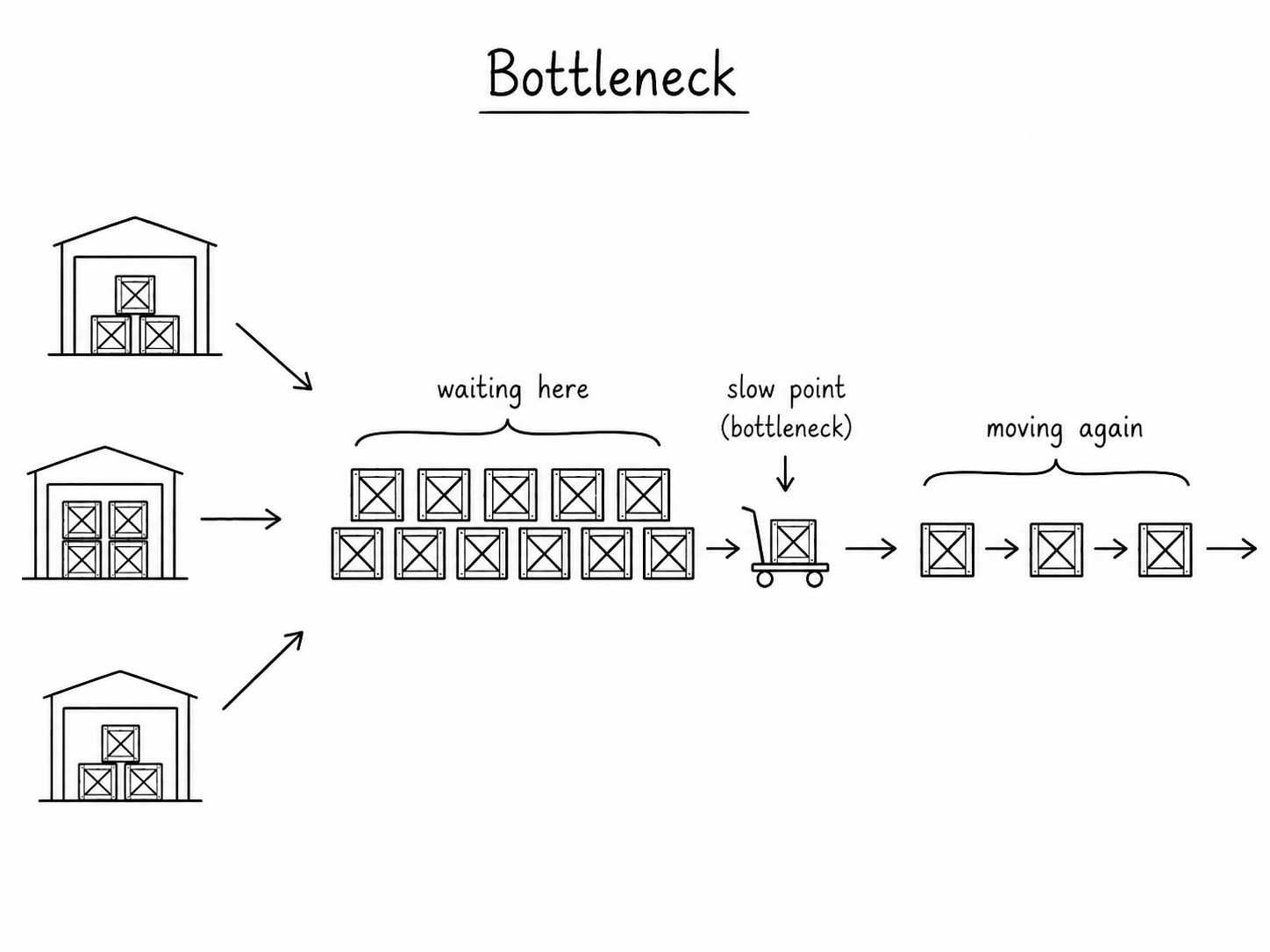
The crates were ready. The workers were ready. The job was ready. But the cart could only carry a little at a time, so everyone had to wait.
When there’s a bottleneck, working harder elsewhere doesn’t really help. The better thing to do is find and fix the slow part.
That way, you fix the most important problem first.
Smudge wasn’t wrong to like the tiny cart. It was a very fine tiny cart, after all. It was just doing a job that was much too big for it.
And as much as Smudge enjoyed wearing his important hat, getting everything else moving was more important.
Smudge’s Takeaway
When progress is slow, find the slowest part. Fixing it can make the biggest difference.
Concept Check
Circle the best answer for each question.
Which sentence best describes a bottleneck?
- A place where everything speeds up.
- A place where work gets held up.
- A place where people take a snack break.
Which of these could become a bottleneck?
- Ten empty football pitches.
- A quiet beach with nobody on it.
- One narrow doorway with lots of people trying to leave.
Which choice would probably help a bottleneck?
- Asking everyone to wait more neatly.
- Making the slow part easier, bigger, or quicker.
- Giving the problem a more important name.
How sure are you?
- I understand it well.
- I mostly understand it.
- I want to read the story again.
Try It
After the tiny cart problem was discovered, Smudge became very excited.
He found a clipboard. He found a pencil. He found a biscuit, and he was ready.
“I have an announcement,” Smudge declared. “Think how much better the warehouse could be if we found all the bottlenecks.”
Lyra nodded.
Orin nodded.
Zia wanted a biscuit too.
“So,” continued Smudge. “We are going bottleneck hunting!”
Can You Help Smudge?
Your task is to create a bottleneck for Smudge to find.
In the following space, invent your own warehouse bottleneck. Show:
- Lots of things waiting.
- One small or slow part where everything gets stuck.
- Things moving again after the slow part.
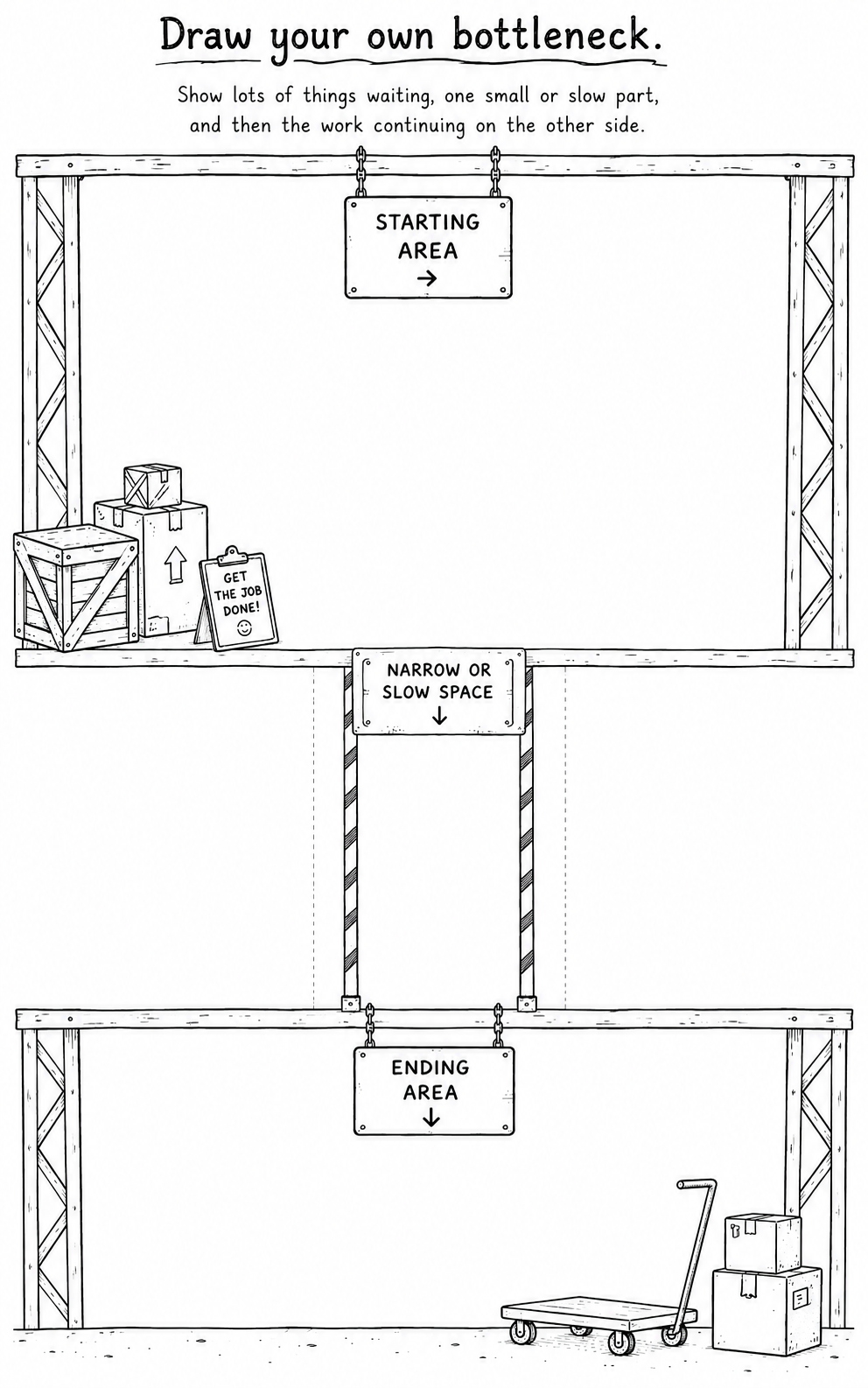
Now, how would you solve your own bottleneck?
What is one change that would help?
You might add a bigger cart, another lift, a second doorway, a new helper, a new route, or one firm but polite sign saying:
NO BOTTLENECKS
Smudge thinks this may help.
Your Grid Fragment
That’s the Tiny Cart job complete. The bottleneck has been found, fixed, and probably given a tiny parking space.
Now you’re ready to collect your fragment and add it to your grid.
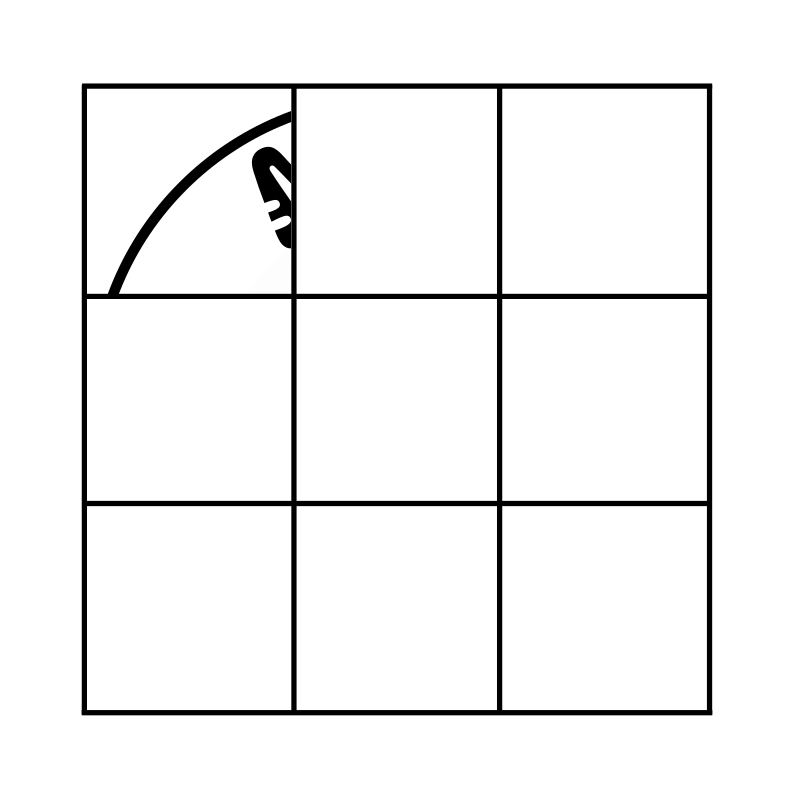
- Do you know what it is yet?
- Can you guess what it might become?
- What makes you think that?
Choose Next Story
Where Next?
Anywhere you like! Choose your next story from the grid.
Finished all nine warehouse jobs? Then you’re ready for The Symbol chapter.
Mail Mountain
Inventory Note
Do what matters most.
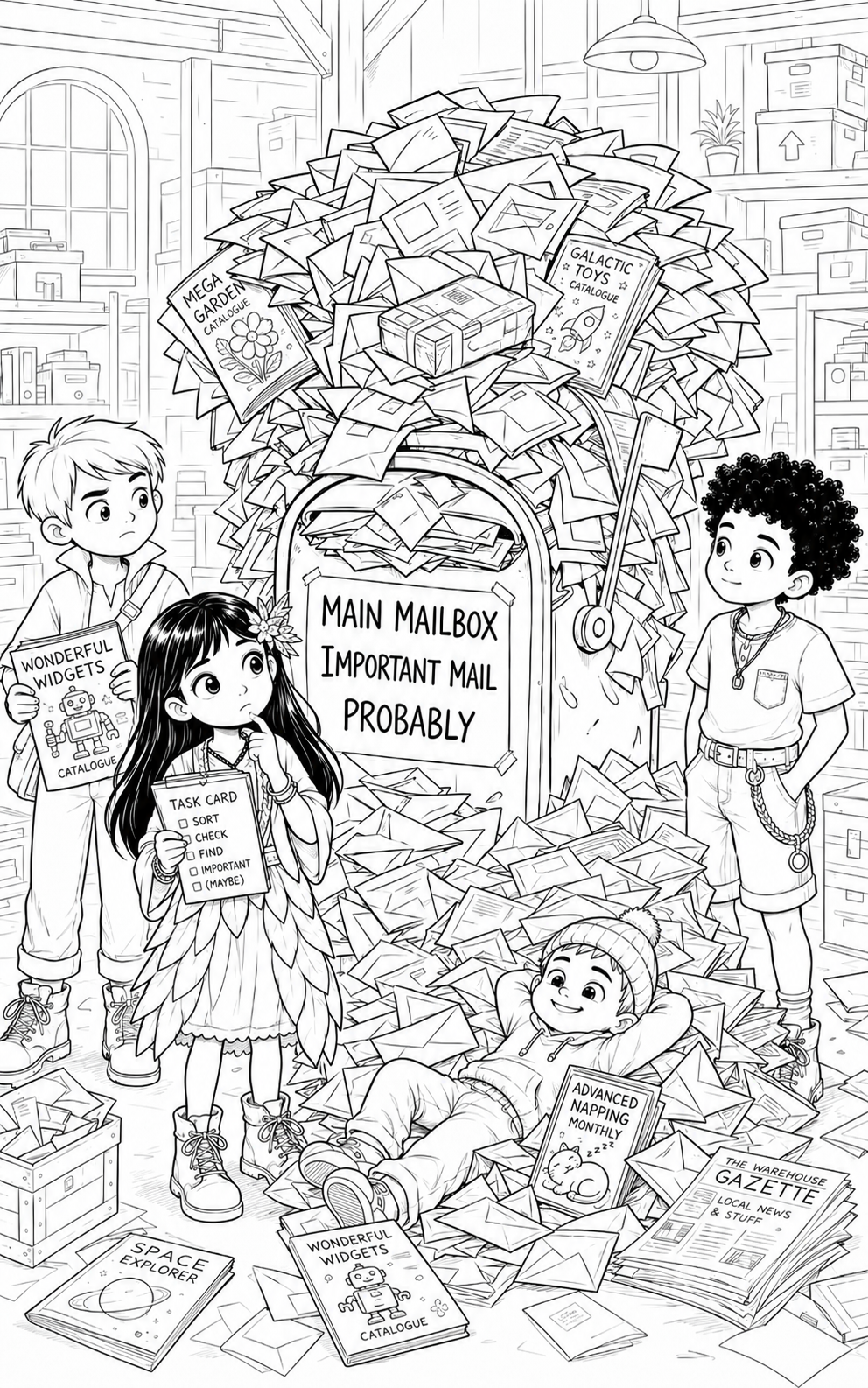
The trio and Smudge stood looking at the main mailbox.
Actually, calling it a mailbox was misleading. It was more of a mail mountain.
Letters spilled from the top. Catalogues hung from the sides. Several magazines had escaped entirely and were lying on the floor. A bunch of newspapers appeared to be starting their own breakaway pile, which did not seem healthy. The mailbox groaned slightly under the weight of its own contents.
Lyra looked down at the inventory sheet.
“Mail,” she read. “Do important stuff.” She lowered the sheet and looked back at the mail mountain. “Oh boy.”
A catalogue slid off the side of the pile and flopped onto the floor. Zia caught it with her foot before it escaped under a shelf.
“The mail is making a break for it,” she said.
Orin picked it up. “It says Five Hundred Excellent Buckets.”
Zia frowned. “That doesn’t sound important.”
“It might be,” said Smudge.
Lyra looked at the mail mountain again. There were letters, catalogues, newspapers, leaflets, booklets, forms, envelopes, and one small packet so badly squashed it also looked like a letter.
“How do we know what’s important?” she asked.
They all looked at Smudge.
Smudge looked blank and shrugged. “Important mail is mail that feels good when you hold it,” he said.
Orin went very still. “That is not a system, Smudge.”
“It is a little bit,” said Smudge.
Orin decided no response was the best one.
The next thing they found was a magazine called Advanced Napping Monthly. Smudge quietly tried to take it.
Lyra pulled it back. “Smudge.”
“What?”
Lyra placed it to one side. “Later pile.”
Orin immediately straightened the later pile so its edges lined up. Zia dropped The Very Serious Sock Report on top of it.
Smudge stared at the pile longingly.
Then came the Emergency Biscuit Catalogue.
“Now pile,” said Smudge immediately.
“No,” said Orin. “Later pile.”
“Snacks can be emergencies.”
“Later pile.”
Smudge sighed.
After that came The Journal of Spoon Appreciation, which Smudge claimed was more serious than it looked. Nobody believed him.
Then Zia found a plain brown envelope with a warehouse stamp on the front. It didn’t have bright colours, funny pictures, shiny letters, or the word biscuit anywhere on it.
“This one looks serious,” said Zia.
Orin took it carefully. “Very serious.”
Lyra pointed to the smaller pile they had started beside the later pile. “Now pile.”
On it went and the sorting continued.
Bright things went into the later pile. Funny-looking things went into the later pile. Snack-related things went into the later pile, despite Smudge’s objections. Anything official went into the now pile. Anything with a warehouse stamp went into the now pile. Anything in a plain brown envelope went into the now pile. Anything that looked serious, cross, urgent, or as if it might become angry if ignored also went into the now pile.
After what felt like never-ending sorting, the mail mountain had become two smaller mountains. One was large, colourful, and rather fun-looking. The other was small, brown, serious, and not especially cheerful.
“There,” said Lyra. “Later pile and now pile.”
Smudge looked at the later pile. “The later pile looks fun.”
“That’s why it’s later,” said Zia.
Orin picked up the now pile. “So now we read these?”
“Carefully,” said Lyra.
And so they began with the first envelope.
WAREHOUSE NOTICE: PLEASE RETURN BORROWED LADDER
“Important?” asked Orin.
“Yes,” said Zia. “But not urgent.”
Lyra wrote on the inventory sheet:
Return borrowed ladder — normal priority.
The next notice was printed in large, serious letters.
WAREHOUSE NOTICE: “PROBABLY SOMETHING GOOD” IS NOT AN INVENTORY ITEM
Everyone looked at Smudge.
Smudge pretended not to notice everyone looking at Smudge.
“That feels important,” said Lyra.
“More important than the ladder?” asked Orin.
“Hard to say,” said Zia. “Maybe the same?”
Lyra looked at the inventory sheet. So far, it had one normal priority and one task that felt important, but nobody could quite explain how important. More, less, or the same?
“We need a way to sort the now pile,” she said.
At this very moment, Smudge rather conveniently found an extra-important-looking letter—plain, brown, serious—and handed it over to Orin.
“Ah,” said Orin. “Look at this.”
He unfolded it with the careful expression of someone opening a treasure map, except the treasure was a list. To Orin, these were much the same thing. He loved a good list.
The title read:
OFFICIAL PRIORITY LIST
Lyra peered over his shoulder. “It tells us how to sort all the others,” she said.
Zia nodded. “Then that must be the most important one.”
“Nothing has more priority than priority,” said Smudge wisely.
“Okay,” said Orin. “Priority number one: the priority list.”
He created a special pile of one for the Official Priority List and moved on to the next letter.
SAFETY WARNING: DO NOT STACK BOXES ABOVE THE WOBBLE LINE
“What’s the wobble line?” asked Zia.
Smudge pointed to a red line painted across the warehouse wall. He pretended to be a little box and did a small wobble demonstration, just to be clear. “No boxes above the wobble line!”
Lyra checked the priority list. “Safety warnings before warehouse notices.”
“Makes sense,” said Zia. “Falling boxes before borrowed ladders.”
“And before the ‘Probably’ notice,” said Orin.
“Correct,” confirmed Lyra.
And so it went. Each item in the now pile was checked against the Official Priority List and arranged properly. Safety warnings went first. Things that might cause problems went next. Things that mattered, but could wait a little, came after that.
At last, they had a neat pile of ordered important things. Not a mountain. Not a mess. A neat, organised pile.
“There,” said Lyra. “Now we know what matters most.”
“And what matters next,” said Zia.
“And what can wait,” said Orin.
With everything organised, prioritised, and optimised, all that was left to do was the highest priority item.
At the top of the list, strangely, in crayon and slightly wobbly handwriting was the most important job:
READ FUN PILE IMMEDIATELY
Lyra slowly looked at Smudge.
“Smudge,” she said. “Did you add this to the priority list?”
Smudge reached into his pocket, pulled out his official warehouse stamp, and stamped it.
“Yes,” he said. “Approved!”
Looking Back
In this story, the trio found a mailbox that had become a mail mountain.
There were letters, catalogues, newspapers, magazines, leaflets, notices, envelopes, forms, packets, and several things Smudge considered extremely important because they mentioned biscuits.
At first, everything was mixed together.
Some things looked fun.
Some things looked serious.
Some things were loud, colourful, shiny, or snack-related.
But not everything needed attention at the same time.
The trio had to decide what mattered now, what could wait, and what should be dealt with first.
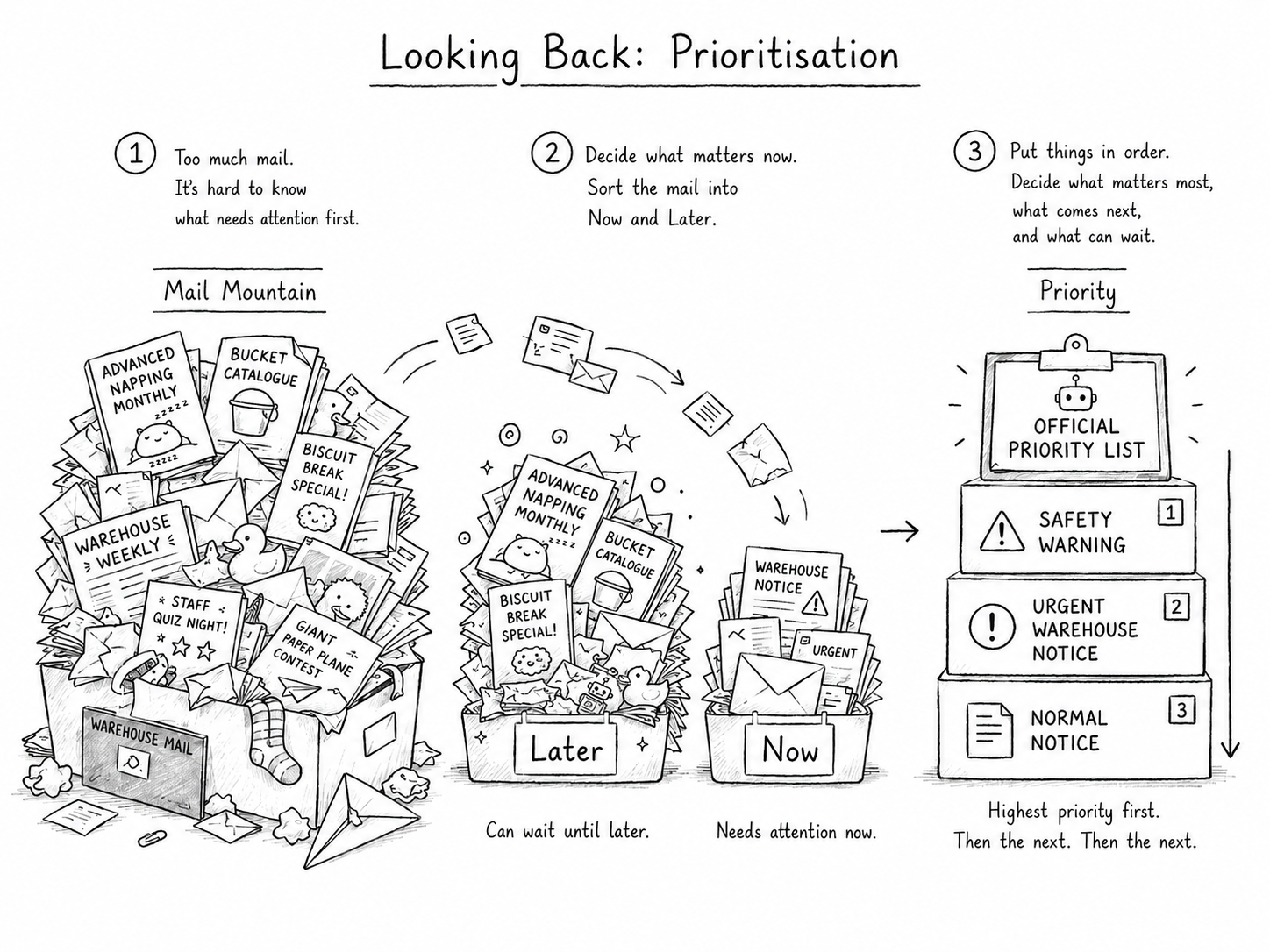
This meant prioritising.
Prioritising means deciding what matters most and putting things in the order they should be done.
The fun pile wasn’t bad.
Advanced Napping Monthly was probably very useful.
Maybe.
But it wasn’t the thing that needed attention first.
The trio began by separating the mail into a now pile and a later pile.
Then they used the Official Priority List to put the now pile in order.
Safety warnings came first. Things that might cause problems came next. Things that mattered but could wait a little came after that.
When there is too much to do, everything can feel important.
Prioritising helps you decide what matters most, what comes next, and what can wait.
Smudge’s Takeaway
When everything feels important, decide what matters most, what comes next, and what can wait.
Concept Check
Circle the best answer for each question.
Which sentence best describes prioritising?
- Doing the easiest thing first every time.
- Letting Smudge choose whatever mentions biscuits.
- Deciding what matters most, what comes next, and what can wait.
Why is prioritising useful?
- It makes every task equally urgent.
- It helps us give our attention to the right things in the right order.
- It helps us make the pile bigger.
Which task should usually receive the highest priority?
- A task involving an immediate safety problem.
- A task that is enjoyable but can wait.
- A task that is easy but not important.
How sure are you?
- I understand it well.
- I mostly understand it.
- I want to read the story again.
Try It
Today is The Big Delivery Day.
Six messages have slid out of the warehouse mailbox and landed in one muddled mini mail mountain.
Smudge picked up the first one. “Important,” he said.
He picked up the second one. “Also important.”
He picked up the third one. “Extremely important. It mentions biscuits.”
Lyra looked at the pile.
“Smudge,” she said, “not every message matters for today’s job.”
Can You Help Smudge?
It looks like Smudge needs help prioritising his work.
In the first picture, read the six messages in the mini mail mountain. Find the three messages that matter now, and the three messages that can wait until later.
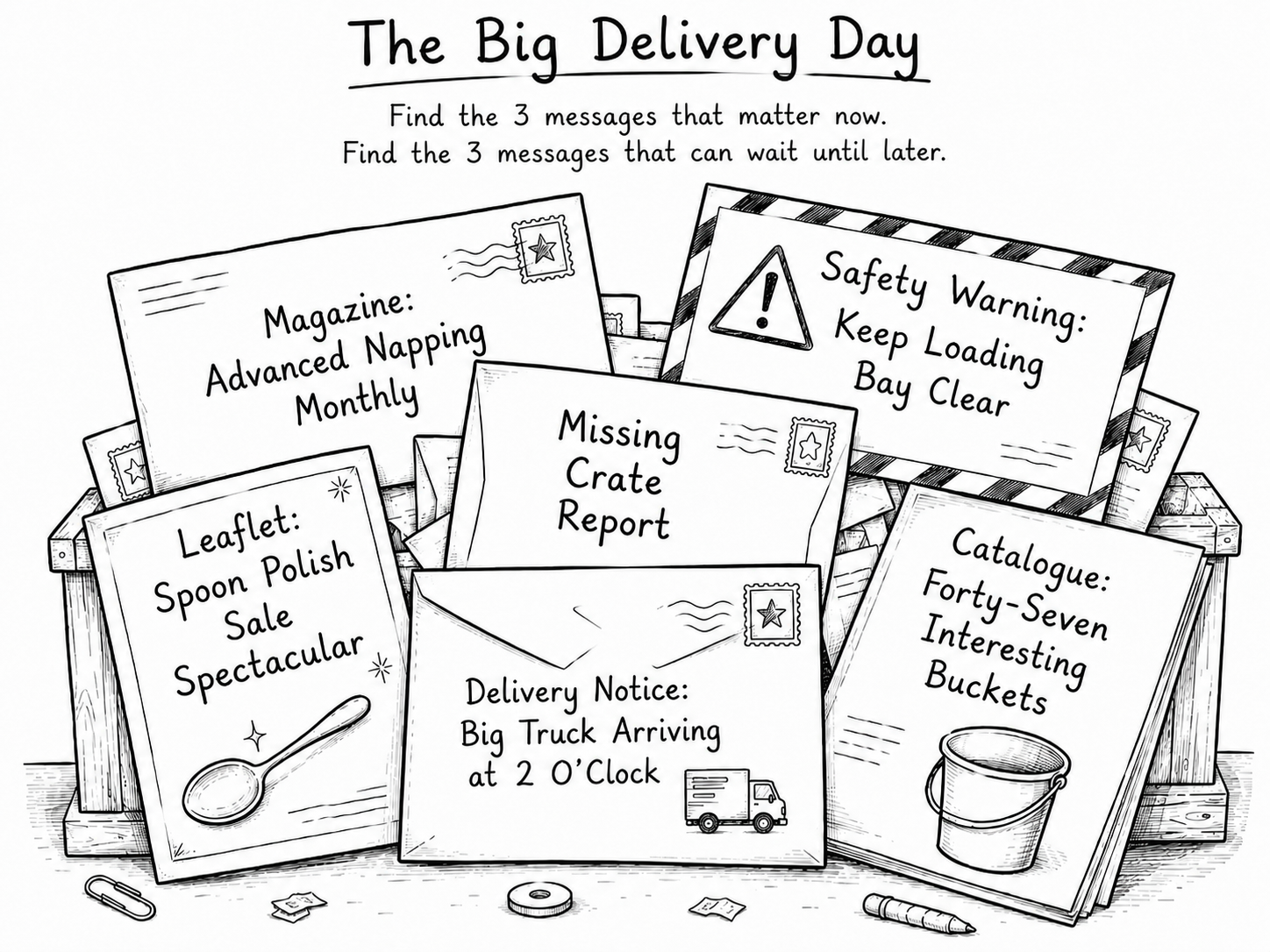
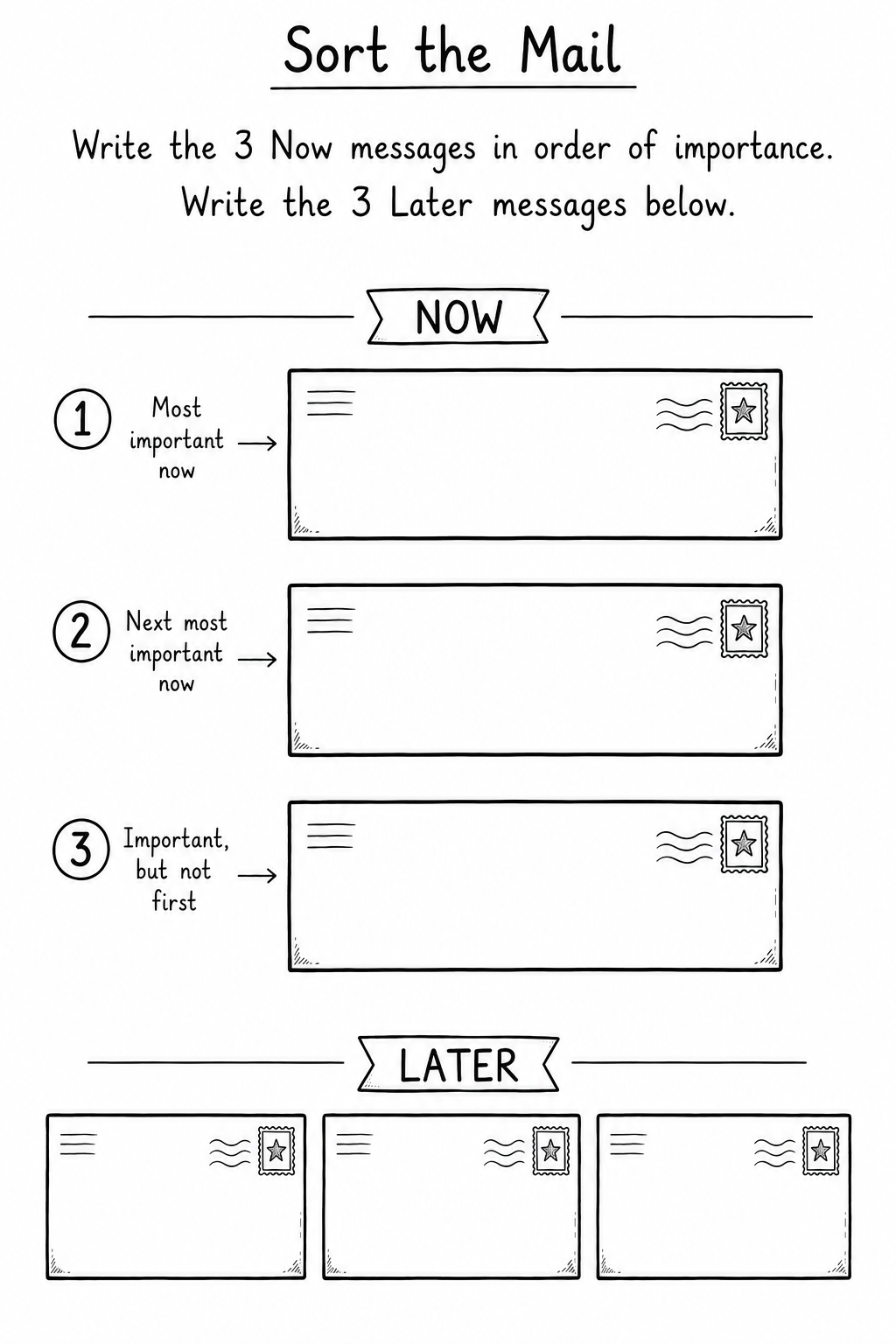
Write the three now messages into the numbered spaces in order of importance.
1 = most important now
2 = next most important
3 = important, but not first
Write the three later messages into the later spaces.
Your Grid Fragment
That’s the Mail Mountain job complete. The important messages have been found, the not-now messages have been moved aside, and Smudge is feeling very organised.
Now you’re ready to collect your fragment and add it to your grid.

- Do you know what it is yet?
- Can you guess what it might become?
- What makes you think that?
Choose Next Story
Where Next?
Anywhere you like! Choose your next story from the grid.
Finished all nine warehouse jobs? Then you’re ready for The Symbol chapter.
Biscuit Imposter
Inventory Note
Looks right. Feels wrong.
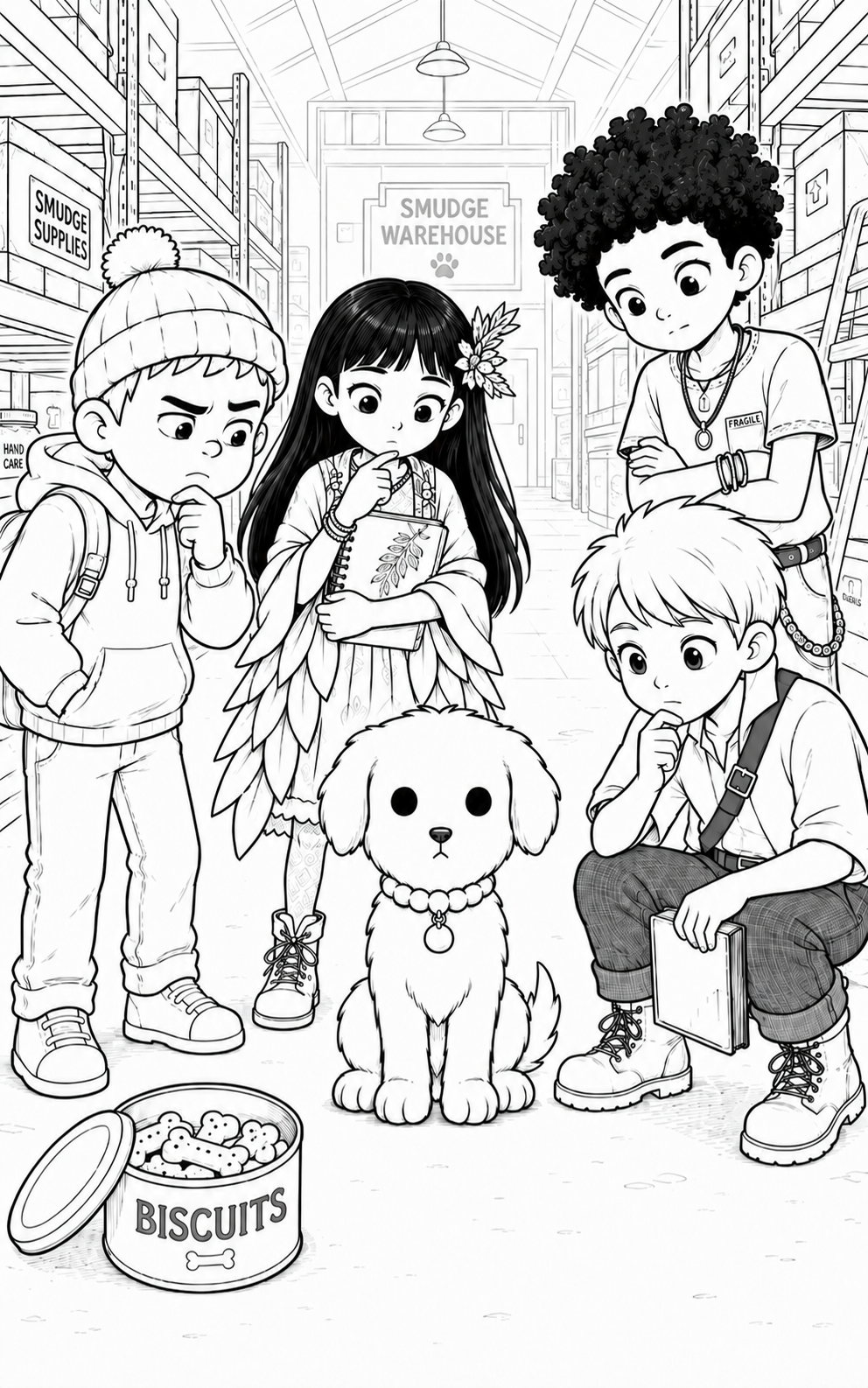
A particularly important job in Smudge's warehouse led to a particularly quiet aisle.
It was quiet. Obviously. Seriously quiet.
Lyra stopped. Orin stopped. Zia stopped. Smudge bumped into all three of them.
In the middle of the aisle sat Biscuit—Smudge’s dog. Or at least, something that looked very much like Biscuit. But something was a bit… off.
He was perfectly still, perfectly upright, and perfectly clean. There wasn’t a single crumb on his nose. There wasn’t a single muddy paw print behind him. There wasn’t even a little wag of his Biscuit tail.
Smudge stared. “That is not Biscuit,” he concluded immediately.
“Don’t be silly,” said Orin, folding his arms. “Of course it’s Biscuit. Look at him.”
“It is not,” said Smudge.
“Well, it looks exactly like him,” said Orin.
Smudge didn’t have an answer to that. Orin was right. Very right. Still Biscuit looked exactly like Biscuit.
Lyra stepped a little closer. “It does look like Biscuit.”
“Golden fur,” said Orin.
“Floppy ears,” said Lyra.
“Biscuit’s collar,” said Zia.
Orin knelt closer to inspect the tag. “Even the tag says Biscuit.”
The tag did indeed say:
BISCUIT
“Case closed,” said Orin. “Biscuit.”
Smudge wasn’t having it.
“Not Biscuit! Labels can be wrong.”
Everyone remembered the box marked SMALL HARMLESS SPOONS. The spoons had not been small. Or harmless. Or, in fact, spoons.
Smudge shook his head. “Nah. Not Biscuit.”
“You cannot just say ‘not Biscuit,’” said Orin. “Where’s the evidence?”
Smudge pointed. “That dog is behaving.”
Everyone looked at still Biscuit. Still Biscuit sat neatly. Still Biscuit blinked slowly. Still Biscuit didn’t knock anything over, eat anything disgusting, lick anything official, or get his head stuck in any kind of container.
Maybe Biscuit had changed. Maybe Biscuit had become tidy. Maybe Biscuit had decided to behave. Maybe Biscuit had turned into a calm and responsible warehouse assistant who respected labels, waited patiently for instructions, and never once put his face in someone else’s lunch.
“Nah. Definitely not Biscuit,” said Smudge, folding his arms.
“It is Biscuit,” said Orin.
“Not Biscuit.”
“Biscuit.”
“Not Biscuit.”
“Biscuit.”
“Not Biscuit.”
Lyra sighed and looked from one to the other. “This isn’t really helping.”
“Right,” said Smudge. “I’ll settle this once and for all.”
He reached into his hoodie pocket and pulled out a heavily chewed pencil and a crumpled piece of paper.
Orin looked at the pencil. “Was that Biscuit?”
Smudge ignored the question and smoothed the paper against a crate.
“What are you doing?” asked Lyra.
“Preparing my case,” said Smudge.
“Your case?” questioned Orin.
Smudge stood up straight, held the paper in one hand, and tapped it with the pencil. “Ladies and gentlemen of the jury—”
“We are not a jury,” said Orin.
“You asked for evidence,” said Smudge. “Now you are a jury.”
Zia folded her arms, but she was smiling. “Go on then.”
Smudge cleared his throat.
“The question before the jury is simple,” said Smudge. “Is that Biscuit?”
“Yes,” said Orin.
“No,” said Smudge. “Please do not interrupt the evidence.”
Orin opened his mouth. Zia shook her head slightly. Orin closed it again.
“I agree that still Biscuit does indeed look like Biscuit. That is true,” continued Smudge. “But looking like Biscuit does not make one Biscuit.”
He tapped the paper again.
“I shall present evidence that this dog only looks like Biscuit, and that nothing here proves that it really is Biscuit. Which can lead to only one extremely serious conclusion…”
Smudge turned dramatically towards still Biscuit and pointed with the chewed pencil. “That… is an imposter!”
There were gasps. Mostly from Smudge.
“Number one,” he continued, wasting no time. “If that is Biscuit, then there should be crumbs.”
The trio turned to inspect still Biscuit. There were no crumbs on his nose. No crumbs near his nose. No crumbs under his nose. No crumbs hiding in his dog beard. Still Biscuit was, indeed, completely crumbless. Smudge checked it off his paper.
“Number two,” continued Smudge. “If that is Biscuit, he should wag his tail when someone says Biscuit.”
He turned to still Biscuit.
“Biscuit?”
Still Biscuit did not wag.
“Biscuit!?”
Still no wag.
Zia crouched down and slapped a quick drumroll on the floorboards—the Biscuit launch rhythm. Nothing. Absolutely nothing.
“Very strange,” said Zia. “Very strange indeed.”
“Tail evidence,” said Smudge, checking off another point on his paper.
“Number three,” said Smudge. “If that is Biscuit, he should be interested in biscuits.”
“And treats,” said Lyra.
“And treats,” said Smudge. “Thank you, Lyra.”
Lyra reached into her bag and pulled out a small dog treat she carried for dog-related emergencies. This was definitely one of them. She held it close to Biscuit’s nose and gave it a teasing little wiggle.
Still Biscuit did not sniff, blink, or lunge forwards. Still Biscuit did not try to eat the treat, Lyra’s hand, or the contents of her bag.
Smudge clutched his chest. “Unthinkable.”
“Maybe he’s full,” said Orin.
Everyone stared at him.
Orin heard what he had just said.
“Objection,” he said quietly.
“Against what?” asked Lyra.
“Myself,” said Orin. “Whatever I just said.”
Smudge nodded. “Sustained.”
“Which leads me to point four,” said Smudge, with extra seriousness. “The real Biscuit has never, ever been full. Ever!”
He smugly checked off another point.
“Number five!” Smudge shouted dramatically. “If that is Biscuit, he should leave a Biscuit trail behind.”
Orin frowned. “What does that mean?”
Smudge gestured around the clean aisle. “You know. Signs of where Biscuit has been.”
They all looked. There were no muddy paw prints. No knocked-over bucket. No chewed label. No dragged string. No suspicious trail. No mystery jam.
“And for number six, ladies and gentlemen of the jury, I call a special witness.”
“We have witnesses?” asked Lyra.
“We do,” said Smudge. “Whiskers.”
Whiskers was the warehouse cat. She was neat, silent, deeply unimpressed by almost everything, and had been sitting on top of a cupboard watching this unfold since they arrived.
“Whiskers, is that Biscuit?” asked Smudge.
“Don’t be silly,” said Whiskers. “Of course that’s not Biscuit. Biscuit is over there eating… something. Hard to say what exactly.”
At that very moment, something crashed in the next aisle. Then something else crashed. Then there was a thud, a scrape, a clatter, and a noise that sounded very much like a dog trying to fit through a gap that was not dog-sized.
A moment later, a biscuit tin rolled out from behind a stack of crates.
Then came Biscuit.
The real Biscuit.
He burst into the aisle with muddy paws, crumbs on his nose, a label stuck to one ear, and three pencils tangled in his fur. His tail wagged so hard it knocked over a small bucket before he had even finished arriving.
Orin turned to still Biscuit. “Oh,” he said. “Right. The label evidence may have been compromised.”
Smudge gave him a look.
Orin sighed. “Not Biscuit.”
Smudge was right. Only one of them had what made Biscuit Biscuit: Biscuitness.
Biscuit saw the dog treat.
Gone.
Instantly.
His tail wagged so hard his back half nearly overtook his front half. He shook himself, sending a spray of mud onto Orin’s shoes. Then he snuffled Lyra’s bag, sneezed, backed into the bucket, and got his head stuck in the biscuit tin.
“So who is this imposter, then?” asked Orin.
Whiskers flicked her tail. “That,” she said, “is Scarecat Biscuit.”
“What?” asked Zia.
“Scarecat Biscuit,” said Whiskers. “It’s supposed to keep me away from the fish biscuit cupboard.”
“Does it work?” asked Orin.
“No,” she said. “I’m sitting on it.”
Looking Back
In this story, the team discovered the important difference between what something looks like and what something really is.
Scarecat Biscuit looked very much like the real Biscuit. It had golden fur, floppy ears, Biscuit’s collar, and even a tag that said BISCUIT. From the outside, it looked convincing. Very convincing.
But Smudge knew immediately that something was wrong. He knew because he knew the difference between what Biscuit looks like and what Biscuit is really like.
To investigate, Smudge thought about what made Biscuit Biscuit, then checked the evidence.
Would Biscuit notice a treat? Would he respond to his name? Would he leave a trail of crumbs, mud, chaos, and possibly mystery jam?
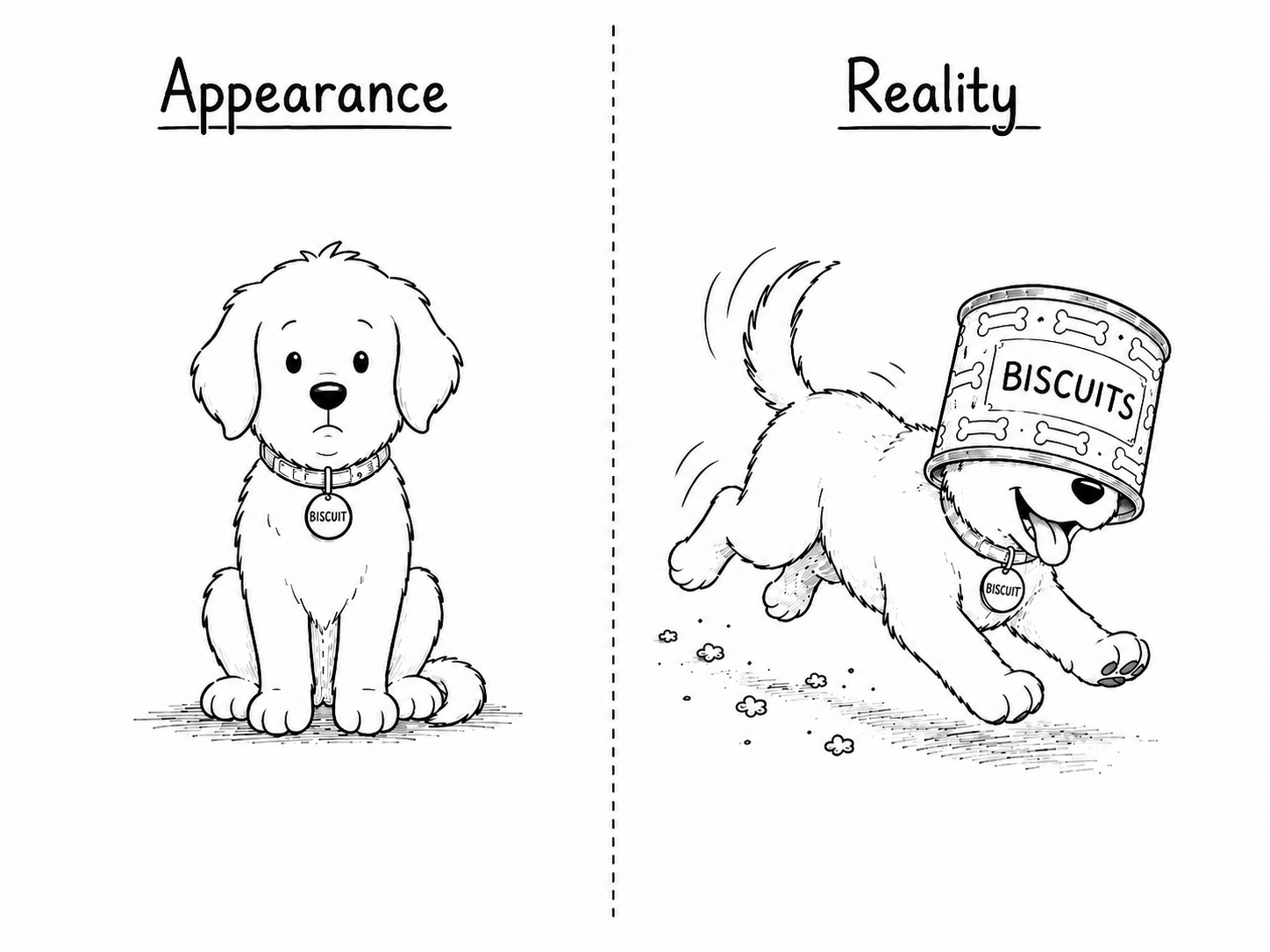
Then the real Biscuit arrived, with muddy paws, crumbs on his nose, a label stuck to one ear, and his head in a biscuit tin.
Scarecat Biscuit had the right appearance. The real Biscuit had the behaviour and evidence to match.
It was obvious which one was really Biscuit.
Smudge’s Takeaway
Don’t rely on appearance alone. Check carefully to discover what is really true.
Concept Check
Circle the best answer for each question.
Which sentence best describes appearance and reality thinking?
- Deciding what something is from its appearance alone.
- Checking whether something is really what it appears to be.
- Thinking that everything unusual must be an imposter.
Why can appearance be misleading?
- Because appearances never provide useful clues.
- Because all clues are always fake.
- Because something can look right on the outside but still be something different.
Why is appearance and reality thinking useful?
- It means we never need evidence.
- It helps us check whether something is really what it appears to be.
- It helps us make decisions from appearance alone.
How sure are you?
- I understand it well.
- I mostly understand it.
- I want to read the story again.
Try It
Something just rustled behind the parcel sacks.
A tail appeared first.
Then two white paws.
Then a cat stepped out, stretched, and sat directly on top of the warmest-looking parcel.
“It’s Whiskers,” said Smudge at once.
Zia narrowed her eyes.
“Is it? How do we know it’s not Imposter 2.0?”
“Oh, trust me,” said Smudge. “That is Whiskers!”
Lyra tilted her head.
“Is it, though?”
Can You Help Smudge?
Uh oh.
Looks like we have another disagreement.
Can you help Smudge settle it?
Is this really Whiskers, or an imposter pretending to be Whiskers?
Look carefully at the clues.
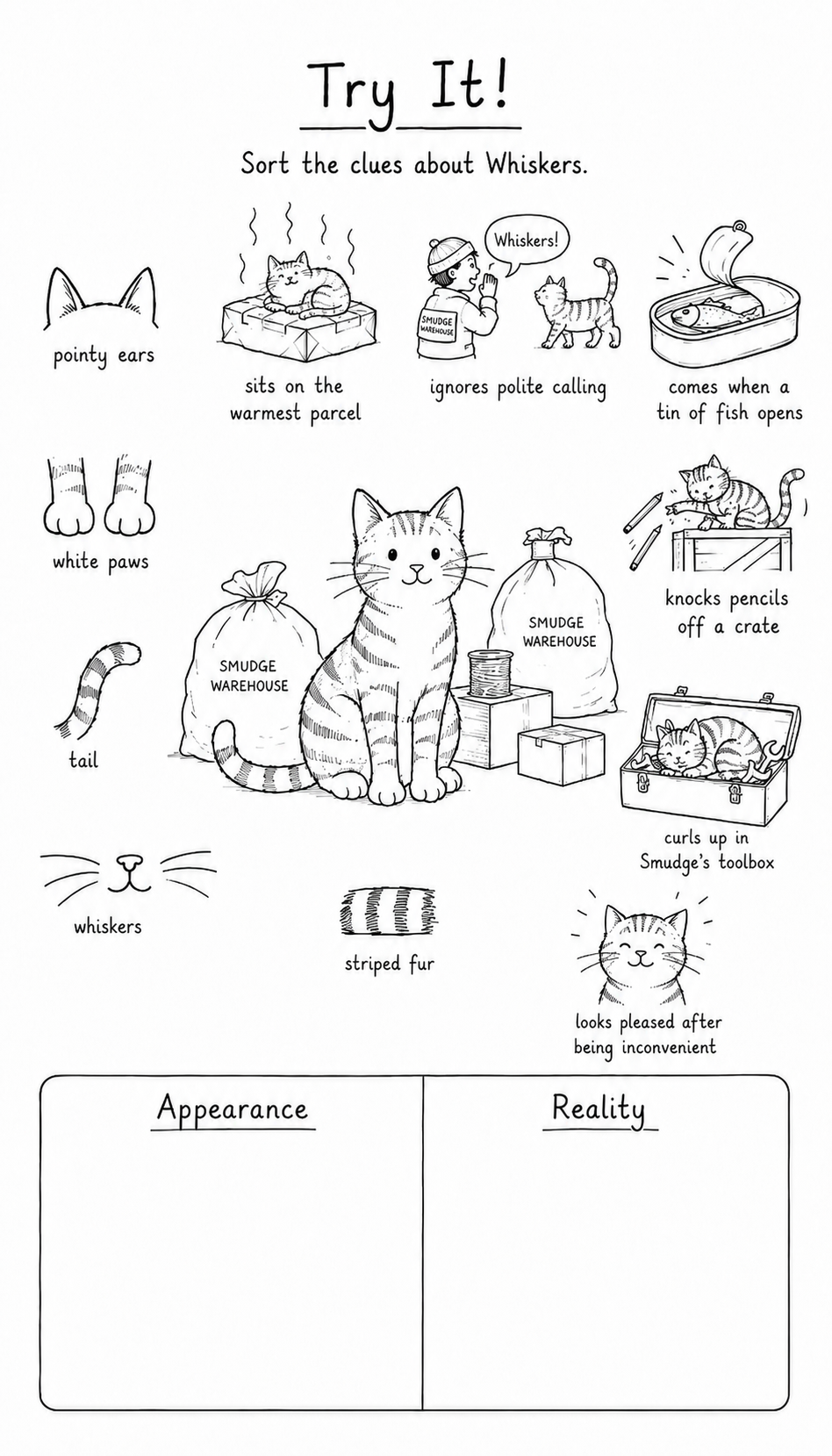
Some are appearance clues. They show what the cat looks like on the outside.
Some are evidence clues. They show how the cat behaves and whether the evidence matches what we know about Whiskers.
Sort the clues into the right groups.
Then decide:
Is this really Whiskers?
YES / NO / NOT SURE YET
Your Grid Fragment
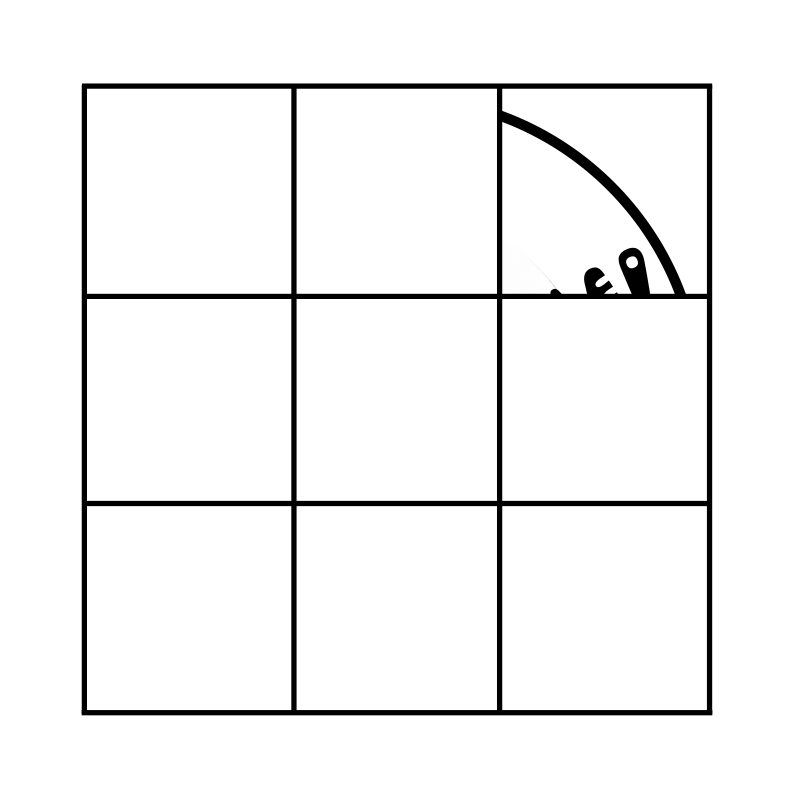
That’s the Biscuit Imposter job complete. The clues have been checked, the real Biscuit has been found, and any suspicious imposters have hopefully been asked some very polite questions.
Now you’re ready to collect your fragment and add it to your grid.
- Do you know what it is yet?
- Can you guess what it might become?
- What makes you think that?
Choose Next Story
Where Next?
Anywhere you like! Choose your next story from the grid.
Finished all nine warehouse jobs? Then you’re ready for The Symbol chapter.
Buzz
Inventory Note
Clues clashing is a clue too.
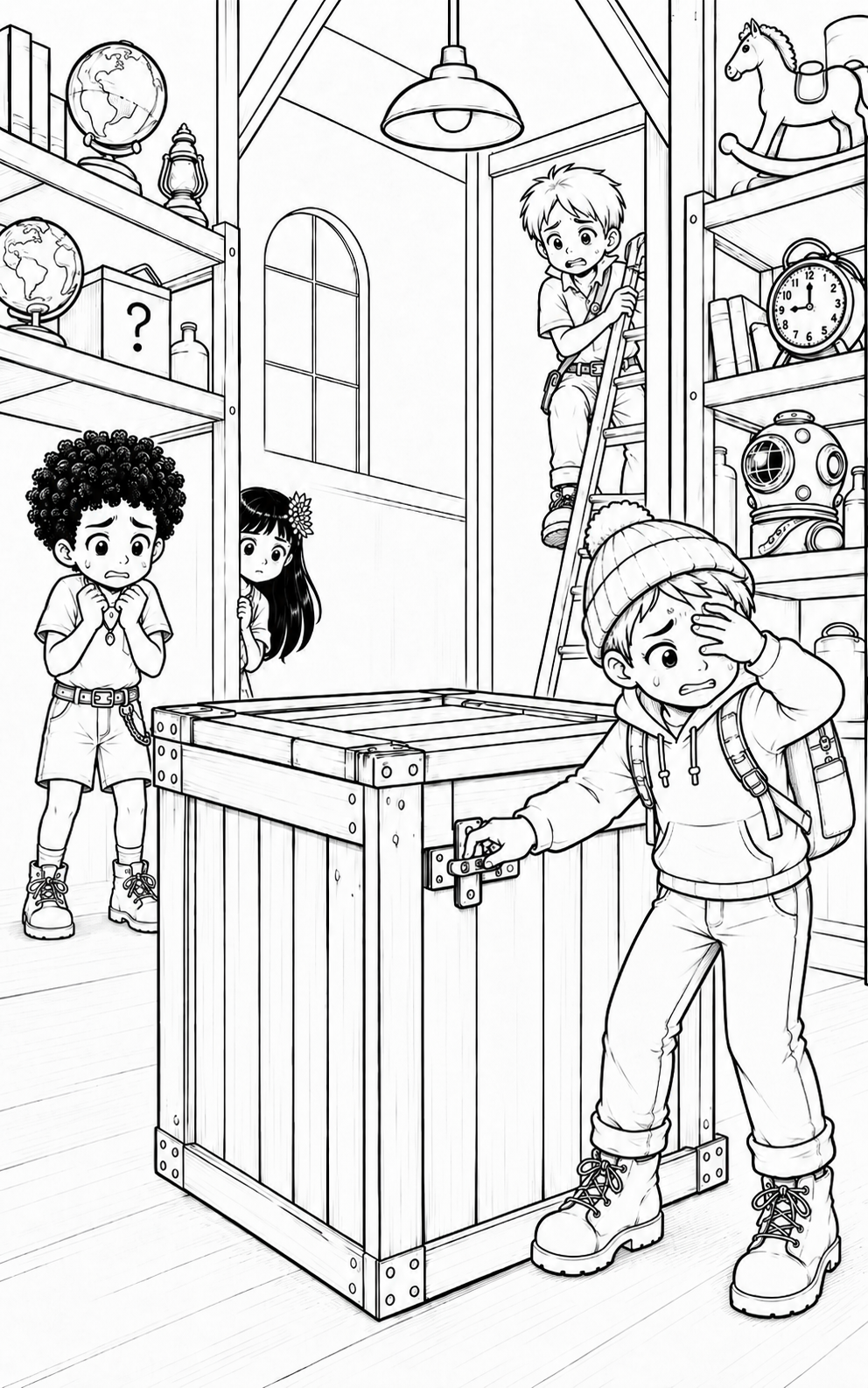
Lyra, Orin, Zia, and Smudge arrived at one of the dustier corners of the warehouse. This was saying something, because the whole warehouse was dusty.
There was ordinary dust, old dust, mysterious dust, and the sort of dust that was waiting for a smiley face to be drawn in it.
Between two towering shelves sat a large wooden crate. It looked as though it had been left there a very long time ago. Possibly for a reason. Possibly for several reasons. Either way, nobody seemed to have come back for it.
Until now.
“Oh, it’s mine,” declared Smudge immediately. “Definitely mine.”
“How do you know that?” asked Lyra.
Smudge pointed at the side of the crate.
Painted there in large, wobbly letters was one very helpful name:
SMUDGE
“That,” said Smudge, “is me.”
There were no arguments about that.
Underneath his name, in smaller writing, it said:
CONTENTS: UNKNOWN
Lyra read it back to herself twice. Then she turned to Smudge.
“Unknown?” she asked.
“Unknown,” replied Smudge proudly.
“You don’t know what’s in it?” asked Zia.
“Not immediately,” said Smudge, which actually meant not at all.
This did tell them one thing, though.
Do not open it.
Instead, they began walking slowly around the crate, looking for clues.
One side had been patched with a bit of metal.
Another side had been patched with a square brown object. Everyone silently agreed not to ask. It may have been toast.
Upon closer inspection, there was also a handwritten note on the front of the crate. It was yellowed with age and stuck down with far more tape than any note should reasonably need.
Lyra leaned closer and read it aloud.
DEFINITELY NOT BEES
Everyone stared at the note.
Then everyone stared at Smudge.
Then everyone stared at the note again, just in case it had decided to explain itself.
It had not.
“Why does it say that?” asked Zia.
Smudge thought carefully.
“I don’t remember.”
“Did you write it?” asked Orin.
“Almost certainly,” said Smudge.
“How do you know?” asked Lyra.
Smudge pointed to the bottom corner of the note.
There, in faded pencil, was a little drawing of a serious face wearing a hat.
“That,” said Smudge, “is Serious Man.”
Orin leaned closer.
“Serious Man?”
“Serious Man. I only use Serious Man,” said Smudge, “when something is serious.”
Nobody could really argue with that either.
So, for a moment, they all stood there, considering the serious little face in the serious little hat.
Then the crate buzzed.
Everyone froze.
The crate buzzed again.
Orin took one small step backwards.
“That sounded an awful lot like bees.”
Smudge shook his head.
“Impossible.”
“Why?” asked Lyra.
Smudge pointed at the note.
“The note clearly says definitely not bees.”
The crate buzzed again. Louder this time.
When a mysterious crate buzzes in a dusty warehouse, the natural response is usually to leave the warehouse immediately and possibly move house.
But not Lyra, Orin, Zia, and Smudge.
Oh no.
They were professional warehouse inspectors, and professional warehouse inspectors took their work very seriously.
Even under threat of…
Lyra glanced at the note.
Well.
Definitely not bees.
Instead, they began examining the crate properly.
“Any clues?” asked Lyra.
Zia crouched beside one of the crates and pointed to a neat row of tiny holes drilled into the wood.
“Tiny holes. Possibly air holes.”
Lyra took out a pencil and wrote it down.
Orin ran the end of his pencil along the edge of the lid. When he lifted it, the pencil was sticky and golden.
“Honey?” he said, looking slightly upset that his pencil was now involved.
Zia leaned closer, sniffed it, and made the sort of face usually reserved for old socks and bad decisions.
“Definitely not real honey,” she said.
Lyra wrote that down too. Then she knelt on the floor and studied the dust. “Tiny footprints.”
Smudge blinked. “Footprints?”
“Tiny ones.”
“How tiny?”
Lyra leaned closer.
“Bee tiny.”
The crate buzzed again.
Zia edged around the back of the crate, crouched down, then dropped onto her stomach to peer underneath. “Found something,” she called out in a muffled voice from behind the crate.
A moment later, she wriggled backwards holding an old delivery form between two fingers. Most of the writing had faded, but a few words could still be read.
HANDLE WITH CARE
BUZZING IS NORMAL
Lyra added both lines to the list.
Smudge inspected the delivery form.
“Hmm.”
The crate buzzed again.
Smudge inspected it even harder.
“Hmmm.”
The others waited.
Smudge tapped his chin with one finger.
“HMMMM.”
“Smudge?” asked Lyra.
“Yes?”
“I think we’re all thinking the same thing.”
“That the crate contains a collection of tiny musical instruments?”
“No.”
“Oh.”
Lyra held up the list. “Let’s read this back, shall we?”
“Air holes.”
“Sticky stuff.”
“Tiny footprints,” added Zia.
“Buzzing,” continued Lyra.
“Buzzing is normal,” added Orin, pointing to the delivery form.
Orin folded his arms. “It’s bees.”
Zia nodded. “It’s definitely bees.”
Lyra looked at Smudge again.
“It is very difficult to see how this is not bees.”
Smudge folded his arms.
“Ah,” said Smudge. “Because you are forgetting one very important thing.”
“What?” asked Lyra.
Smudge pointed at the note.
DEFINITELY NOT BEES
“Smudge,” said Zia carefully, “everything here says bees.”
Smudge pointed at Serious Man.
It appeared to be a stand-off.
Smudge and Serious Man on one side.
The bee evidence on the other.
The trio looked at one another. Then they looked at the crate.
“Well,” said Zia, “you won’t mind opening it then, will you?”
Smudge looked ever so slightly less confident.
“Open it?” asked Smudge, taking a step back.
“Open it,” said Lyra.
Smudge had a choice to make. He could admit that the crate might actually contain bees, or he could open it and prove that it did not.
Smudge looked at the note.
He looked at Serious Man.
Serious Man looked back with calm certainty.
Smudge believed in Serious Man. It definitely was not bees.
He stepped up to the crate, released the latch, and flipped open the lid.
Out came a swarm of mechanical bees.
Hundreds of them. Maybe thousands.
Tiny golden bodies. Fluttering wings. A busy, buzzing cloud rising from the crate.
All four warehouse inspectors ran away.
After the kerfuffle had died down, and the Official Warehouse Bee Team had arrived in their thick yellow suits and dealt with the situation, Lyra, Orin, Zia and Smudge returned to the crate.
“I remember now,” said Smudge. “Mechanical bees… That was it.”
The trio stood there covered in tiny mechanical bee stings, looking highly unimpressed with Smudge.
“Definitely not bees, Smudge?” said Lyra.
“They aren’t,” said Smudge.
Orin opened his mouth.
Then closed it again.
Then opened it once more.
“I dislike how technically correct that is,” he said.
Annoyingly, Smudge was right. Even more annoyingly, they had all been right.
The note had been right. The buzzing had been right. The air holes, the tiny footprints, and the not-quite-honey had all been right too.
None of the clues had been wrong.
In fact, they had been extremely clear.
They just needed to put them all together.
Smudge picked up the inventory and completed it smugly.
Crate 48
Owner: Smudge.
Contents: DEFINITELY NOT MECHANICAL BEES.
Official mark: Serious Man.
Mystery: solved.
Looking Back
To work out what was inside the crate, the team had to look carefully at the crate and everything around it.
This is called observation. Observation means looking closely at what is actually there. It means noticing all the details in front of you, rather than choosing one and ignoring the rest.
That was Smudge’s big mistake. He trusted the note too much: DEFINITELY NOT BEES.
And he wasn’t wrong exactly. His understanding was just incomplete.
The others weren’t so easily convinced, because what they observed seemed to say: BEES. They found tiny holes in the wood. Orin found sticky golden stuff near the lid. Lyra spotted tiny footprints in the dust. Zia found an old delivery form that said BUZZING IS NORMAL.
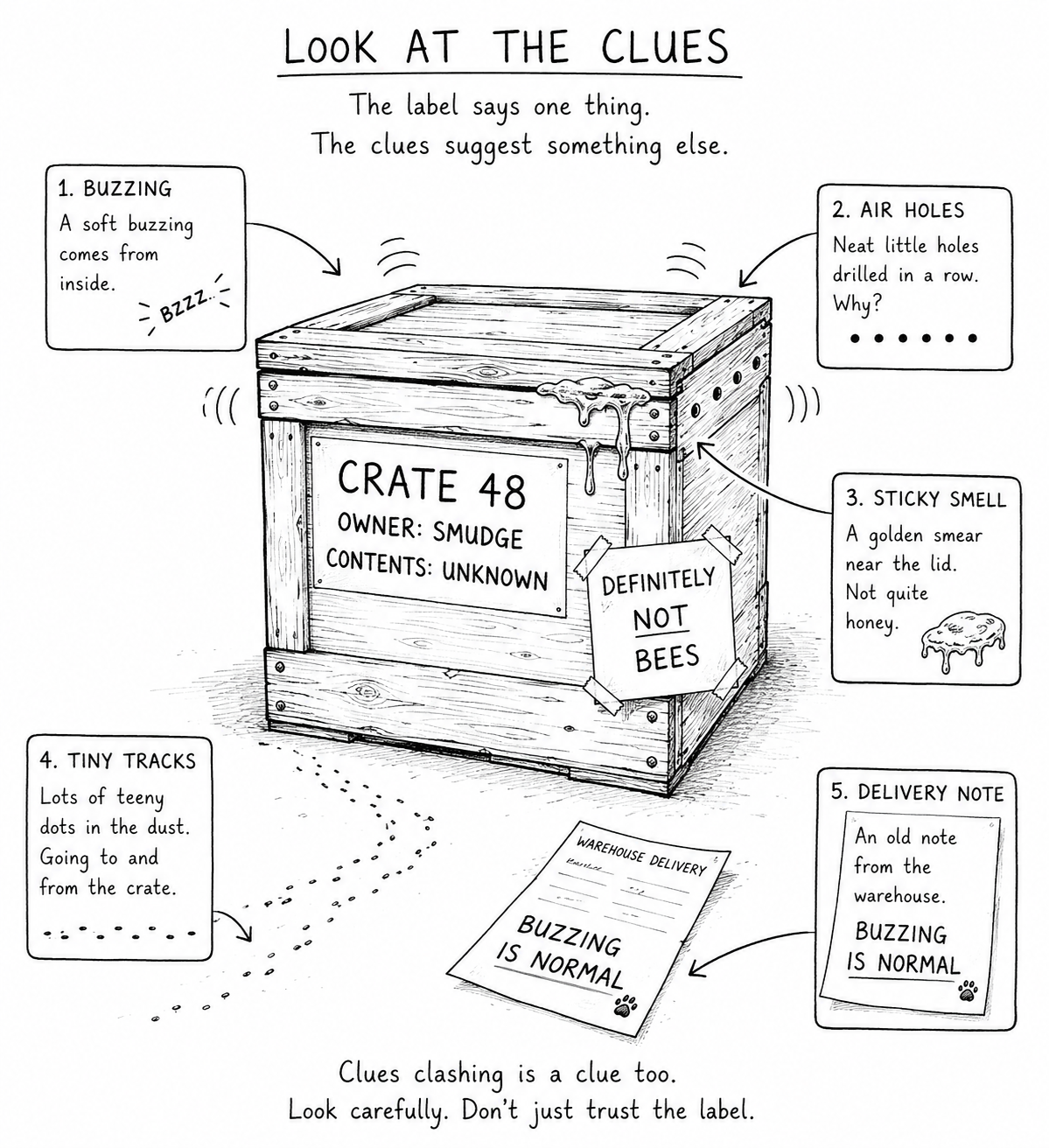
What the note said and what they observed didn’t seem to fit together. When something doesn’t make sense like this, it usually means there’s something you don’t understand yet.
The clues that don’t seem to fit may tell you the most.
In the end, all the clues were true. The crate didn’t contain ordinary bees. It contained mechanical bees. The label was right, and the bee clues were right too.
The clashing clues were pointing to the real answer all along.
Smudge’s Takeaway
Observe everything. Rule out nothing. And remember: clues clashing is a clue too.
Concept Check
Circle the best answer for each question.
Which sentence best describes observation?
- Choosing one clue and ignoring the rest.
- Looking carefully at what is actually there.
- Guessing quickly because guessing is faster.
Why were the clashing clues important?
- They proved the note should be ignored.
- They meant the crate was definitely empty.
- They showed there was something the team did not understand yet.
Why is observation useful?
- It helps us ignore strange details.
- It helps us notice what is really there before deciding.
- It means the first answer is always right.
How sure are you?
- I understand it well.
- I mostly understand it.
- I want to read the story again.
Try It
Another crate has been found in the warehouse. Nobody remembers ordering it. Nobody remembers moving it. And nobody is completely sure why it is making the floorboards feel warm.
Very warm.
On the front of the crate is a large note:
DEFINITELY NOT A BABY DRAGON
Underneath the note is a small official mark:
Serious Man
Smudge folded his arms.
“Well,” he said, “that’s settled then. Totally safe to open.”
Then he paused. He thought about the definitely-not-bees incident.
Smudge scratched his head. “Actually,” he said, “is it?”
Can You Help Smudge?
It looks like Smudge could use some help.
Inspect the crate carefully. Is this definitely definitely not a baby dragon… or is something else going on?
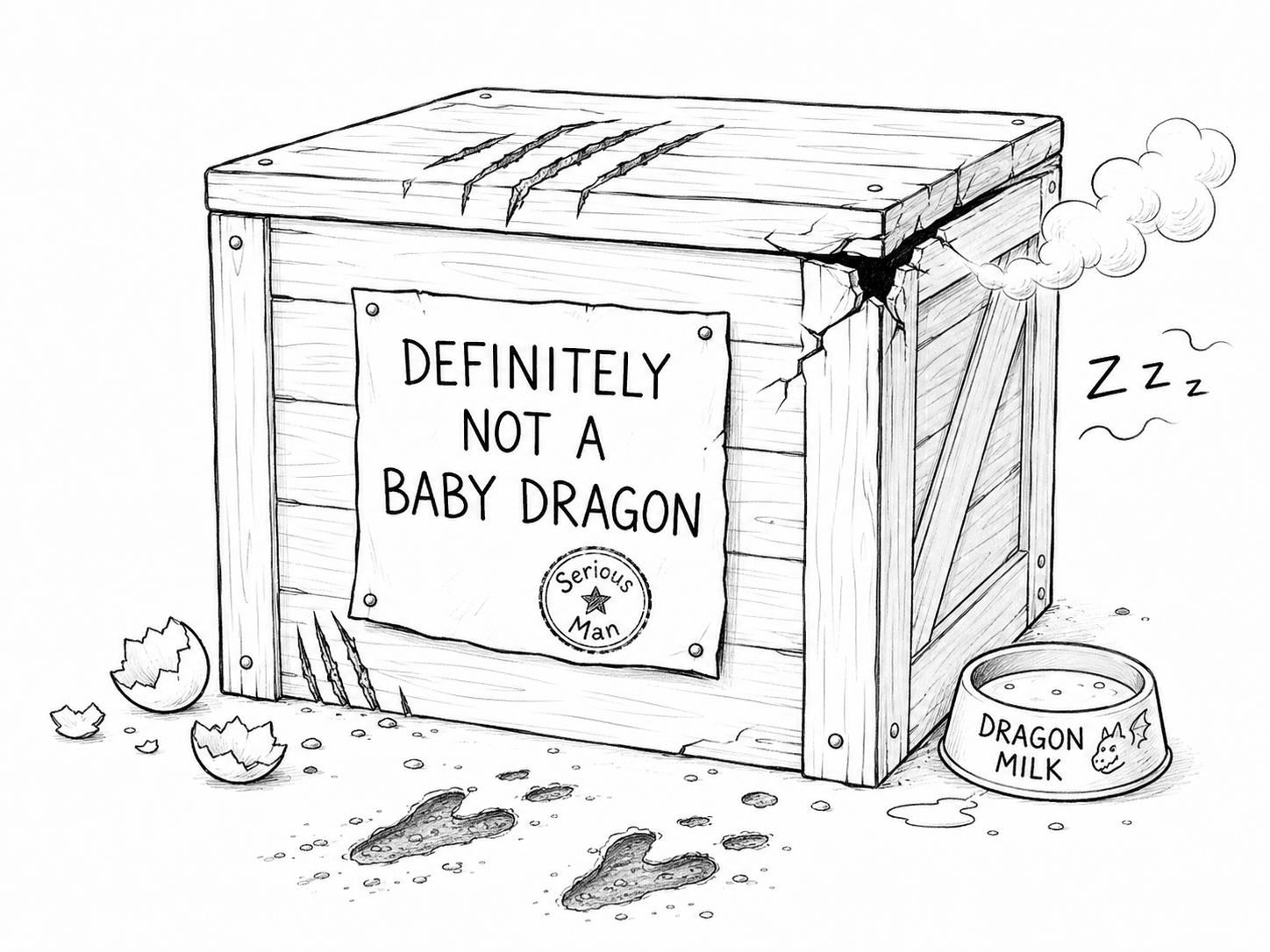
What do you notice?
- There are old eggshell pieces in the dust.
- There is a little bowl labelled DRAGON MILK.
So far, the note seems suspiciously wrong. It is hard to see how this is not a baby dragon.
But wait. There are more clues:
- There are large claw marks on the lid.
- One corner of the crate has cracked open.
- Smoke is puffing through the gap.
- The floor in front of the crate is covered in large footprints.
- Something inside the crate is snoring… long, low snoring.
“Uh oh,” said Smudge. “Clashing clues. I’ve seen this before.”
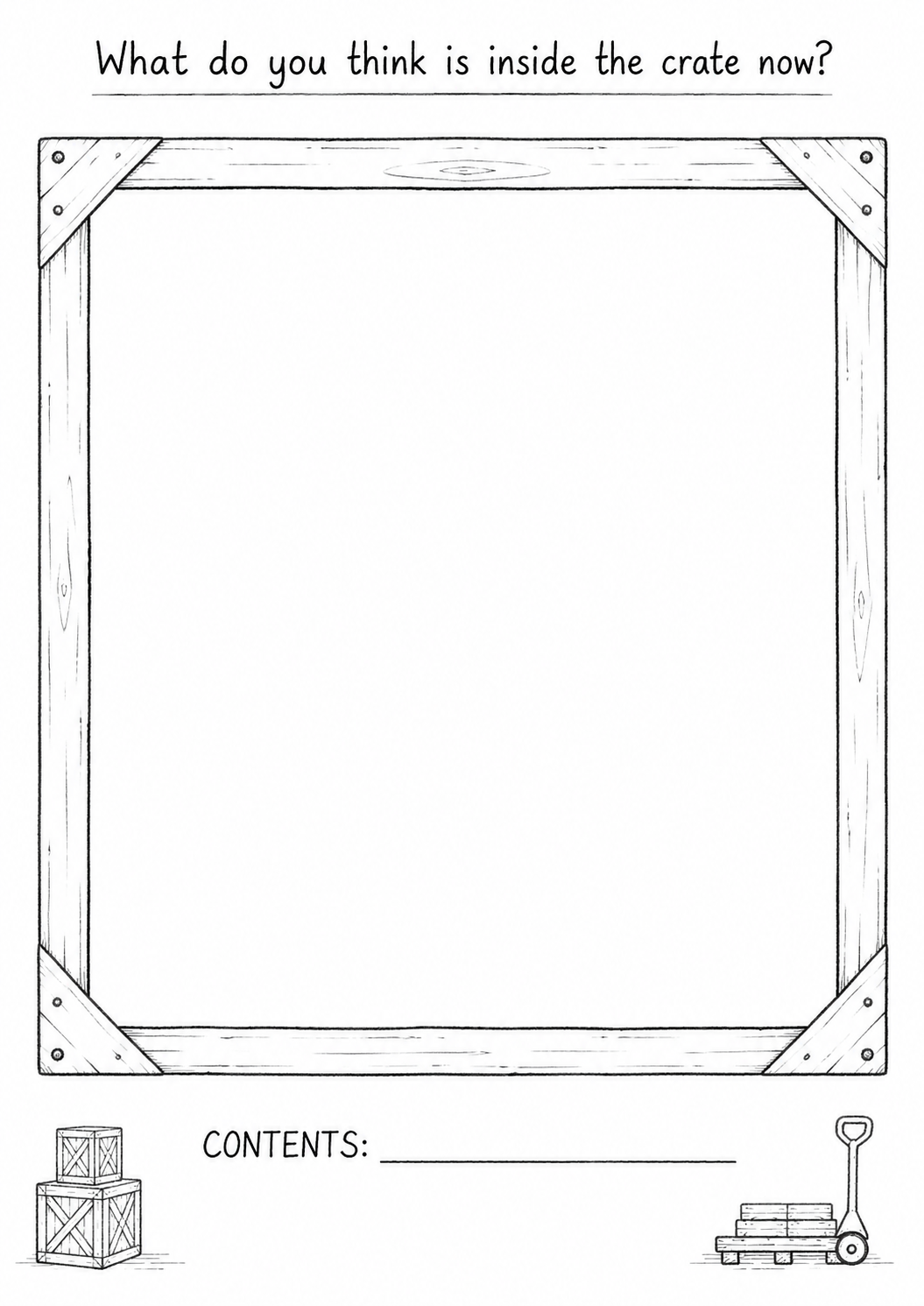
What do you think is really inside the crate?
- Look at the clues again.
- Draw what you think is really inside.
- Label it correctly and accurately.
Your Grid Fragment
That’s the Buzz job complete. The clues have been noticed, the clash has been spotted, and the truth was buzzing there all along.
Now you’re ready to collect your fragment and add it to your grid.
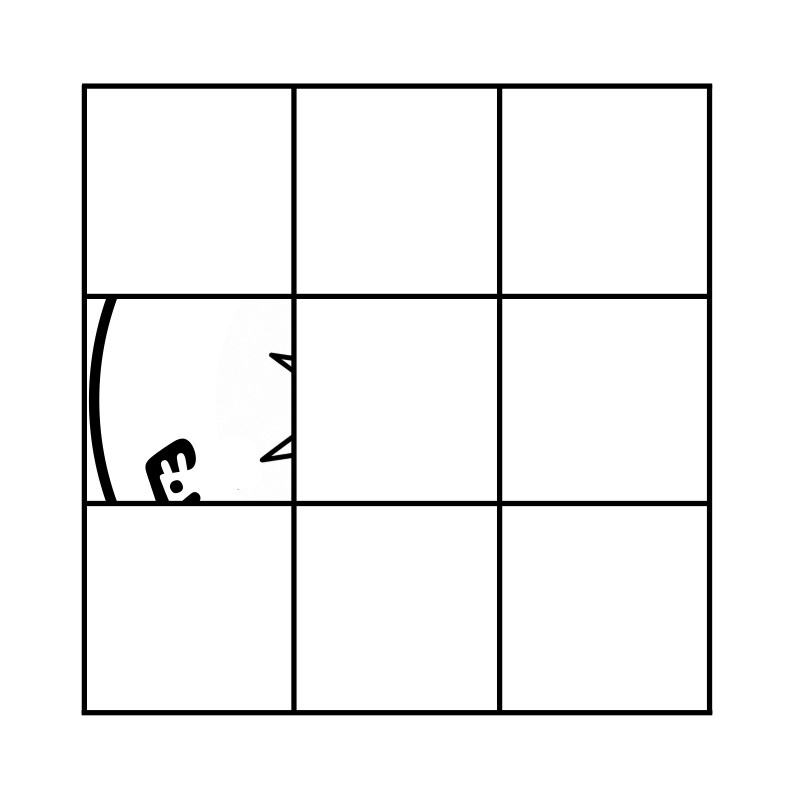
- Do you know what it is yet?
- Can you guess what it might become?
- What makes you think that?
Choose Next Story
Where Next?
Anywhere you like! Choose your next story from the grid.
Finished all nine warehouse jobs? Then you’re ready for The Symbol chapter.
Holey Crates
Inventory Note
Find the cause. Fix the problem.
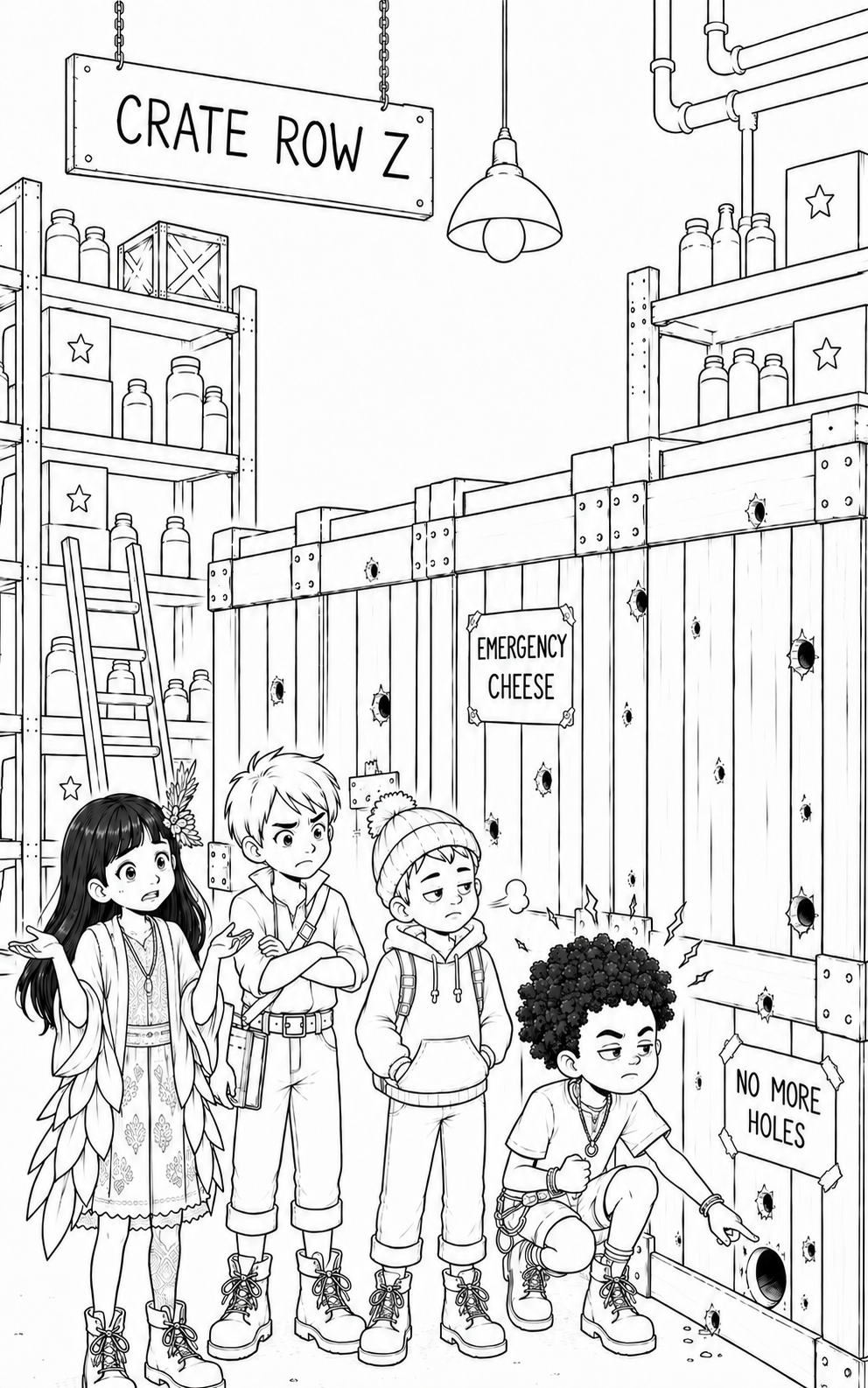
Crate row Z sat near the back of the warehouse. At first, the crates looked fairly ordinary. Some had no labels. Some had faded labels. One had a label that simply said:
YUMMY
Beside the row was a clipboard hanging from a nail. Someone had written in tired handwriting:
(SIGH) HOLES AGAIN
And underneath that, in even more tired handwriting, someone had added:
HELP! HOLES WINNING.
Zia crouched beside the nearest crate. “Here’s one.”
Near the bottom of the crate was a small round hole. Around it lay tiny scraps of wood, as if the crate had been quietly nibbling itself.
Lyra checked the next crate. “This one has one too.”
Orin checked another. “And this one.”
Smudge looked along the whole row. “Holes,” he said. “Lots of them.”
Lyra took a careful breath. “Right. I guess we need hole-fixing stuff then.”
It seemed like a simple enough job, so the team got to work.
Zia found scraps of wood, including one piece that was far too large for the hole but, in her words, “had serious patching energy.”
Orin found nails and immediately began sorting them by size.
Lyra found a pot of thick warehouse glue with a warning label that said:
DO NOT GLUE YOURSELF TO THE PROBLEM
Smudge was more of a tape man. More specifically, he was not allowed near the glue, for reasons best left alone. He had tape in his pocket. Tape in his bag. Tape tucked behind one ear. There was even a small emergency roll of tape hanging from a string around his neck.
Orin stared at it. “Why do you have so much tape?”
“For emergencies,” said Smudge.
“What sort of emergencies?”
Smudge nodded at the holey crates. “Exhibit A.”
“Fair,” Orin replied.
Together, they patched the holes carefully. Zia held each scrap of wood in place while Orin tapped in the nails. Lyra checked that every edge was covered. Smudge added tape over the top, then more tape over the tape, then taped on a small label saying:
HOLE FIXED
After the last hole was patched, Smudge stood back proudly. “Problem solved. Well done us!”
Everyone was extremely satisfied with a job well done.
For the day.
The next morning, the team returned to the same row of crates to check the glue had dried. And, yes. The glue had dried. But alongside the dry glue were more holes!
Lyra stared.
Orin pinched the bridge of his nose.
Zia looked away, as if she needed a moment.
Smudge whispered, “The holes have moved.”
“They have not moved,” said Orin. “These are new ones.”
Smudge looked at Orin suspiciously and counted them to be sure. “Oh no,” he said. “I think you’re right. The holes have friends.”
The new holes were neat and round, just like the old ones. And just as before, tiny scraps of wood lay on the floor beneath them.
“Well,” said Lyra, “we’d better fix these ones then.”
So they did. This time they used thicker wood. Bigger nails. Extra glue. (Not Smudge.)
By lunchtime, every damaged crate had a neat patch, a strong cover, and at least one warning label.
NO MORE HOLES
They left the crates patched, protected, and completely hole-free. Again.
Everyone agreed it was a job well done.
The next morning, the team returned to the same row of crates to check that the glue had dried. And, yes. The glue had dried. But alongside the dry glue and the fixed holes were more holes! A lot more holes.
At this point, somebody made a noise that could only be written down as:
ARRRGHHH
This time there weren’t twice as many holes. There were three times as many holes. And one had appeared directly underneath one of the labels that said:
NO MORE HOLES
Smudge sighed. “That’s just rude.”
Then he looked along the row again. “There’s almost as much hole as crate,” he said. “They’re everywhere.”
Orin stared at the holey mess. “We aren’t fixing the problem,” he said slowly. “We’re decorating it.”
He paused, rubbed his forehead for a moment, then held up both hands. “Right. Stop. Stop. Stop.”
So everyone did. Even Smudge, who had already reached for the tape.
“No more patching,” said Orin.
“Fixing the holes isn’t working,” agreed Zia. “We need to find what’s making them.”
Orin put his hole-fixing stuff to one side and started looking around for clues. That was when he noticed the stamp on the nearest damaged crate.
CHEESE
Zia checked the next damaged crate.
CHEESE
Lyra checked the third.
CHEESE
Smudge checked the last one and read aloud, “EMERGENCY CHEESE.”
Everyone looked at him.
“What?” said Smudge. “Emergencies happen.”
Lyra looked at the crates without holes. One said FAKE CHEESE. Another said MORE FAKE CHEESE. Another said POSSIBLY CATS. None of them had holes.
Now, I don’t like to rush an investigation, but it didn’t take a genius to work out why the holes kept appearing.
Smudge blinked. “Is the cheese trying to escape?”
“No, Smudge. It’s not the cheese trying to escape,” said Orin.
“We don’t know that,” said Smudge.
“We do know that.”
“Where’s the proof?”
Orin decided not to continue arguing with Smudge and let the situation speak for itself. This was often wise.
Zia crouched beside the crates again. Now that they had stopped patching and started looking, she noticed more. The damaged crates were all beside the same wall. The holes were all low down. The edges of the holes were not cracked like broken wood. They were marked with tiny little teeth marks.
Lyra touched the floor beneath the crate. “There are cheese crumbs too.”
Smudge gasped. “Cheese crumbs.” Then, very slowly, he pointed at Orin. “I told you the cheese was escaping.”
Before Orin could answer, a faint sound came from behind the crates.
Scratch scratch scratch.
Everyone froze.
Scratch scratch scratch.
Lyra crouched beside the crates and peered into a gap near the wall. At first she saw only darkness. Then she saw a tiny nose. Then two whiskers. Then a mouse.
The mouse looked at Lyra.
Lyra looked at the mouse.
“What can you see?” whispered Smudge.
“A mouse,” whispered Lyra.
Smudge’s eyes widened. You could see his brain working in overdrive. Nobody spoke for a moment. Even the mouse seemed to be waiting for Smudge to catch up.
“Maybe it’s the mouse!” Smudge said finally.
“Yes, Smudge,” said Lyra. “Maybe it’s the mouse.”
Smudge nodded. “You’re welcome.”
This time, they didn’t reach for the tape, patches or glue. Not at first, anyway.
They put the cheese in mouse-proof boxes with proper lids. They moved the boxes away from the wall and onto a higher shelf. Zia placed a tiny dish of mouse food in a safer corner, well away from the inventory.
“There,” she said. “Snacks without crime.”
Smudge helped. He added a small sign beside it.
MOUSE SNACKS
Everyone looked at the sign. Then everyone looked at the mouse. The mouse looked at the snacks. This seemed fair to everyone.
The next morning, the team returned to the crates.
Smudge inspected the row carefully. No new holes. The patches were still patched. The cheese crates were still crate-shaped, and the cheese had not escaped. Smudge checked the row once more, just to be sure. Then he checked it again, because sure was good, but surer was better.
“Success,” Smudge declared finally.
Lyra nodded and completed the inventory sheet carefully:
Crate row Z
Issue: holes forever.
Status: fixed (hopefully).
Looking Back
Sometimes a problem keeps coming back because we only fix what we can see. To fix something properly, we need to ask what is making the problem happen in the first place.
That kind of thinking is called cause and effect. The effect is what happens. The cause is what makes it happen.
It means asking:
- What is happening?
- Why is it happening?
- What can we change to fix things?
In this story, the team found holes in the crates, so they fixed them. Then more holes appeared, so they fixed those too. Then even more holes appeared. But the holes weren’t appearing by themselves. Something was causing them.
The holes were the effect. The mouse, the cheese, and the crates by the wall were all part of the cause.
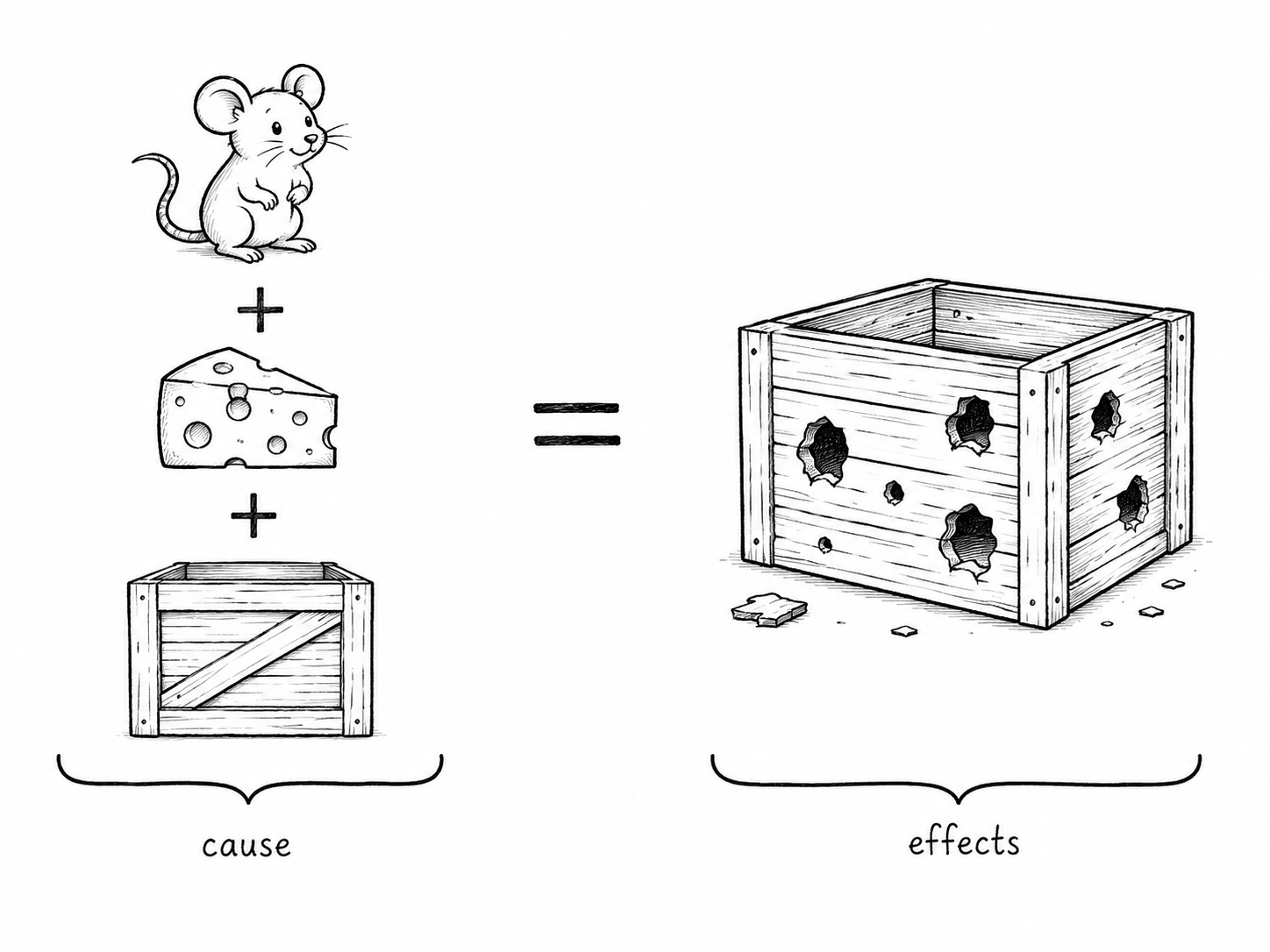
Patching the holes helped for a little while, but it didn’t stop the thing that was making them happen. Once the team understood the cause, they could make a better fix. They moved the cheese, used stronger boxes, and gave the mouse a better snack place.
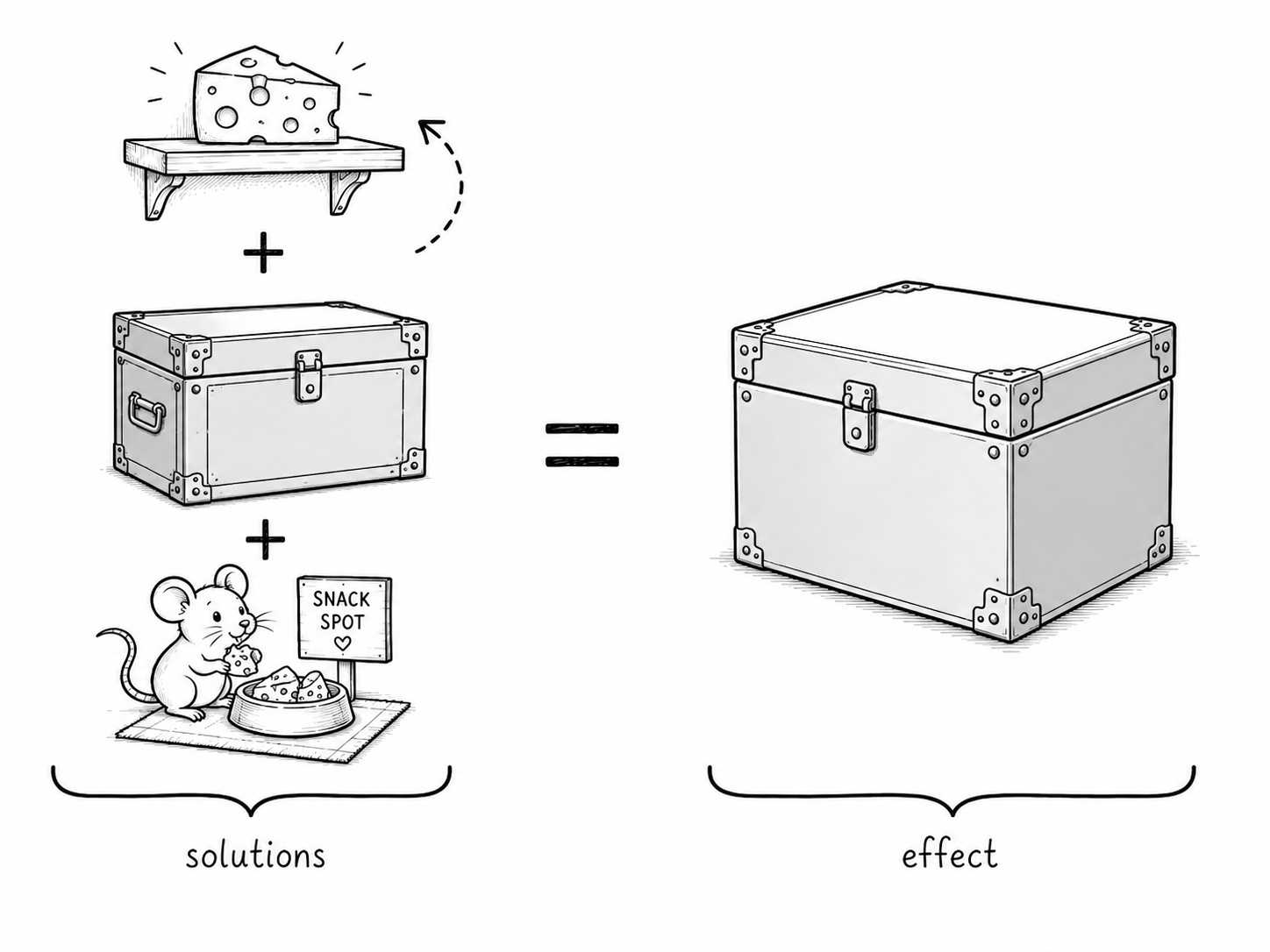
And with the cause fixed, all that remained was one happy mouse, hole-free crates, and four considerably less frustrated hole fixers.
Smudge’s Takeaway
When a problem keeps coming back, look for the cause.
Concept Check
Circle the best answer for each question.
Which sentence best describes cause and effect thinking?
- Fixing what you can see without asking why.
- Looking for what is making a problem happen.
- Blaming the nearest crate.
Why didn’t patching the holes fix the real problem?
- Because the patches were too tidy.
- Because the team had not stopped what was causing the holes.
- Because the holes were moving around by themselves.
Why is cause and effect thinking useful?
- It helps us fix the real problem, not just what we can see.
- It makes problems come back again.
- It means every problem needs more tape.
How sure are you?
- I understand it well.
- I mostly understand it.
- I want to read the story again.
Try It
Smudge has a problem. Actually, Smudge has a list of problems. A very long list.
“I have fixed these at least a thousand times,” he said to himself.
The same shelf keeps getting messy. The same labels keep falling off. The same parcels keep rolling away. The same cupboard keeps opening. The same boxes keep leaning.
Smudge narrowed his eyes. “Maybe I need to find out why.”
Can You Help Smudge?
Choose one problem from Smudge’s list or a repeating problem of your own.
In the following space, show two things:
- The cause: What is making it happen?
- The effect: What happens because of it?
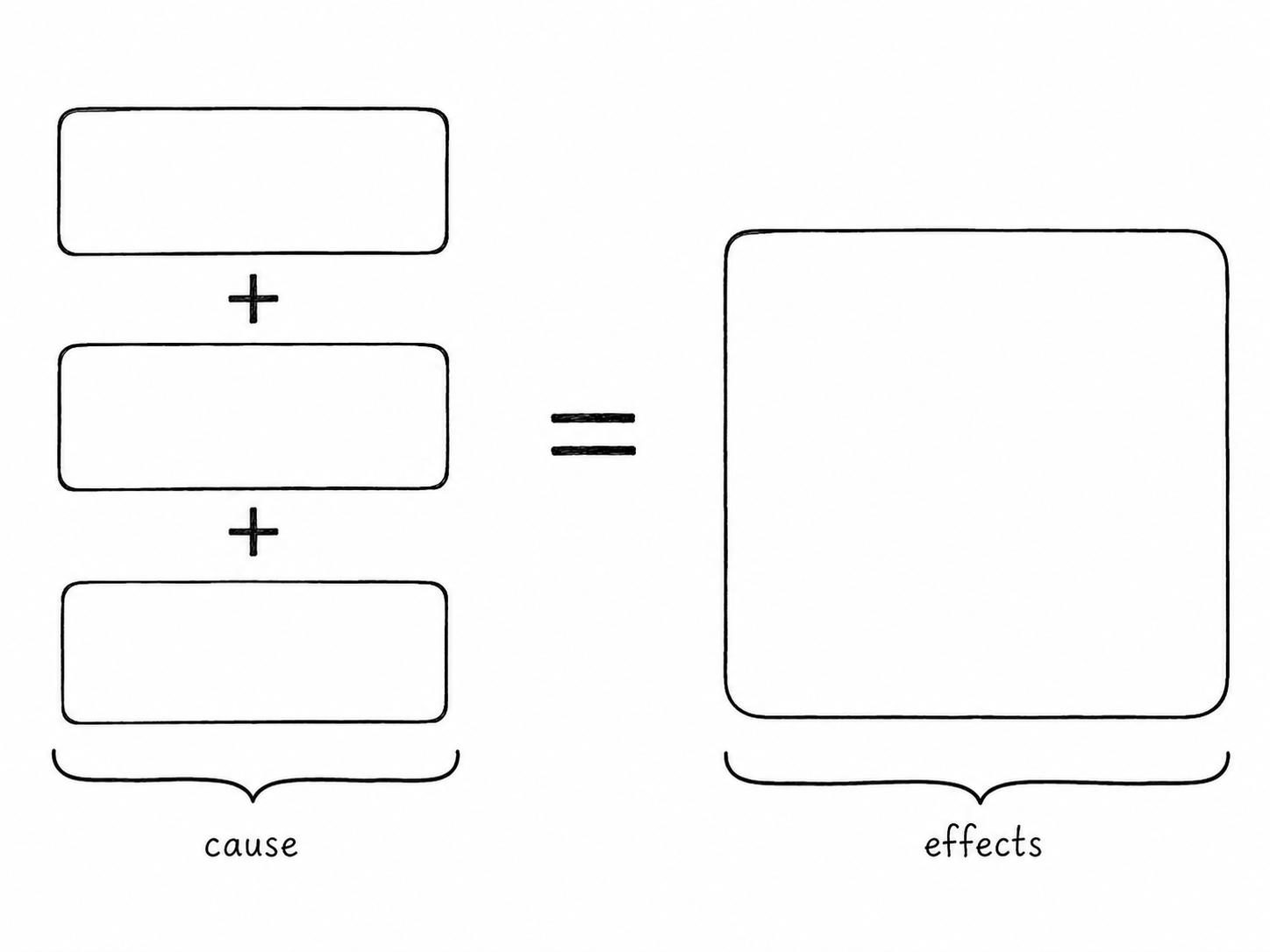
Now look at the cause you found.
What would fix the real problem?
Maybe something needs to be moved, changed, strengthened, labelled, cleaned, repaired, explained, protected, organised, closed, opened, or put somewhere else.
Draw or write your fix for the problem in the following space.
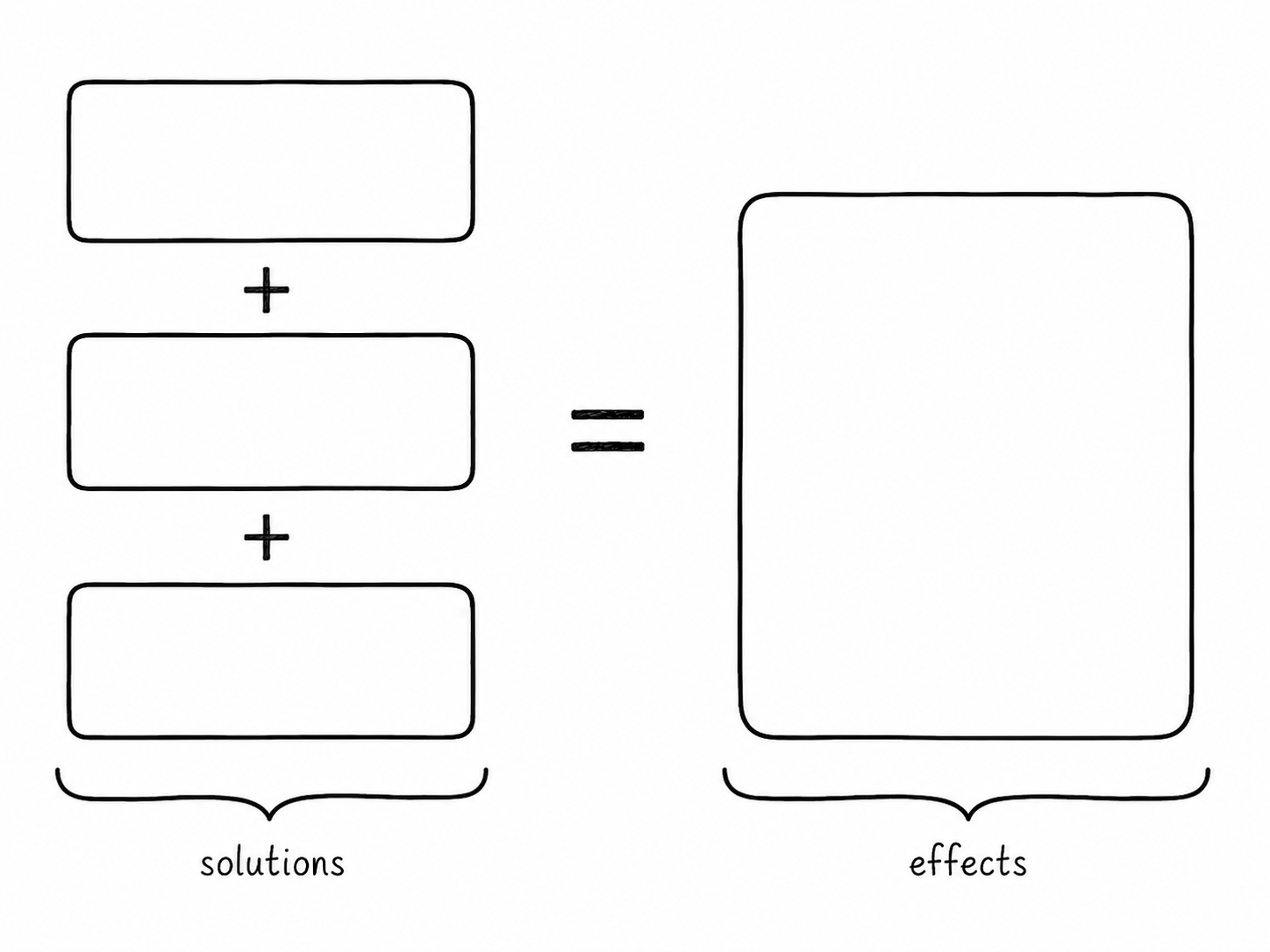
Your Grid Fragment
That’s the Holey Crates job complete. The holes have been noticed, the cause has been found, and the mouse has been redirected to a more suitable snack area.
Now you’re ready to collect your fragment and add it to your grid.
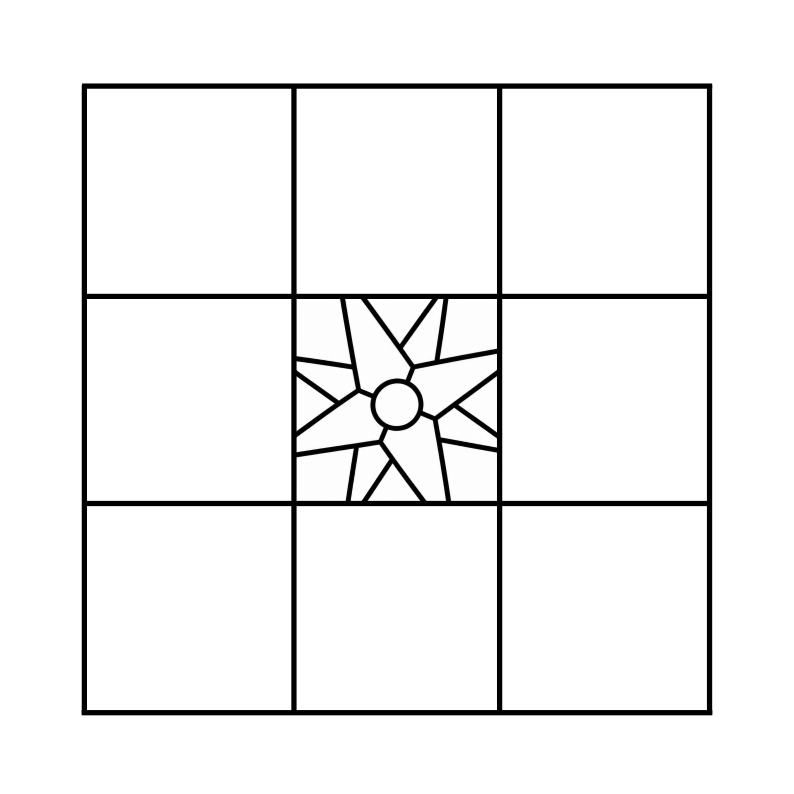
- Do you know what it is yet?
- Can you guess what it might become?
- What makes you think that?
Choose Next Story
Where Next?
Anywhere you like! Choose your next story from the grid.
Finished all nine warehouse jobs? Then you’re ready for The Symbol chapter.
Sweetie Jar
Inventory Note
The exact answer isn’t always the best answer.
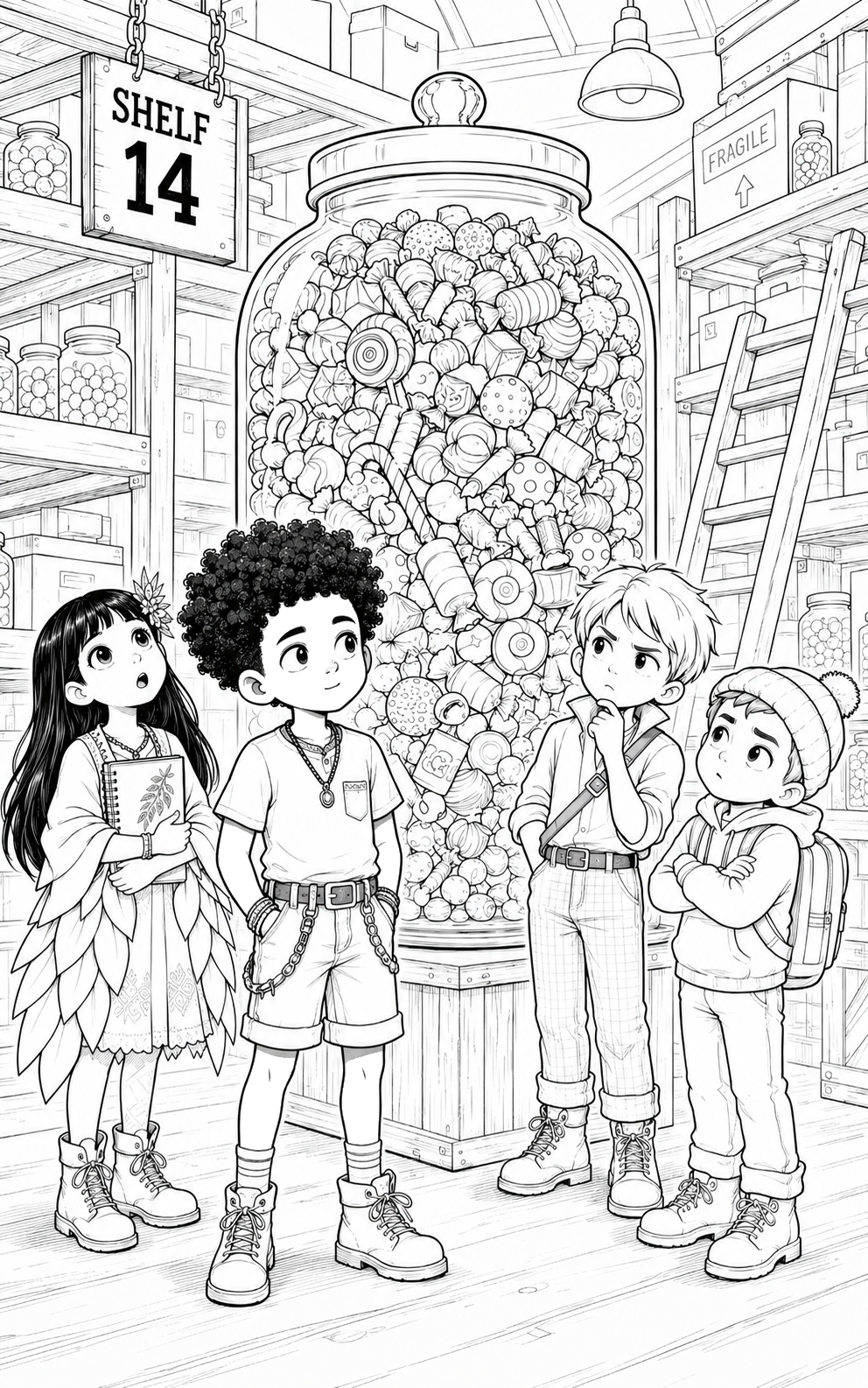
The inventory sheet for this task was surprisingly short.
It simply said:
Jar 14
Count the sweeties.
“That sounds easy,” said Lyra.
“Too easy,” said Orin, raising an eyebrow.
Too easy usually meant trouble.
Regardless, Zia led the way and followed the inventory map until they reached Zone F. Sitting on its own special shelf was a giant glass jar.
And by giant, I mean giant. It was even taller than Zia.
Inside were hundreds and hundreds of brightly coloured sweeties: red sweeties, blue sweeties, green sweeties, yellow sweeties, stripy sweeties, and swirly sweeties.
Lyra stared at the jar.
“Oh boy,” she said. “Not that easy then. How many do you think there are?”
Zia pressed her face close to the glass and squinted. “At a guess, I’d say about three hundred and fifty.”
Orin looked personally offended by the word guess.
“More than that,” he said. “Based on my careful observations, there are at least four hundred.”
Lyra tilted her head, looking from the top of the jar to the bottom. “I’d say… maybe three hundred and eighty.”
Smudge appeared beside them.
“Three.”
The trio looked at him.
“Three?” asked Lyra.
“Possibly four,” said Smudge.
He was holding a handful of sweeties.
“Please put those back,” said Orin.
Smudge looked disappointed. Then the sweeties disappeared into his pocket.
“Inventory reasons,” said Smudge.
Wasting no more time, the trio began counting. Unfortunately, counting hundreds of sweeties inside a giant jar turned out to be much harder than it sounded.
The sweeties were all stacked on top of each other. Some were hiding at the bottom. Some were pressed against the glass. Some looked like two sweeties but were actually one very lumpy sweetie. Some looked like one sweetie but were actually many.
Lyra counted first.
“Three hundred and eighty-two,” she said.
Orin went second.
“Three hundred and seventy-four,” he said.
Zia went last.
“Three hundred and seventy-five,” she said.
“Interesting,” said Orin. “How can they all be different?”
“Maybe we made mistakes,” suggested Lyra.
And so they counted again.
Lyra counted three hundred and seventy-two.
Orin counted three hundred and seventy-one.
Zia counted three hundred and seventy-six.
“That’s odd,” said Lyra.
“Very odd,” agreed Zia.
There was silence for a moment as they pondered the situation—a silence which was broken by the sound of loud chewing.
Everyone turned.
Smudge was standing beside the jar, chewing slowly and rather suspiciously. Even more suspiciously, he had his hand in the jar.
“What?” asked Smudge.
“Are you eating the inventory?” asked Orin.
Smudge thought about this.
“Define inventory,” he said.
“The sweeties,” said Orin.
Smudge swallowed.
“Honestly, this is not how it looks,” said Smudge.
Except it was exactly how it looked.
The trio looked at the jar. Then at Smudge. Then at the jar again.
Zia sighed. “We’re never going to get the same answer, are we?”
“Nope,” said Orin. “Not with Sweetie Man around.”
Smudge looked as if he had suddenly become very interested in the ceiling.
The trio thought about this for a while. Even if they counted perfectly, the answer might not stay true for very long. Not even by the time they wrote it down.
“What do we do then?” asked Lyra.
“How about this?” said Zia. “We make our best estimate and put that on the inventory sheet.”
Orin gasped and looked up sharply.
“An estimate? On an inventory sheet?”
Smudge looked from Zia to Orin.
“What’s an estimate?” he asked.
“It’s a sensible almost-answer,” said Zia. “Not just a wild guess. You use what you know and get as close as you can.”
Orin looked at the jar. Then at Smudge.
“I dislike this, but I think you might be right,” he said.
They looked at their numbers. Some were higher. Some were lower. None of them matched exactly, but most of them were around the same place. Sort of.
“Three hundred and eighty-two, three hundred and seventy-four, three hundred and seventy-five,” said Lyra.
“Then three hundred and seventy-two, three hundred and seventy-one, and three hundred and seventy-six,” said Orin.
He tapped his pencil against the inventory sheet. “They’re mostly around three hundred and seventy-five.”
“So we write about three hundred and seventy-five?” asked Lyra.
“Approximately,” said Zia.
Orin wrote:
Jar 14: approximately 375 sweeties.
He was about to write the date, then paused.
“How long will that last, though?”
Everyone looked at the jar.
Then everyone looked at Smudge.
Smudge was holding another sweetie.
“What?” he said. “I can’t help myself, okay?”
“If the number keeps changing,” Orin continued, “then our estimate won’t stay useful forever.”
“That’s very true,” said Lyra.
“I guess it depends how quickly they are disappearing,” said Zia.
The trio looked at Smudge’s hand.
“How many sweeties are in one Smudge handful?” asked Orin.
Smudge looked down.
“Not enough,” he said.
They made him open his hand. There were, indeed, three sweeties in it.
“So one Smudge handful is about three sweeties,” said Lyra.
“Good,” said Orin. “Approximately three sweeties are going missing from the jar every time Smudge goes near it.”
“How often do you go near the jar?” asked Zia.
Smudge thought about this.
“Once a day,” he said.
The trio stared at him.
“Maybe twice,” said Smudge.
The trio kept staring.
“Okay,” said Lyra. “Let’s use three.”
And on that basis, they made their best guess.
If Smudge ate three handfuls a day, that would be about nine sweeties gone each day. In one week, that would be about sixty-three sweeties.
“So next week,” said Lyra, “there might be about three hundred and twelve sweeties left.”
“Next month?” asked Zia.
“One hundred and five,” Orin said immediately.
Zia and Lyra looked at Orin in slight amazement.
Orin shrugged. “I like maths.”
“Next year?” asked Lyra.
“Almost certainly none,” said Orin.
“Maybe some,” said Zia, “if someone moves the jar.”
“Or hides it,” said Lyra.
“Or locks it in a cupboard,” said Orin.
Smudge looked offended.
“I think you’re underestimating my self-control.”
At that exact moment, he ate another sweetie.
“We’ll assume none,” said Lyra.
“Definitely none,” agreed Orin.
With a firm nod, he completed the inventory sheet:
Jar 14
Current estimate: approximately 375 sweeties.
Warning: estimate changes over time.
Assumption: one Smudge = about 9 sweeties per day.
Next week: about 312.
Next month: about 105.
Next year: none, unless drastic anti-Sweetie Man measures are taken.
Behind them, Smudge continued his important inventory work.
Mostly by making sure the sweeties still tasted the same.
Looking Back
In this story, the team had to use approximation.
Approximation means making a careful estimate when an exact answer is hard to find, or when the exact answer will not stay exact for very long.
It is not a wild guess. It is not closing your eyes and saying the first number that falls out of your head. Approximation means using what you know to get close enough for the job.
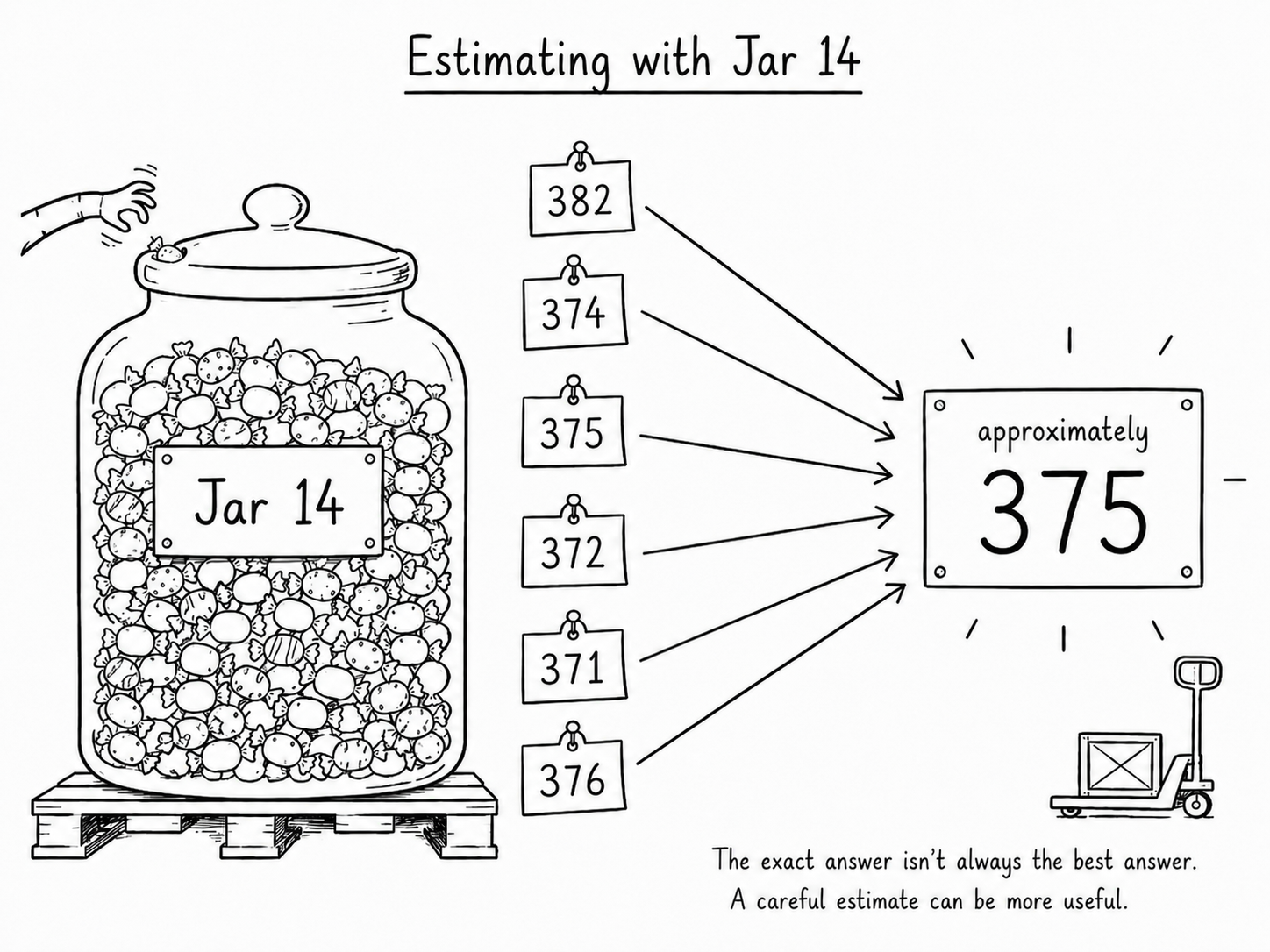
The job looked simple at first. The sweeties in Jar 14 needed counting. That was all.
Unfortunately, Jar 14 was full of hundreds of sweeties, and they weren’t sitting neatly in rows like sensible inventory items.
Some were hiding. Some were squashed together. Some looked like one sweetie. Some looked like two.
And then there was Smudge.
Smudge was making the number change.
The exact answer would only be best if it stayed exact. But when the number is hard to count, or when the number keeps changing, sometimes the best answer isn’t the perfect answer.
Sometimes the best answer is the useful one.
Smudge’s Takeaway
When the exact number is uncertain or changes, make a careful estimate.
Concept Check
Circle the best answer for each question.
Which sentence best describes approximation?
- Making a careful estimate when an exact answer is hard to find.
- Saying any number that pops into your head.
- Counting forever, even when the answer keeps changing.
When is approximation useful?
- When you do not want to think at all.
- When Smudge has hidden the clipboard.
- When the exact number is hard to count or keeps changing.
In which situation would an estimate be most appropriate?
- Working out roughly how many people are in a large crowd.
- Checking that every child has returned from a school trip.
- Entering the correct code to open a locked door.
How sure are you?
- I understand it well.
- I mostly understand it.
- I want to read the story again.
Try It
Uh oh.
Another jar has arrived in the warehouse.
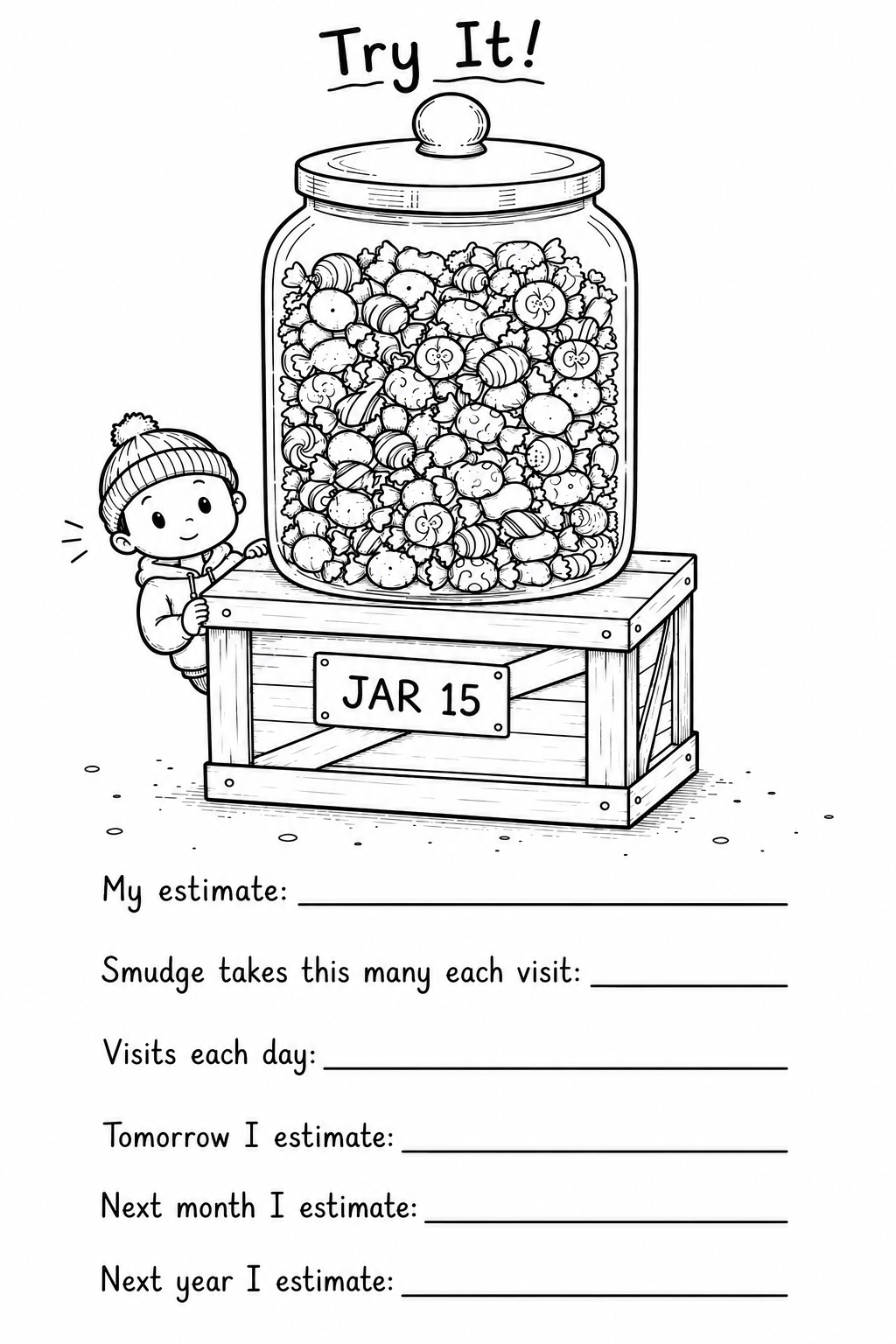
JAR 15
It too is full of sweeties.
Unfortunately, Smudge has noticed. And he is circling the jar.
He says he is “only looking,” but Lyra is not convinced.
Can you estimate how many sweeties are in Jar 15 before they start disappearing?
Look carefully at the jar. Don’t count every sweetie one by one. That would take too long, and Smudge is already getting closer.
Try using a quicker method. You might count one small section, then use that to estimate the whole jar. Or you might look for groups, layers, rows, or patterns that help you make a careful estimate.
Your Grid Fragment
That’s the Sweetie Jar job complete. The exact number may have wriggled around, but the careful estimate did its job.
Now you’re ready to collect your fragment and add it to your grid.

- Do you know what it is yet?
- Can you guess what it might become?
- What makes you think that?
Choose Next Story
Where Next?
Anywhere you like! Choose your next story from the grid.
Finished all nine warehouse jobs? Then you’re ready for The Symbol chapter.
Shelf 27
Inventory Note
A pile is not a plan.
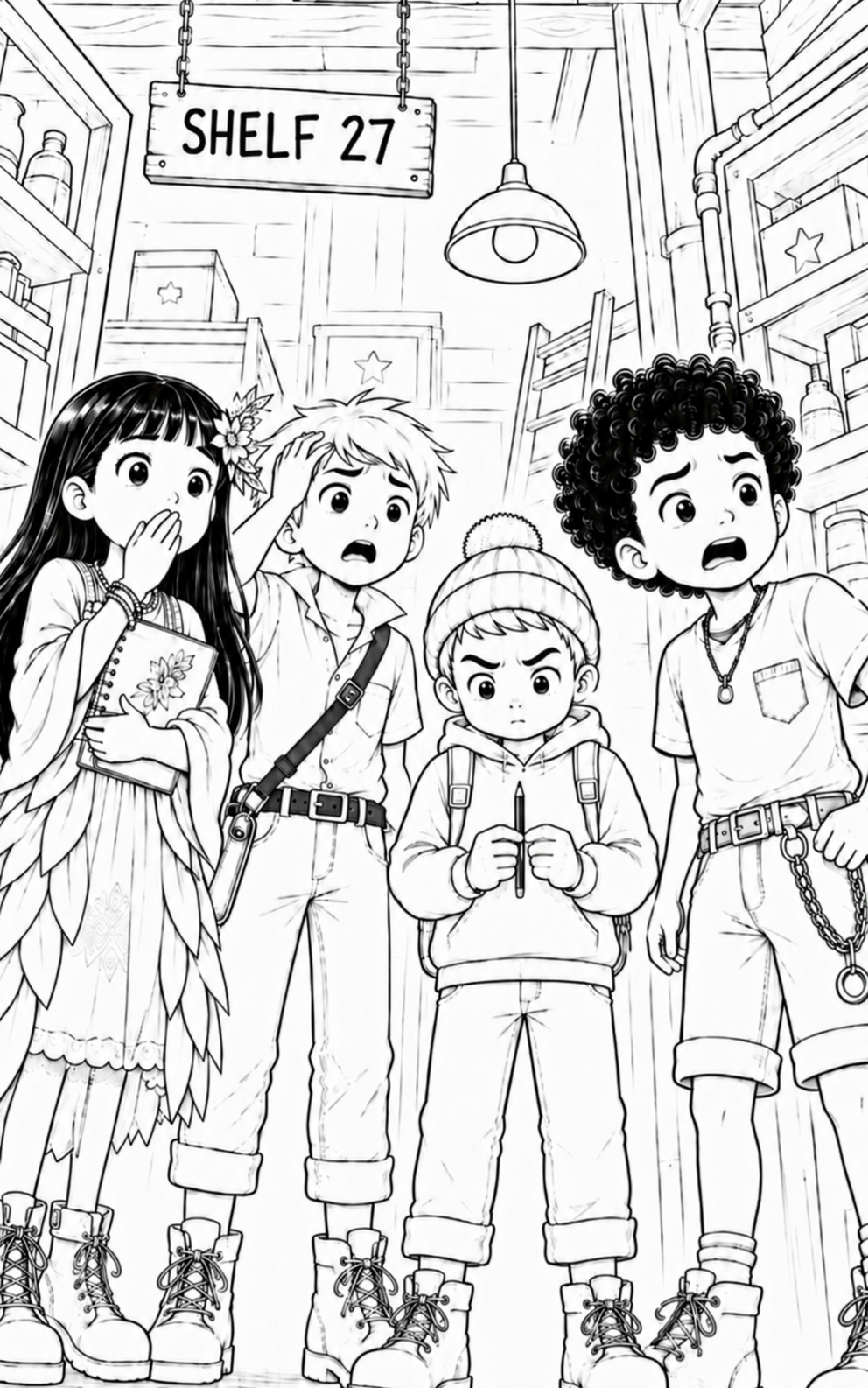
“Right,” said Smudge. “Shelf 27.”
The trio looked at Shelf 27. Then they looked at Smudge. Then they looked back at Shelf 27.
Shelf 27 was a disaster. A rubber duck sat beside a wrench. Three spoons were tangled together with a sock. A banana rested on top of a map. A tiny screw was sitting in the bottom of a teacup. A pencil was balanced on something that might have been a machine part, a hat stand, or a very small chair. And that was only one corner of the shelf.
“According to the inventory note…” said Smudge, “our task is to count everything.”
“Everything?” asked Orin.
“Everything.”
Before Orin had time to object, Zia got to work. She reached for the tangled spoons and the sock tightened around them. The teacup wobbled. The rubber duck tried to escape entirely.
“The shelf is fighting back,” said Zia.
“Please don’t wrestle the shelf,” said Orin. “We are here to count it, not defeat it.”
“One duck,” Lyra called.
“Three spoons,” said Zia.
“One wrench,” added Orin reluctantly.
“Two spoons,” said Smudge.
Everyone stopped. Smudge was proudly holding a spoon in each hand.
“When did you pick those up?” asked Lyra.
“A moment ago.”
“Wait,” said Zia. “Was that two more spoons, or two of my three spoons?”
Smudge shrugged. He seemed to like spoons for some reason.
“Please put them back.”
Smudge returned the spoons.
The counting began again.
“One duck.”
“One wrench.”
“Three spoons.”
“One banana.”
“Two bananas,” said Smudge.
Everyone stopped again. Smudge was now holding two bananas.
“Fine bananas,” he said.
“Smudge, please.”
Smudge returned the bananas.
“Right,” said Orin. “Was that one banana, two bananas, or three bananas?”
No one was sure.
The counting began again. Actually, the counting restarted several more times. That was until Lyra folded her arms in a way that meant the counting was over.
“We can’t count anything if everything keeps moving, disappearing, reappearing, or hiding.”
“Why are you looking at me?” asked Smudge.
Lyra didn’t answer.
Zia looked at the shelf. Then at the objects. Then back at the shelf. “I have an idea,” she declared proudly. “I think Smudge needs a job.”
Smudge stood up straight and puffed out his chest. “At your service.”
After a short discussion, the trio gave him an important job. A very important job. An extremely important job. Possibly the most important job in the warehouse.
“You count the pencil,” said Lyra.
Smudge looked at the pencil. Then at the clipboard. Then back at the pencil. He nodded seriously. “Under control.”
“Just the pencil,” said Orin.
“Do not count the spoons,” said Zia.
“Or the bananas,” said Lyra.
Smudge narrowed his eyes at the pencil. “One,” he whispered.
The trio returned to Shelf 27. For a while, they simply stared at it.
“It isn’t just that there are lots of things,” said Orin. “It’s that everything is mixed together. We are trying to count a muddle.”
Lyra picked up a spoon and held it beside the teacup. “How about this? We sort by what kind of thing it is.”
Orin brightened.
“Object type,” he said. “Excellent. A fine category.”
And so that’s what they did.
Zia cleared a space with one dramatic sweep of her arm. “Sorting zone,” she announced.
Next they began moving things carefully into groups. Kitchen things went together: the three spoons and the teacup. Tools went together: the wrench, the potato peeler, a tiny hammer, and something that claimed to be a left-handed screwdriver. Food things went together: the banana, two biscuits, and a tomato that had the potential to complicate things. Machine parts went together: a screw, a spring, a cog, and a bent metal thing that turned out to be a bracket. Mystery things went together too: the sock and the map, because sometimes the correct category is “we do not know yet, but at least we know that.” Toy things went together: the rubber duck.
Slowly, Shelf 27 began to look less like an argument and more like a shelf.
“That’s better,” said Lyra. “Now it’s only a little chaotic.”
“Now we can count how many are in each group,” said Orin.
And so they did that too.
Four kitchen things.
Four tools.
Four machine parts.
Four food things.
Two mystery things.
One toy thing.
Smudge raised his hand.
“One pencil,” he reported.
“Excellent,” said Zia. “Keep monitoring it.”
“I shall.”
The shelf was much easier to deal with now, but Zia still wasn’t happy.
“What is it?” asked Lyra.
“They’re grouped and counted,” said Zia, “but some groups still look messy.”
Orin looked closer. The tools were all together, but the tiny hammer was hidden behind the wrench. The tiny screw was almost invisible beside the large spring. The banana was sitting on one of the biscuits in a way that felt unnecessary.
“We should sort inside the groups,” said Orin.
“Big ones at the back so they don’t squash the tiny ones,” said Zia.
Orin nodded approvingly. “By size.”
So they sorted again. This time, each object type had its own little order. Large things at the back. Medium things in the middle. Small things at the front.
The big wrench went behind the tiny hammer. The large spring went behind the tiny screw. The banana was moved behind the biscuits, and on it went.
At last, Shelf 27 made sense. Not because there were fewer things. Not because the things had become any more sensible. They definitely had not. It made sense because the mess had been given a structure.
Smudge wandered over, still holding the pencil like a guard at a very small palace. “How are we doing?”
“We sorted everything by object type,” said Lyra.
“Then counted how many were in each group,” said Orin.
“Then sorted each group by size,” said Zia.
Smudge looked at the shelf. Then at the clipboard. Then at the pencil.
“One,” he reported.
Lyra nodded, took the inventory sheet, and filled it out confidently.
Shelf 27
Sorted by object type.
Counted by number.
Arranged by size: large at back, small at front.
Kitchen things: 4.
Tools: 4.
Machine parts: 4.
Food things: 4.
Mystery things: 2.
Toy things: 1.
Pencil: 1.
Under Smudge’s supervision.
Looking Back
In this story, the team had a muddle that needed categorisation.
Categorisation means sorting things into groups that make sense. It helps turn a muddle into something easier to understand, count, use, or fix.
That was exactly what Shelf 27 needed.
At first, the team tried to count everything as it was.
That didn’t go well.
Mostly because the shelf was muddled.
After a few failed attempts, the trio realised they needed a plan. The plan was to start sorting. Kitchen things went together. Tools went together. Food things went together. Machine parts went together.
Mystery things went together too, because sometimes “we do not know yet” is a perfectly useful group.
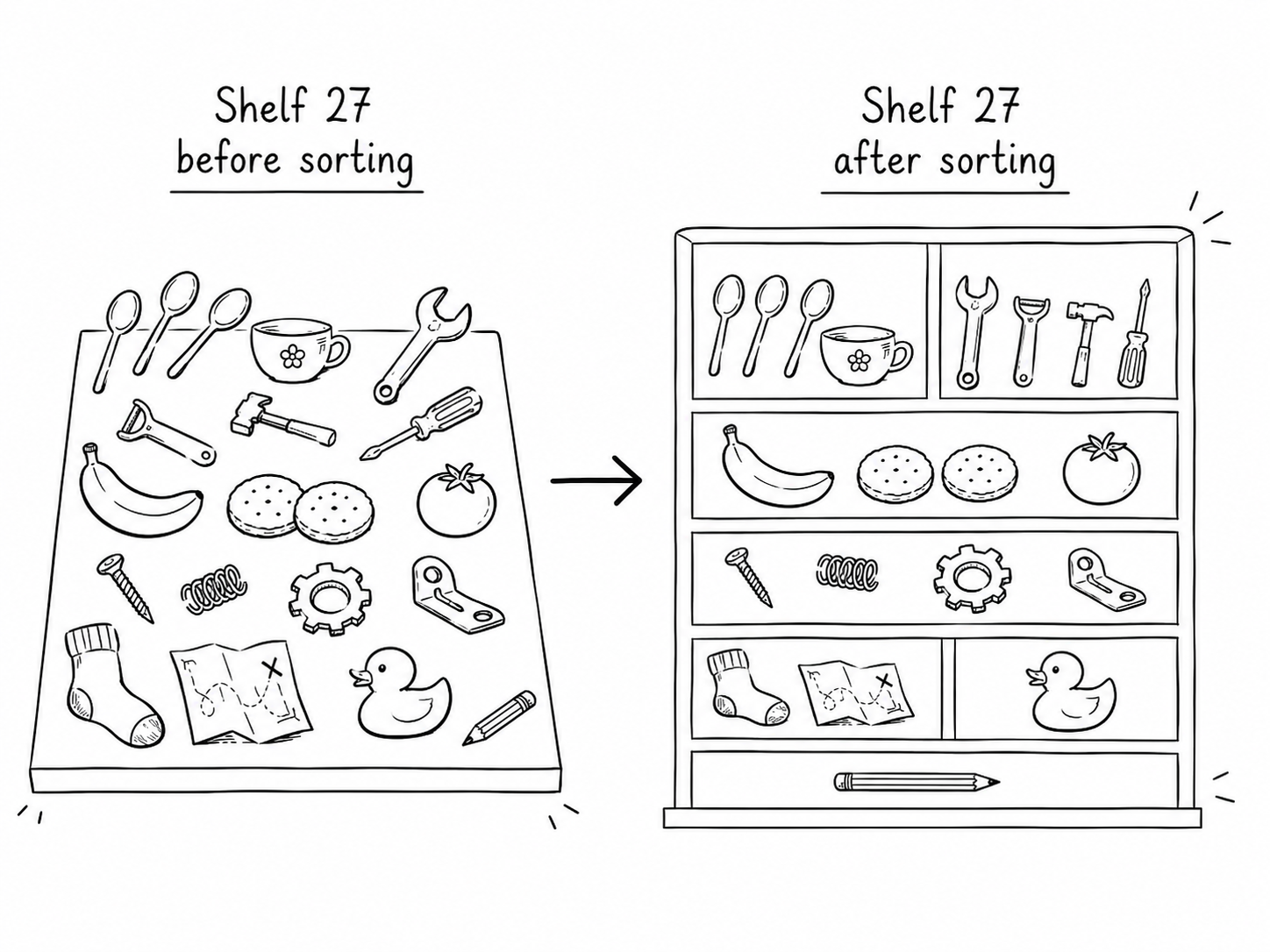
Once the objects were in categories, the shelf made more sense. The team could see what they had, what belonged together, and what still needed thinking about.
Smudge’s Takeaway
When everything is muddled, sort the muddle into groups that make sense.
Concept Check
Circle the best answer for each question.
Which sentence best describes categorisation?
- Putting things anywhere as long as the shelf looks full.
- Counting a muddle without changing anything.
- Sorting things into groups that make sense.
What should a good category have?
- A reason that makes sense.
- A funny name and no plan.
- As many random things as possible.
Which choice shows good categorisation?
- Putting a spoon, a sock, and a banana together because they were nearby.
- Moving everything into one bigger pile.
- Putting tools with tools, food with food, and mystery things together.
How sure are you?
- I understand it well.
- I mostly understand it.
- I want to read the story again.
Try It
Smudge was very proud of Shelf 28.
He said it was organised by Smudge logic.
Lyra looked at the shelf. Then she looked at Smudge. Then she looked back at the shelf.
“Smudge,” she said carefully, “why is there a teacup balanced on a wheel?”
Smudge smiled.
“Because they are both excellent.”
Lyra took a slow breath.
Can You Help Smudge?
It looks like Smudge needs help sorting Shelf 28 into groups that make sense.
In the first space, draw your own mixed-up shelf.
Put anything you like on it. The stranger the shelf, the better.
Then move to the second space.
Draw the same items again, but this time add your own sorting system.
You might group things by what they are, what they do, where they belong, who uses them, or any other pattern that makes sense to you.
Your Grid Fragment
That’s the Shelf 27 job complete. The muddle has been sorted, the shelf has been organised, and everything is much easier to find.
Now you’re ready to collect your fragment and add it to your grid.

- Do you know what it is yet?
- Can you guess what it might become?
- What makes you think that?
Choose Next Story
Where Next?
Anywhere you like! Choose your next story from the grid.
Finished all nine warehouse jobs? Then you’re ready for The Symbol chapter.
Grumbly Box
Inventory Note
One clue is useful. More clues are better.
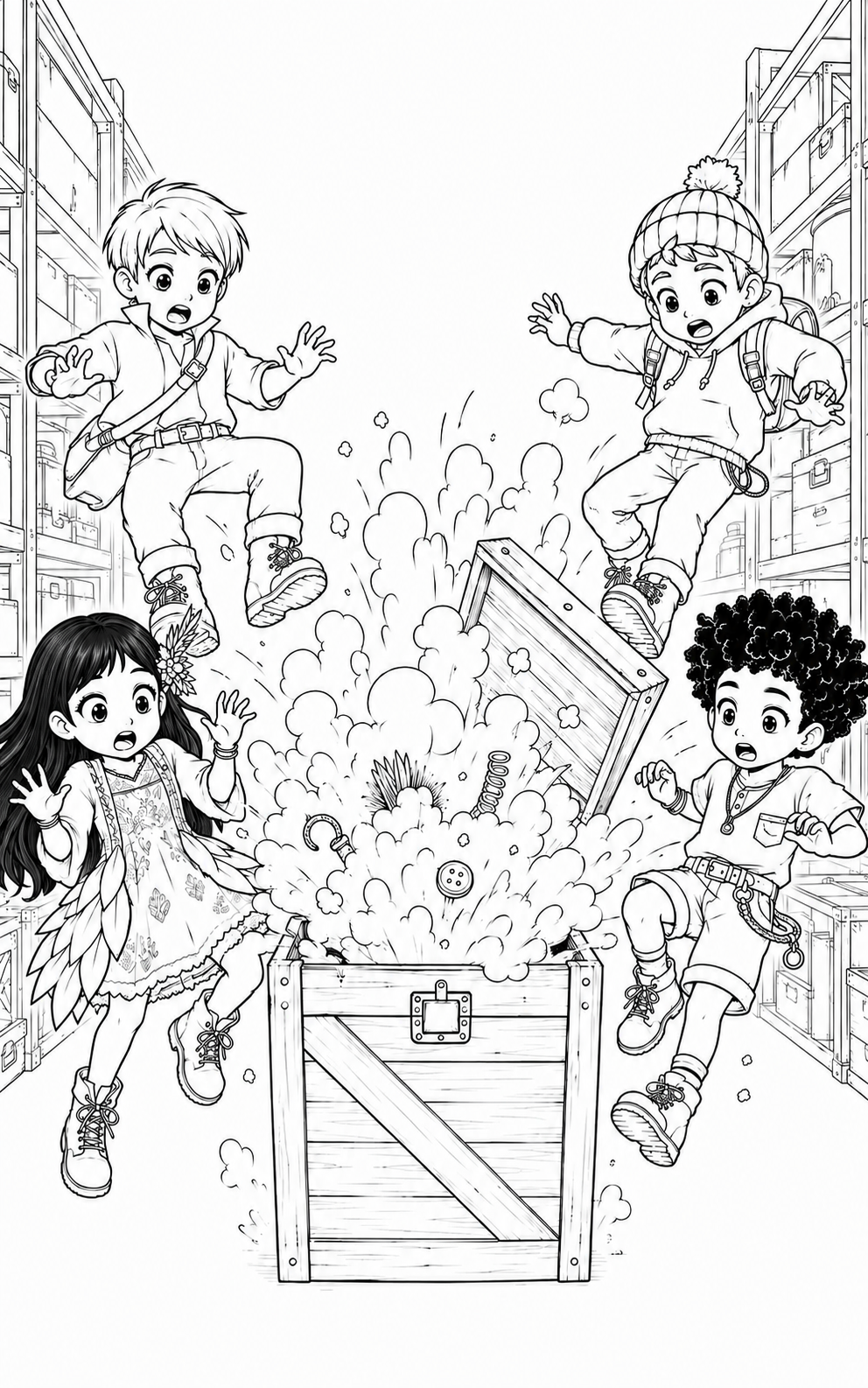
The inventory sheet led the trio and Smudge to a large wooden box in the middle of a narrow aisle.
The box sat by itself away from all the others, which was usually a sign that something interesting had happened. Or that something unfortunate had happened. It could be either. Sometimes both.
Lyra read the inventory sheet aloud.
Box 31
Identify contents.
Orin reached for the lid and tried to lift it.
Nothing.
He pulled harder.
Still nothing.
Then the box made a long, miserable sound.
“Grrrrrroooooaaannnn.”
Orin jumped back.
The box fell silent as if nothing had happened.
“Did the box just groan?” asked Orin.
“I think it did, you know,” said Zia.
Smudge crouched beside it and peered closely at the lid. “Perhaps it dislikes being opened,” he supposed.
“It’s a box,” said Orin. “That’s what boxes do.”
“Open?”
“Yes.”
“GROOOAAAN.”
The box did it again. Louder this time. And somehow more to the point.
Smudge nodded. “Not this one. This one’s a groany one.”
“A groany one?” Lyra repeated.
Smudge nodded again. “A groany one.”
Lyra looked at the box more closely. This time, she noticed a blank label attached to the lid.
Beneath it, written in tiny letters, was a short instruction:
LABEL CORRECTLY TO OPEN
The four of them stared at the instruction. They stared at the box. Then they looked rather puzzled.
“How are we supposed to label it correctly if we don’t know what’s inside?” asked Zia.
“Let’s have a guess,” said Smudge. Before anyone could stop him, he picked up a marker and wrote:
SNOOZY BLANKET
Smudge stood back with his fingers crossed. “Please,” he whispered. “Please. Please. Please.”
For a moment, nothing happened. Then the box groaned even louder than before.
“GROOOOOOOOOAAANNNNN.”
This time the groan was accompanied by a loud click. The lid creaked and ratcheted itself even more tightly closed.
“Shame,” said Smudge.
It was safe to say that the trio weren’t impressed with Smudge’s snoozy blanket guess.
Lyra shook her head, leaned in, and crossed out SNOOZY BLANKET. As she did, she noticed another line of tiny writing beneath the first.
FIVE WRONG GUESSES WILL LOCK THE BOX FOREVER
Beneath the warning was a small mechanical counter.
WRONG GUESSES: 1 OF 5
There was a brief awkward silence.
“In my defence,” Smudge said, “it could have been a snoozy blanket.”
Orin stared at the counter. “We have four guesses left,” he said. “Four. That is not enough guesses for Smudge-based methods.”
“Let’s think about this, shall we?” said Lyra.
Smudge raised a finger.
“Treasure.”
“No,” said Lyra. “Not like that.”
Smudge lowered his finger.
“She means think about how we can find out,” said Zia as she set about examining the box more closely.
The box was old and worn, with little gaps showing here and there between the wooden boards.
“There’s a crack down here,” said Zia.
She dropped flat onto the floor and pressed one cheek against the wood to see through it properly.
“I can see something… something smooth.”
“Smooth?” said Orin.
“And shiny.”
“Metal?” asked Lyra.
“Yes,” said Zia. “Definitely metal.”
She looked at the blank label. “It’s a metal plate.”
“That makes sense,” said Lyra. “Smooth. Shiny. Metal.”
Zia took the marker confidently and wrote:
METAL PLATE
The box gave a tired groan.
“Grooooooaaannn.”
Then came another loud click.
The lid ratcheted another notch tighter.
WRONG GUESSES: 2 OF 5
“No! Not a metal plate,” said Zia, with a sigh.
“So, it isn’t a snoozy blanket or a metal plate,” said Smudge. “Interesting… very interesting.”
A few moments later, Lyra found another gap near the back. “Let’s have a look through this one, shall we?”
She crouched down and shuffled into an awkward position before peering through it.
“That’s odd.”
“What is it?” asked Zia.
“A spring.”
Now they had three clues. Smooth. Shiny. Springy.
Lyra thought for a moment. “Maybe it’s some sort of wind-up toy.”
“That would explain the metal,” said Zia.
“And the spring,” added Orin.
The idea seemed to fit all the clues they had so far, so she picked up the marker and wrote:
WIND-UP TOY
“GROAN!”
Click.
Lyra winced.
WRONG GUESSES: 3 OF 5
“Another useful discovery,” said Smudge, undeterred.
“Only two guesses left,” said Orin.
The search continued.
Eventually Orin found a narrow split near one corner. He crouched beside it and squinted through the gap.
“Hmm.”
“What?” asked Lyra.
“I can see bristles.”
“Bristles?” said Zia.
“Like a brush.”
Orin thought about the clues for a moment.
“A wind-up, mechanical brush?” suggested Lyra.
“That makes sense,” said Zia.
Orin frowned. “Does it?”
Zia shook her head. “Not really. But it’s Smudge’s warehouse,” she said.
Orin considered this, which clearly caused him pain. “That is, annoyingly, a valid point.”
He held the marker above the label, hesitated briefly, then wrote:
AUTOMATIC BRUSH
The box groaned again. Not loudly this time. Disappointedly.
“Groooan.”
Click.
The lid ratcheted tighter yet again.
WRONG GUESSES: 4 OF 5
“Nooooo.” Orin crossed it out, looking thoroughly dejected.
After that, nobody reached for the marker. One wrong guess was all they had left and no one wanted to lock the box forever.
The four of them just sat on the floor beside it.
“So,” said Orin. “We know it’s not a metal plate, a wind-up toy, or an automatic brush.”
“Or a snoozy blanket,” added Smudge.
“Yes,” said Orin. “Thank you, Smudge.”
Zia recounted what they knew. “But it’s smooth, shiny, springy, and bristly.”
“Oh,” Smudge interjected.
The trio looked around to see Smudge peering through one final gap in the lid.
“What?” asked Lyra.
“There’s a button.”
“A button?” said Orin.
“A round button.”
The group looked slightly worried because Smudge had a history with buttons. Regardless, they thought about the clues again.
Smooth.
Shiny.
Springy.
Bristly.
And now: button.
Everyone still looked baffled. Everyone except Smudge.
“Oh,” he said, his eyes widening. “Ohhh.”
The others turned.
“Oh what?” asked Lyra.
“I remember.”
“You remember what’s inside?”
Smudge nodded. “Yep!”
He picked up the marker.
“Are you sure?” asked Lyra.
Smudge nodded. “Yep! Sure as a light switch turns the dark on.”
The trio exchanged concerned looks.
Very carefully, he wrote across the label:
BUTTON-ACTIVATED SELF-BRUSHING HAIR-TIDYING HELMET
“That sounds made up,” said Orin eventually.
“It is,” said Smudge. “By me. I made it.”
Smudge looked ever so slightly worried as the box remained silent. Absolutely nothing happened. For a moment, anyway. Then it all happened.
Click.
Click.
Click-click-click-click-click-click.
The lid exploded open with such enthusiasm that everyone jumped backwards.
“WOOHOO!” cheered the box.
A puff of dust burst into the air as the lid sprang open and slammed against its hinges.
Inside sat a strange metal helmet covered in tiny brushes, springs, and polished fittings.
There it was.
The smooth metal. The shiny surface. The spring. The bristles. The button.
Smudge picked it up. “Ah,” he said. “Version Three.”
“Version Three?” asked Orin.
“Yes. Deluxe.”
“And what, may I ask, does it do?”
“Tidies your hair while you think.”
Orin blinked. “Why?”
“Why not?” said Smudge.
“Does it work?”
“Sort of.”
“What happened to Version One?”
“Version One brushed too enthusiastically.”
“Too enthusiastically?”
“It removed the problem.”
“What problem?”
“The hair.”
Orin stared at him.
“And Version Two?”
“We don’t talk about Version Two.”
One of the brushes spun suddenly.
Whirr.
Everyone stepped back.
Smudge nervously held the helmet away from himself. “I’ll just pop it back in the box, shall I?”
Lyra completed the inventory sheet.
Box 31
Contents: Button-Activated Self-Brushing Hair-Tidying Helmet.
Owner: Smudge.
Inventory note: multiple views required to identify.
Safety: questionable.
Mystery: solved.
Looking Back
In this story, the team collected a range of perspectives to help them.
A perspective is a way of looking at, or seeing, something. When you collect more than one perspective, you can understand something more clearly than you could from just one viewpoint.
The box was a mystery. Nobody could open it. Nobody could see the whole thing inside. And wild guesses made the box groan, click, and become even more difficult.
Even though none of them could see much alone, each person found and contributed a different clue.
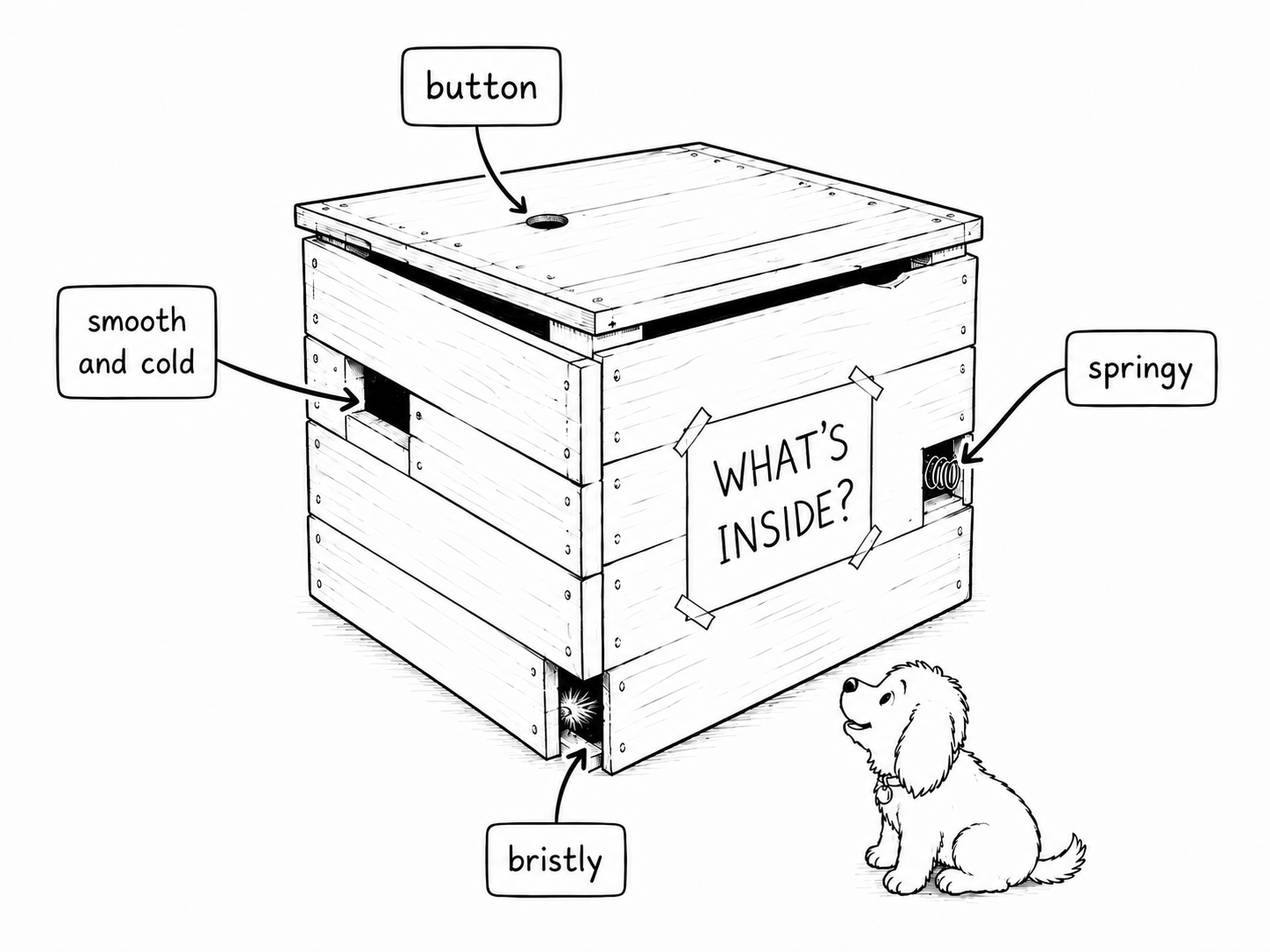
Each viewpoint revealed something new. No single clue was enough, but when they brought their different perspectives together, a clearer picture began to form.
Only with everyone’s perspective, including his own, was Smudge able to remember what was inside the box.
Smudge’s Takeaway
To understand something better, bring together different points of view.
Concept Check
Circle the best answer for each question.
Which sentence best describes perspective?
- A wild guess written in marker.
- A way of looking at, or seeing, something.
- A box making rude noises.
Why were the clues helpful even though they were incomplete?
- Each clue showed one true part of the mystery.
- Each clue proved the others were wrong.
- Each clue made the box sleepier.
Why is perspective useful?
- It means everyone must think exactly the same thing.
- It helps us lock boxes forever.
- It helps us understand something more clearly by seeing it from more than one angle.
How sure are you?
- I understand it well.
- I mostly understand it.
- I want to read the story again.
Try It
Smudge has decided to build a secret invention.
He says you can help.
This is excellent news, because Smudge inventions usually need someone sensible nearby.
The Secret Invention
Invent something special with Smudge.
It can be useful, silly, mysterious, magnificent, or slightly difficult to explain.
In the space at the top, draw your invention. Then give it a name and write a few words about what it does beneath.
Don’t let Lyra, Orin, or Zia see it yet.
Smudge says they are “nosey parkers,” and if they found out about it, they would almost certainly start talking about “rules.”
He’s going to put it in a secret crate that will never be found.
It will be nice and safe from fun ruiners and people who ask difficult questions like, “Is that supposed to have smoke coming out?”
The Discovery
Uh oh. That didn’t take long.
The trio have found the mystery crate, and they are worried. Possibly because it is humming. Possibly because it is wobbling. Possibly because Smudge is standing in front of it saying, “Nothing to see here,” which is never reassuring.
Smudge isn’t saying another word, but the trio are already circling the crate.
What will they notice from the outside?
Show what they’ll discover from different viewpoints around the crate.
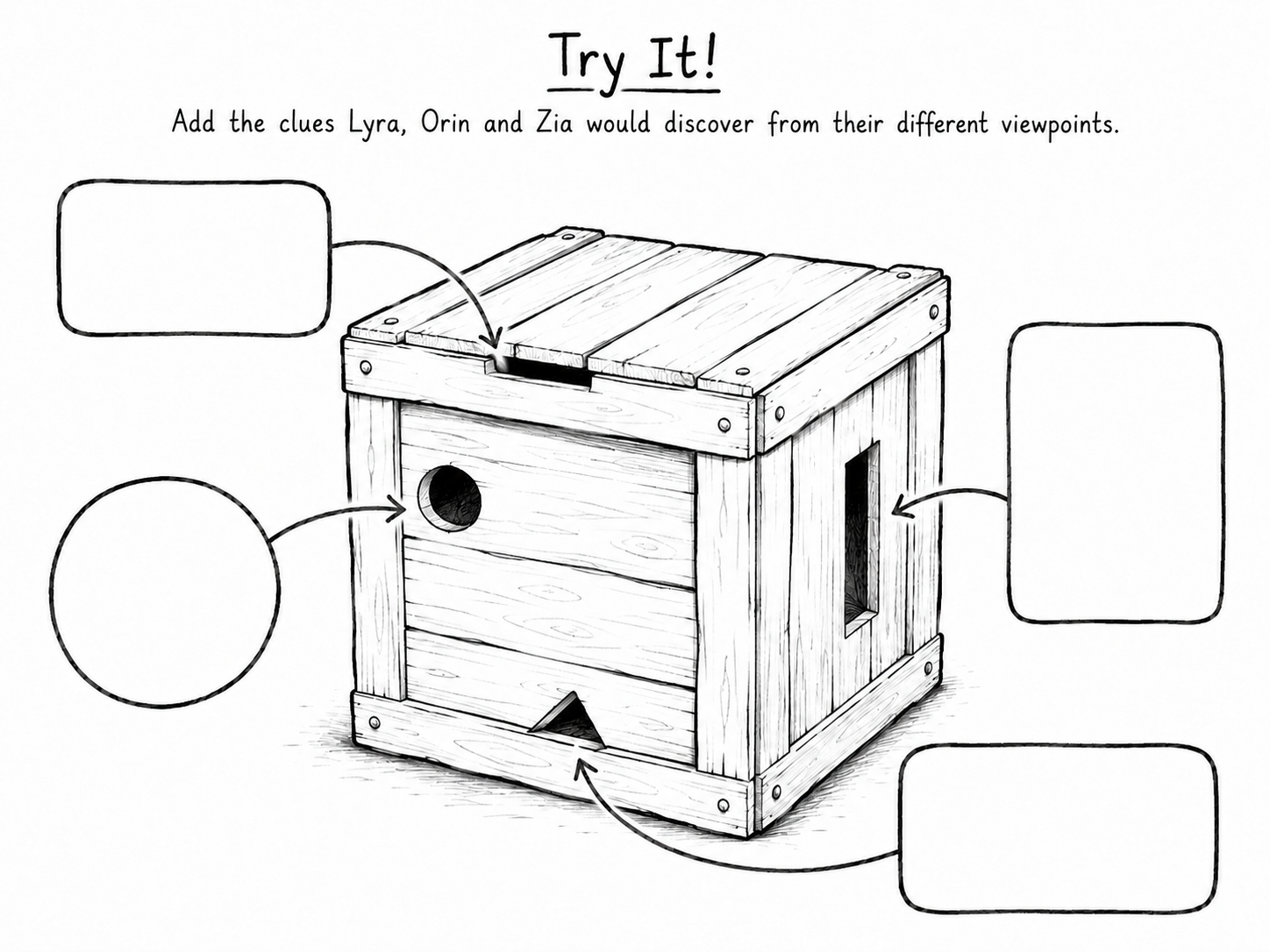
Your Grid Fragment
That’s the Grumbly Box job complete. The clues have been noticed, the different perspectives have been brought together, and the mystery object has been understood… sort of.
Now you’re ready to collect your fragment and add it to your grid.

- Do you know what it is yet?
- Can you guess what it might become?
- What makes you think that?
Choose Next Story
Where Next?
Anywhere you like! Choose your next story from the grid.
Finished all nine warehouse jobs? Then you’re ready for The Symbol chapter.
Lonely Button
Inventory Note
Connections are everywhere.
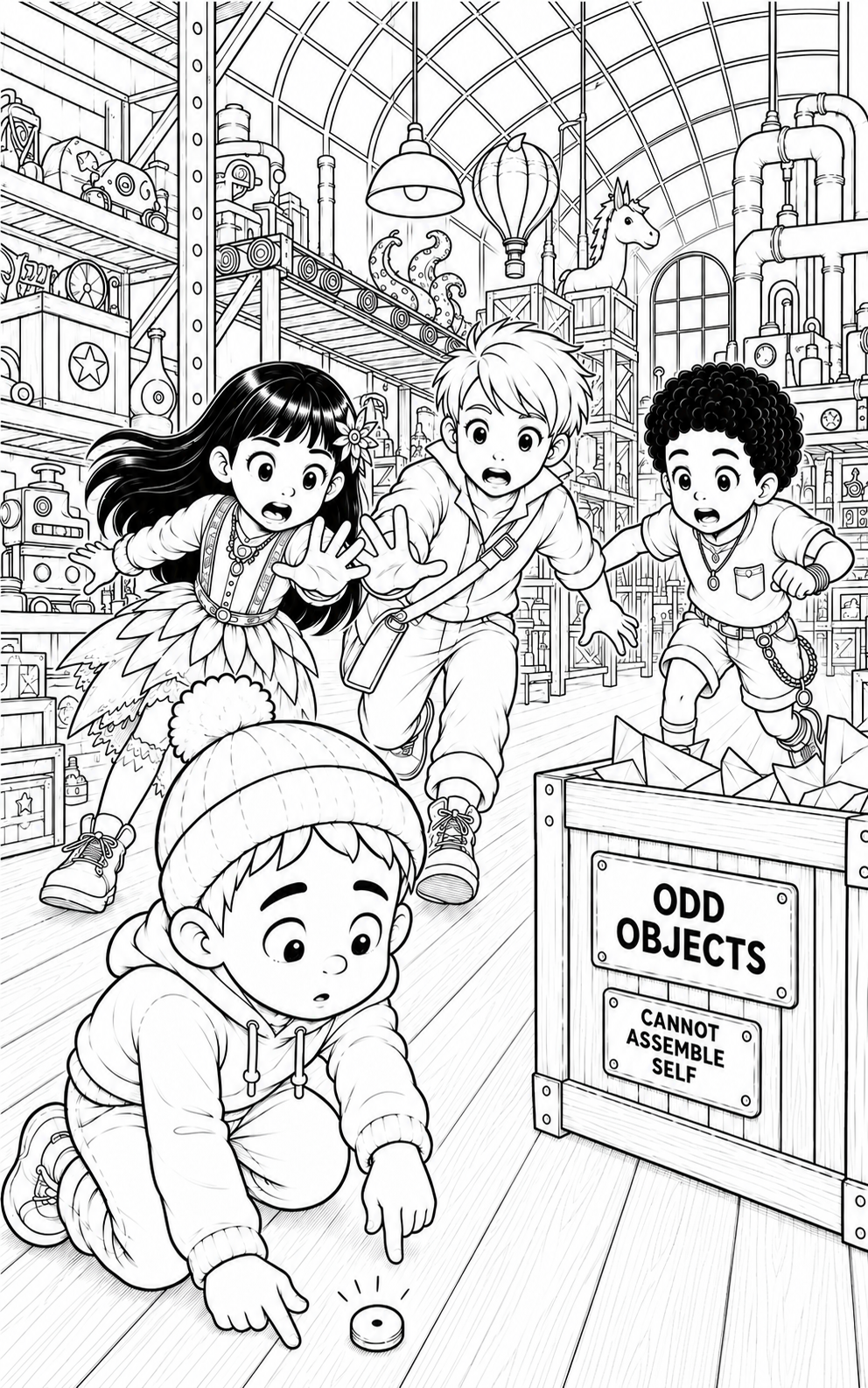
A mystery crate sat by itself at the end of an aisle in Smudge's warehouse.
It wasn’t large. It wasn’t small. It was the sort of crate nobody had known where to put, so they had put it anywhere and walked away quickly.
The crate didn’t hum, rattle, glow, leak, tick, whisper, or smell faintly of something burning. This made Orin suspicious at once, because in Smudge’s warehouse, the normal things often turned out to be the opposite.
Zia gave the crate a cautious nudge with one boot. Nothing happened.
“That is strange,” she said. “Things usually fall off, pop out, or make a noise at us.”
On the front of the crate was a label.
ODD OBJECTS
And underneath that, fixed to the wood with tiny screws, was a little metal plate.
CANNOT ASSEMBLE SELF
Lyra read the plate twice. “What on earth does that mean?”
Smudge didn’t seem particularly interested in what it meant. He was already in the box. Apparently, rummaging first and understanding later was the plan.
Zia shrugged and started rummaging around inside too. After a few moments, she dug out a round thing. “Wheel?” she asked no one in particular.
“Looks more like a floor circle to me,” said Smudge.
“A what?”
“You know. A circle. For the floor.”
The trio stared at him. Not even confused—just… what.
“Definitely a floor circle,” Smudge added.
“It is not a floor circle,” said Orin. “There’s no such thing as a floor circle. It’s a wheel.”
Zia lifted out what was probably a handle. “Handle.”
“Portable handshake,” insisted Smudge.
Lyra picked out a spring. “Spring.”
“Emergency boing,” said Smudge.
Orin stared at him. “Do you have a name for everything?”
“Only the important things,” said Smudge. “And all the unimportant things in case they become important later.”
One by one they took the rest of the objects out of the crate and laid them carefully on the floor.
Smudge helpfully provided names as they went. The tube was a “short-distance tunnel.” The panel was a “shield with ambitions.” The lever was a “finger for machines.” The three little brass feet were “shoes for a tiny table.” The spoon-shaped thing was, according to Smudge, “a soup detector.”
“It has gears,” said Lyra.
“Advanced soup detector,” added Smudge.
Lyra picked up the wheel and turned it over in her hands. It was heavier than she expected, with a tiny metal peg sticking out from the back.
“This has a red sticker on it,” Lyra noticed.
Zia held up the handle. “This too.”
Orin checked the spring. “And this.”
Lyra looked from one red sticker to another. “They’re marked the same way.”
“Ah. Remembery-bits,” Smudge concluded.
“Remembery-whats?” asked Orin.
“Remembery-bits,” said Smudge. “You know. For remembering important things.”
“So what’s the important thing?” asked Lyra.
Smudge looked at the stickers and frowned. “That, I do not know.”
The tube had a red sticker near one end. The panel had one beside a row of holes. The lever had one on its side. Each of the three brass feet had a red sticker. Even the “soup detector” had a red sticker wrapped around its handle.
Near the bottom of the crate, partly hidden under a flap of torn packing paper, Zia found one more object. It was a small button with a blue dot in the middle.
It was shiny, round, and exactly the sort of button that should not be pressed unless everyone had first agreed where to run.
Smudge’s eyes lit up.
“No,” said Orin immediately.
“I didn’t do anything!”
“You were about to.”
Smudge did not bother to argue. He knew they knew he knew he was going to try to push it. His best chance was to pretend he would not, wait until everyone was busy with something else, and then press it later. Sneakily. Quietly. Possibly with a pencil.
Zia placed the blue-dot button beside the crate, away from the other objects, and especially Smudge. Then she placed an empty jar over it.
“Button jail,” she said.
Once all the objects had been taken out, Lyra put the inventory sheet on the floor beside them.
“Right. We need to record what’s here.”
Lyra began to write in the space provided. “Wheel. Handle. Spring. Tube…”
Then her pencil stopped.
She looked at the inventory sheet, then at the objects, then back at the sheet.
“Oh.”
Orin leaned over her shoulder. “What?”
“There isn’t room.”
“There must be room. It’s an inventory sheet.”
“Nope,” said Lyra. “Not on this one. There’s room for a few words.”
They all stared at the sheet.
Lyra was right.
The space wasn’t large enough for a list. It wasn’t even large enough for a small list written by someone with very neat handwriting. It was a single blank line, waiting for a short answer.
Orin looked at the objects scattered across the floor. “Hmm.”
“We could write Miscellaneous,” suggested Zia.
Smudge gasped in disbelief. He marched over and pointed to a sign fixed to the wall.
WAREHOUSE RULES
Rule 1: Put things where they belong.
Rule 2: Do not lick the labels.
Rule 3: Miscellaneous is forbidden.
Smudge tapped Rule 3 with great seriousness.
“No Miscellaneous!”
So that was that.
Orin opened his mouth to ask why, then looked at Smudge’s serious face, the warehouse rules, and the word forbidden. After a brief moment of thought, he closed his mouth again. Some questions, he decided, were probably better left in the warehouse past.
So, they couldn’t write all the objects down. They couldn’t write Miscellaneous. They had one blank line, a crate full of odd objects spread across the floor, a blue-dot button they were trying their best to keep away from Smudge and his button fingers, and possibly a spoon.
Unsure what else to do, Orin picked up the wheel. He turned it over and noticed the little peg on the back. Then he looked at the panel covered in tiny holes. “Wait a minute.”
The others leaned closer as Orin lowered the peg into one of the holes.
Click.
The wheel fitted perfectly.
Nobody spoke for a moment.
“Interesting,” Zia said.
“Very interesting,” said Orin, trying not to sound too pleased with himself. He did not entirely succeed.
Smudge looked alarmed. “You’ve attached the floor circle.”
“It was not a floor circle,” said Orin.
“It was before you attached it,” said Smudge.
Zia picked up the handle.
Now that Orin had found one fit, she looked at her object differently.
“Right,” she said. “Who else has been pretending to be separate?”
It wasn’t just a handle with nowhere to go. It had a narrow slot underneath. She turned it sideways and tried it against the edge of the panel.
Click.
“That’s another one,” said Lyra.
Zia smiled. “It isn’t a box of random objects, is it?”
She picked up the tube next and noticed a little notch at one end. “I wonder if…”
Click.
The tube fitted perfectly in a round opening in the panel.
After that, the work became easier. Not easy, exactly, because Smudge’s warehouse didn’t seem to do easy. But easier.
One piece suggested the next.
Click.
Click.
Click.
Before long, something had taken shape. And whatever it was began to move.
Whrrp.
The wheel spun. The spring bounced. The lever flicked up and down. The little brass feet stamped themselves into position, and the whole thing gave a low, pleased purr, as if it had been waiting a very long time to become itself.
A tiny screen blinked on and words appeared across it.
INVENTION ASSEMBLER PRO
READY TO ASSEMBLE
Lyra stepped back. “Oh.”
Orin stared at the screen. “It’s an invention assembler!”
The invention assembler sat neatly on the floor, no longer a pile of strange objects and no longer a mystery of separate things.
Orin looked at the inventory sheet again.
The blank line no longer seemed too small. It seemed exactly the right size, because now they did not have a pile of odd objects. They had one thing.
Orin wrote carefully:
Invention Ass...
Then he stopped, tapped his chin with the end of his pencil, and looked across the floor.
“What about the blue-dot button?”
The trio turned to witness something unfortunate.
While they had been distracted by the invention assembler coming to life, Smudge had noticed something important: nobody was standing between him and the button anymore.
He was already beside it.
One finger hovered in the air.
“No,” said Lyra.
“Smudge, no,” said Zia and Orin together.
“Jailbreak!” said Smudge as he lifted the jar and pressed the button.
For one glorious second, nothing happened.
Smudge smiled.
“See?”
He looked around proudly.
“Nothing to worry about.”
KLIK-CLANK.
The noise came from behind them—three shelves away.
They looked over to see another crate—this one marked with a blue dot, just like the button.
KLIK-CLANK.
The noise came again, clearly from inside the crate. For a moment, nothing happened. Then the crate began to shake. A few seconds later, its lid popped open.
A tiny metal robot jumped out. It had a blue dot on its chest and very unsettling blue-light eyes. It landed on the shelf, saluted nobody in particular, and shouted, “READY!”
Everyone stared.
It occurred to Smudge, a little late, that the blue-dot button was part of something bigger.
It had friends. Many friends. Too many friends.
“Oh dear,” said Lyra.
KLIK-CLANK.
A second robot jumped out.
“READY!”
KLIK-CLANK. KLIK-CLANK.
Two more jumped out.
“READY! READY!”
“Maybe they’re friendly,” said Smudge.
“We are not friendly,” said the robots together in unison.
“Smudge, what are they ready for?” asked Lyra, looking extremely worried. “Smudge?”
Smudge looked at the button. “I can stop this.”
“No,” said Zia.
Smudge pressed it again.
The crate began to rattle harder.
KLIK-CLANK-KLIK-CLANK-KLIK-CLANK.
Robots sprang out in a blue-and-silver blur.
“READY! READY! READY! READY!”
“Abort,” said Smudge.
“Do NOT press it again,” yelled Lyra.
“Abort, abort, abort,” said Smudge, hammering the button in desperation.
KLIK-CLANK-KLIK-CLANK-KLIK-CLANK-KLIK-CLANK!
The robots marched forwards in a perfectly straight line.
Lyra, Orin and Zia stepped back. Smudge stepped back twice.
But the robots marched straight past them. One by one, they arranged themselves in a tight circle around the blue-dot button, facing outwards with their little metal arms folded.
The last robot replaced the empty jar, climbed on top, and raised a little robot fist.
“BUTTON PROTECTION UNIT READY!”
Smudge blinked. “Protection from what?”
Every pair of blue-light eyes turned towards him.
“YOU.”
For once, Smudge had absolutely nothing to say.
Orin returned to the inventory sheet and carefully finished writing:
INVENTION ASSEMBLER PRO
(Plus one extremely well-protected button.)
Looking Back
At first, the things they found seemed separate: one object here, another clue there. None of them told the whole story on its own. The team only began to understand what was happening when they considered how the different pieces might fit together.
Smudge, admittedly, took a little longer.
This way of looking at a problem is called connected thinking. It means looking at separate pieces and asking how they might belong to something bigger. Instead of only asking, “What is this thing?” you also ask, “What does it belong to—and what might belong with it?”
The crate had seemed to be full of odd objects. A wheel was a wheel. A handle was a handle. A spring was a spring. But the red dots weren’t just decoration. They made the connections easier to see, helping the trio realise that the objects weren’t odd at all—not once they were brought together.
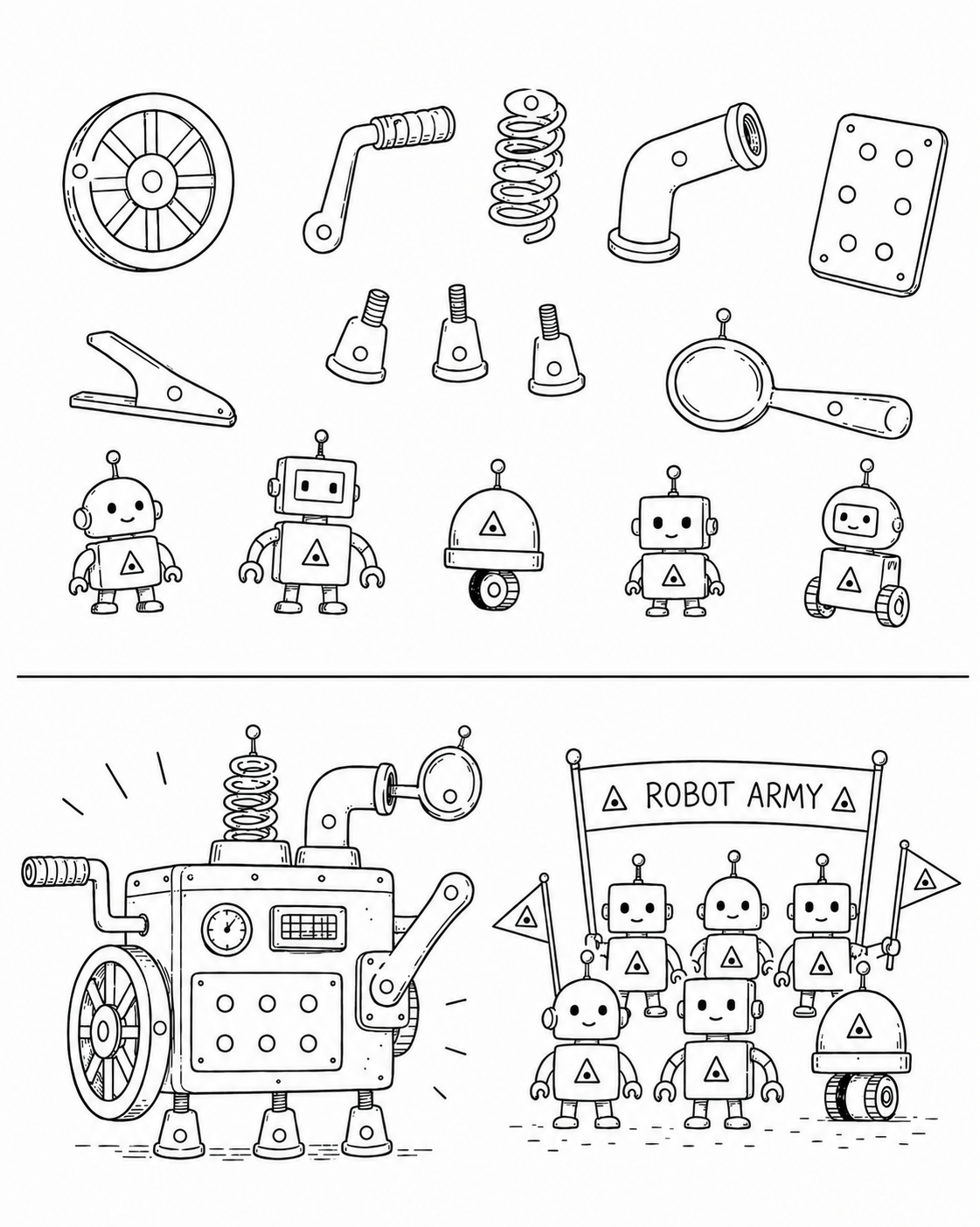
In real life, connections don’t always come with dots. There aren’t always stickers, arrows or helpful little marks showing what belongs together. But that doesn’t mean the connections aren’t there. Sometimes you have to find them yourself.
That’s when connected thinking becomes powerful. You stop seeing only separate parts and start looking for the bigger thing they might belong to—or the missing piece that might complete them.
Smudge’s Takeaway
When things seem separate, look for what connects them.
Concept Check
Circle the best answer for each question.
Which sentence best describes connected thinking?
- Looking at one thing by itself and stopping there.
- Looking at separate pieces and asking how they might belong together.
- Pressing every button because buttons are exciting.
Why can connected thinking be tricky?
- Separate things can never belong together.
- Every connection is obvious immediately.
- Connections are not always marked with dots, arrows, or labels.
Why is connected thinking useful?
- It helps us see how separate parts might make a bigger picture.
- It helps us forget what we noticed.
- It means everything belongs to the same thing.
How sure are you?
- I understand it well.
- I mostly understand it.
- I want to read the story again.
Try It
Somehow, another crate had tipped over in Smudge’s warehouse, scattering wheels, handles, springs, tubes and several things that even the inventory list had given up trying to name.
Smudge was standing beside the mess, looking extremely innocent.
“Ah well. We’d better make the best of this terrible situation,” he said, smiling far too broadly for someone who definitely had nothing to do with it. “There’s an invention in there somewhere. We just have to work out which bits belong to it—and what on earth it does.”
Can You Help Smudge?
- Invent something using several parts from the pile.
- Create a connection mark to show which parts belong to your invention. You could use a dot, a moon, a zigzag—or invent a symbol of your own.
- Add your mark to each part you want to use. Leave the other parts unmarked.
- Draw any other parts you might need in the Extra Parts section.
- Bring your chosen parts together in the space provided and draw your invention.
- Give it a name and explain what it does.
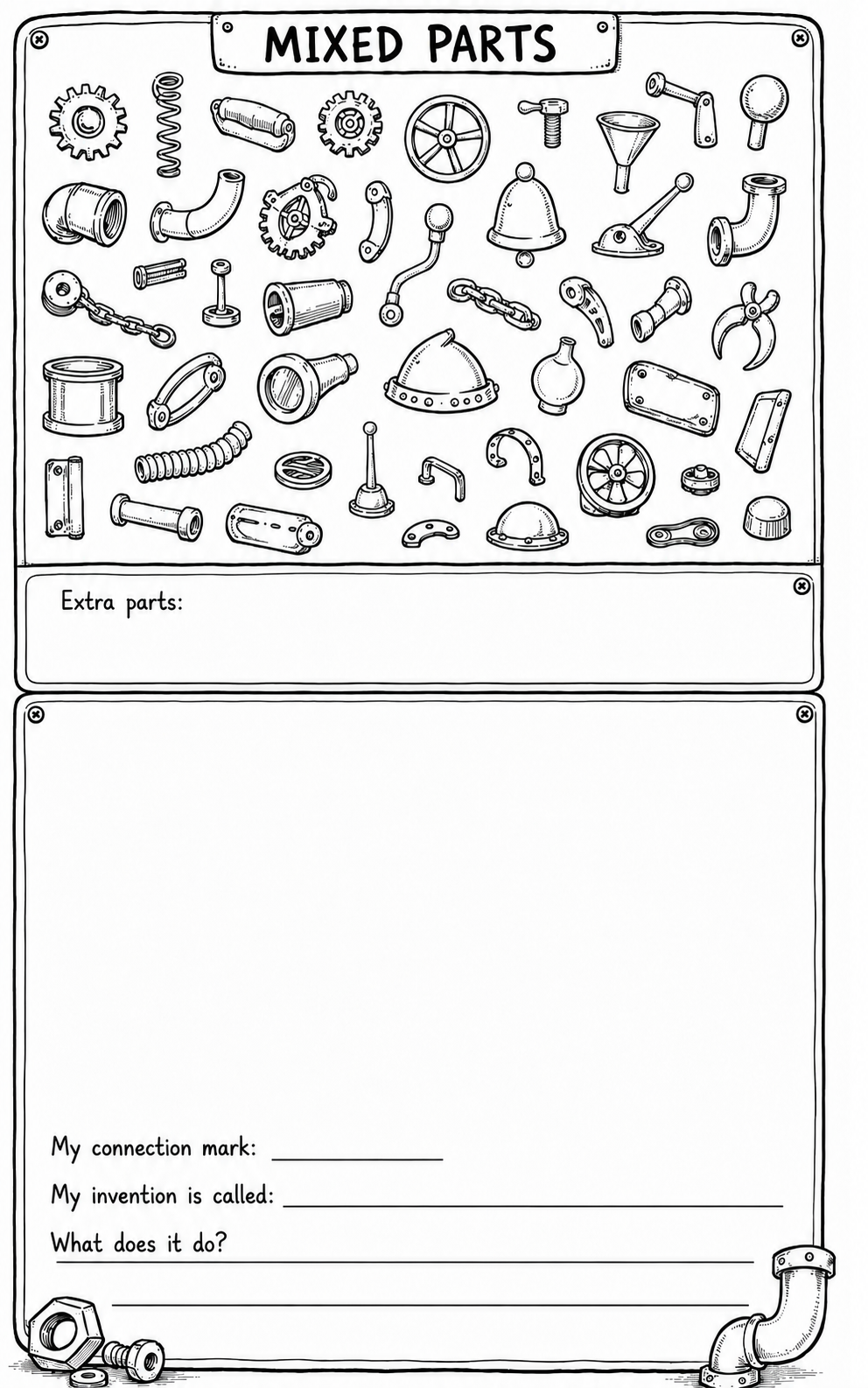
Your Grid Fragment
That’s the Lonely Button job complete. The button has been pushed, the parts have connected, and Smudge is now being watched very carefully around anything round, shiny, or pressable.
Now you’re ready to collect your fragment and add it to your grid.

- Do you know what it is yet?
- Can you guess what it might become?
- What makes you think that?
Choose Next Story
Where Next?
Anywhere you like! Choose your next story from the grid.
Finished all nine warehouse jobs? Then you’re ready for The Symbol chapter.
The Symbol
Congratulations! You’ve done the miraculous.
- You’ve completed all nine tasks.
- You’ve sorted messy mail, followed a tiny cart, investigated a suspiciously well-behaved dog, and dealt with quite a lot of Smudge.
- You’ve counted, noticed, questioned, sorted, and connected.
Each time, you added one more piece to the grid, and now it’s complete.
So… what is it?
If you think you know, find the hidden name of the symbol in the word search.
Symbol Word Search
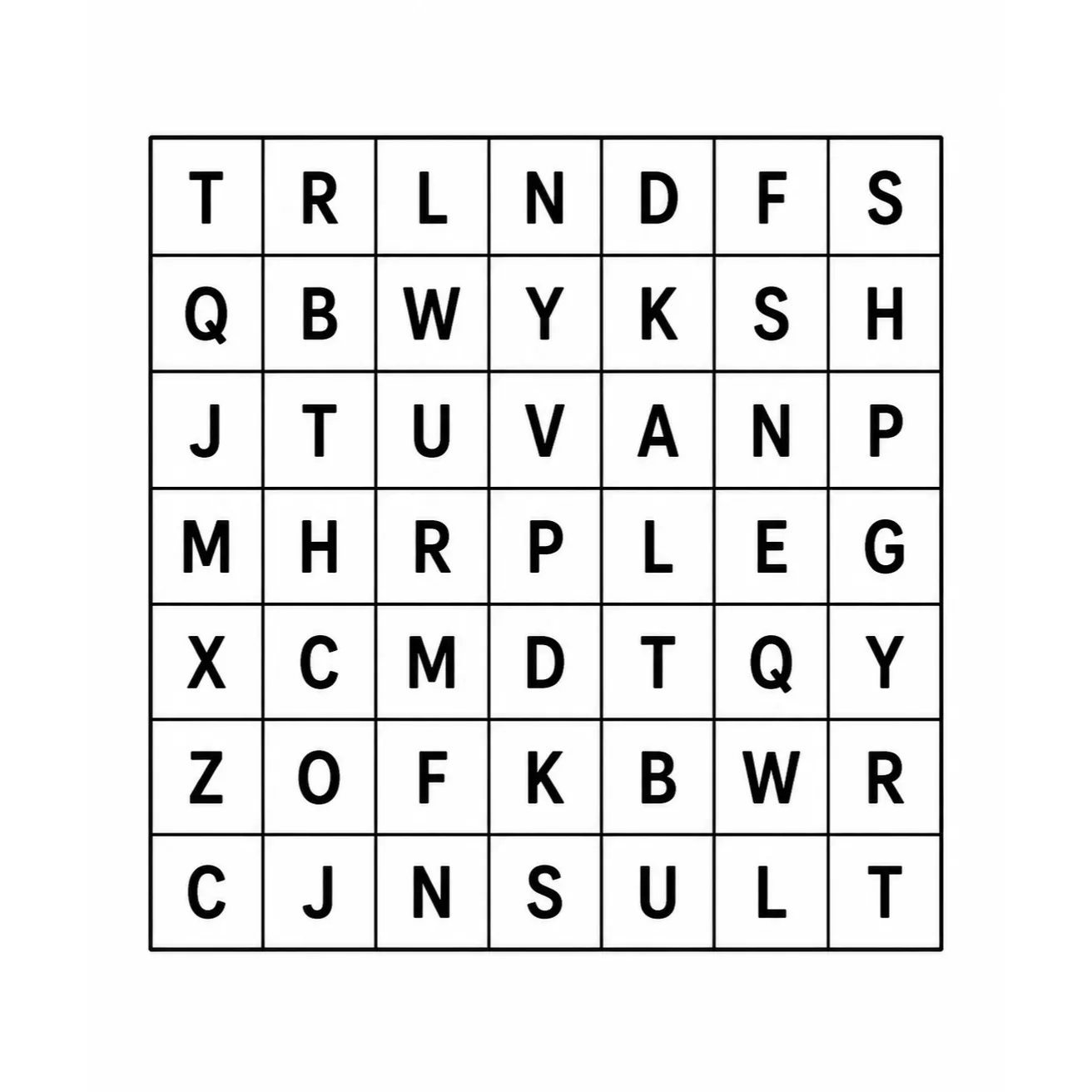
The grid symbol is: ________________________
But wait. Finding its name is only the beginning.
A symbol isn’t just a picture. It can carry an idea. And the idea inside this one has been hiding inside every task in the warehouse.
Let’s return to the story and find out what it means.
The Inventory of Everything
Inventory Note
Confusion calls for clarity. Clarity clears confusion.
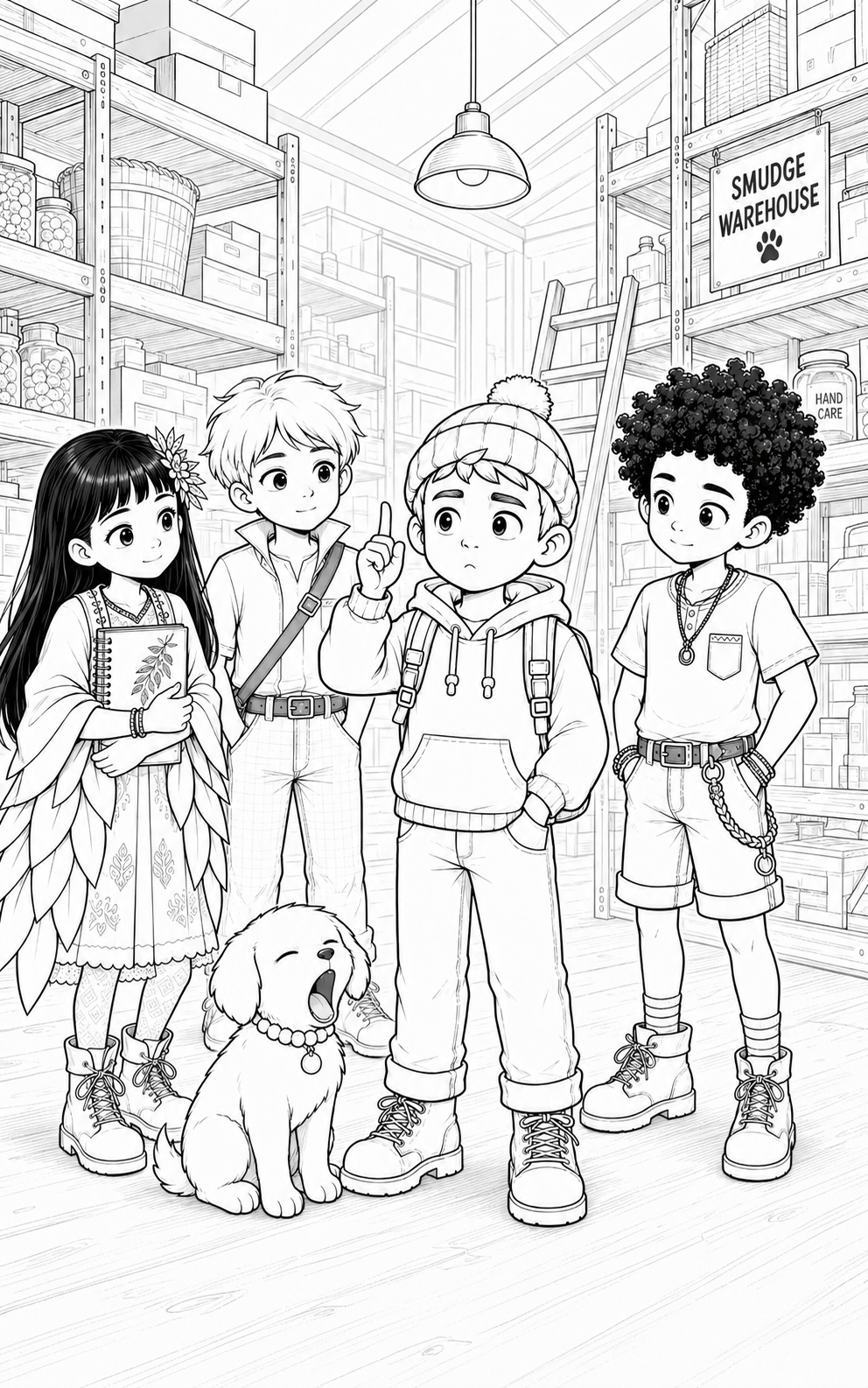
Everyone stood around the completed grid, seeing it properly for the first time.
For a moment, nobody said anything.
Partly because Smudge’s little job felt different now, and partly because Smudge had raised one finger in the air, as if he were about to say something very wise.
Everyone looked at him.
“Are you going to say something?” asked Lyra.
“I can feel wisdom about to arrive,” said Smudge.
Smudge listened carefully.
Biscuit yawned.
“No,” said Smudge, lowering his finger. “Nothing.”
He turned back to the completed grid.
“What does it mean?”
“You know what the symbol is,” said Orin.
“Yes,” said Smudge. “I know that part. But what does it mean?”
“It helps you find your way,” said Lyra.
Smudge glanced around the warehouse.
“But we’re already here… in the warehouse.”
“Not that kind of way,” said Zia.
Smudge frowned. “There are other kinds?”
“There are,” said Orin as he picked up one final task from the table.
He held it out for Smudge to see. At the top, in official-looking letters, it said:
The Inventory of Everything: Finding Your Way
Lyra nodded and pointed at the nine squares.
“What did all these tasks have in common?”
Smudge looked at the grid.
“They were all in the warehouse?”
“That’s true,” said Orin.
“And they all involved me?”
“That is also true,” said Zia.
“And they were all handled extremely well by management?”
There was a short silence.
“Let’s keep looking,” said Lyra.
They looked at the grid again.
At first, the tasks seemed completely different.
A tiny cart, a mail mountain, a Biscuit imposter, a buzzing crate, holes, jars, shelves, boxes, and odd bits.
Each one had begun with confusion.
Some things got stuck. Others got mixed up. Some looked true, but weren’t. Some made noises. Others didn’t fit. And some just kept going wrong.
And each time, they had to pause, look again, and work out what was really happening.
Smudge looked back at the completed grid. He had always thought of being lost as something that happened in large forests, confusing corridors, or shops with too many kinds of jam.
But now he began to see that you could be lost in a problem as well.
And when you’re lost in a problem, you still have to find your way.
Not out of a forest.
Out of the muddle.
Finding Your Way
Lyra pointed gently at the symbol.
“That’s what the symbol represents,” she said. “Finding your way.”
“Finding your way,” Smudge repeated.
“Not just where you are,” said Orin. “What’s happening, how the pieces fit together and what to do next.”
Lyra smiled. “That’s what all these jobs taught us—how to turn confusion into clarity.”
“And once things are clearer,” said Zia, “you can decide what to do next.”
Smudge was quiet for a moment.
This was unusual, so everyone allowed it.
Then his face brightened as the final piece fell into place. “So the compass reminds us to find our bearings.”
Smudge looked at the nine squares again. The tasks had been messy, noisy, strange and occasionally biscuit-related. But each one had taught them to pause, look again and use different ways of thinking to make sense of what was happening.
Out of nowhere, Smudge gave a tremendous gasp. Everyone jumped.
“I think,” he said carefully, “the wisdom may have arrived.”
His face went blank.
“No, sorry. It’s gone.”
A moment later, he gasped again. “It’s back! Paper!” he demanded.
Lyra blinked. “What?”
“And a pencil!”
“Why?” asked Zia.
“Quickly,” said Smudge. “Before the wisdom escapes.”
Orin slid a sheet of paper and a pencil across the table.
Smudge leaned over the table and began scribbling.
“What are you doing?” asked Lyra.
Smudge didn’t look up.
“An invention,” he said.
“For the warehouse?” asked Orin.
“For anyone,” said Smudge. “Anyone trying to find their way through a problem.”
He scribbled furiously, scattering sheets across the floor and leaving his hair pointing in directions no compass could explain.
At last, he dropped his pencil, stood back and revealed the invention of all inventions:
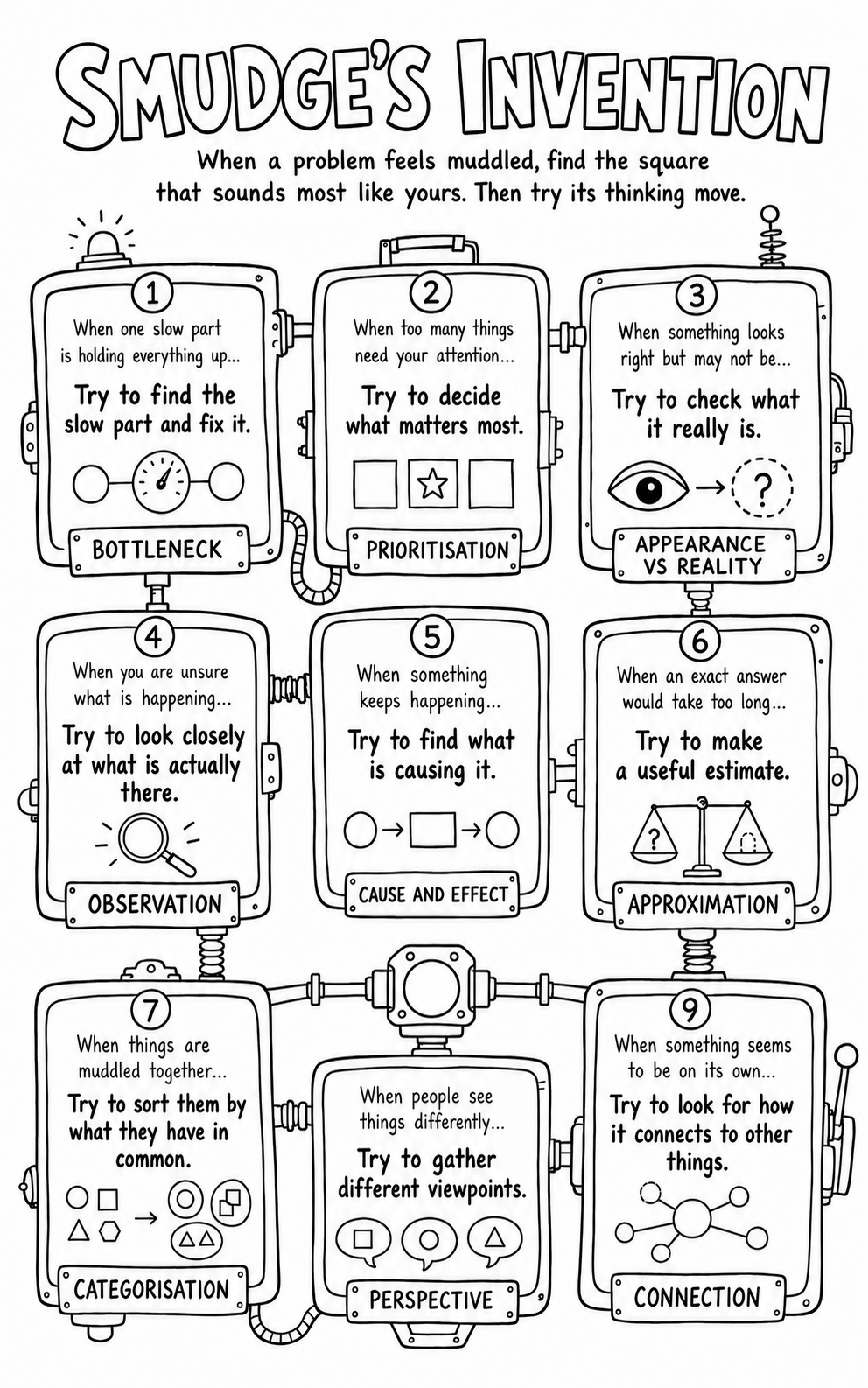
Biscuit wagged his tail.
The whole journey finally made sense.
And Smudge, somehow, had found his next big idea.
Looking Back
Every warehouse job began with a muddle, but not every muddle was the same.
Before the team could decide what to do, they first had to make sense of what was happening. Sometimes they needed to look more carefully, find a cause, decide what mattered, gather another viewpoint or discover a connection.
Finding your way means making sense of a problem so that you can choose a useful direction.
Smudge’s Takeaway
Before you solve a problem, find your bearings. Then begin.
Try It
You have used all nine sensemaking ideas inside Smudge’s warehouse. But you have probably used some of them in your own life too—perhaps without knowing their names.
Use Smudge’s Problem Compass to think of three examples from your own life:
- One from the past.
- One in the present.
- One you might meet in the future.
They can be big muddles or very small ones.
Where Next?
The warehouse job is finished, but the Problem Compass is yours to keep.
Whenever you find yourself lost in a muddle, pause and use it to find your bearings.
Then begin.
Smudge’s Little Job
Smudge’s Little Job is an experience-first Story Grid adventure for children aged 8–12. It can be explored in any order and used independently, with a parent, or as part of a classroom or homeschool programme.
When Lyra, Orin, and Zia arrive at Smudge’s office, they find him asleep in the middle of his usual magnificent mess. Buried among the papers, inventions, and biscuit crumbs is something rather important: the warehouse inventory, which Smudge was supposed to complete 48 tomorrows ago. He assures them that he only needs help with a few bits and bobs—then opens the door onto an enormous warehouse filled with towering shelves, rattling machines, mysterious crates, and more muddles than anyone could possibly count.
Across nine short stories, the team encounters stuck carts, muddled shelves, mysterious noises, misleading appearances, lonely buttons, and other warehouse problems. Each encounter gives the reader a different way to make sense of a muddle, from identifying bottlenecks and separating signal from noise to categorising information, considering different perspectives, and finding connections.
After each story, simple activities help readers name and apply the thinking move they have just experienced. Every completed encounter also adds a new fragment to the Grid. Finish all nine and the fragments reveal a hidden symbol that brings the lessons together.
The Story Grid